Architecture
How the driver is put together: three layers, what each owns, and how one call reaches the chip.
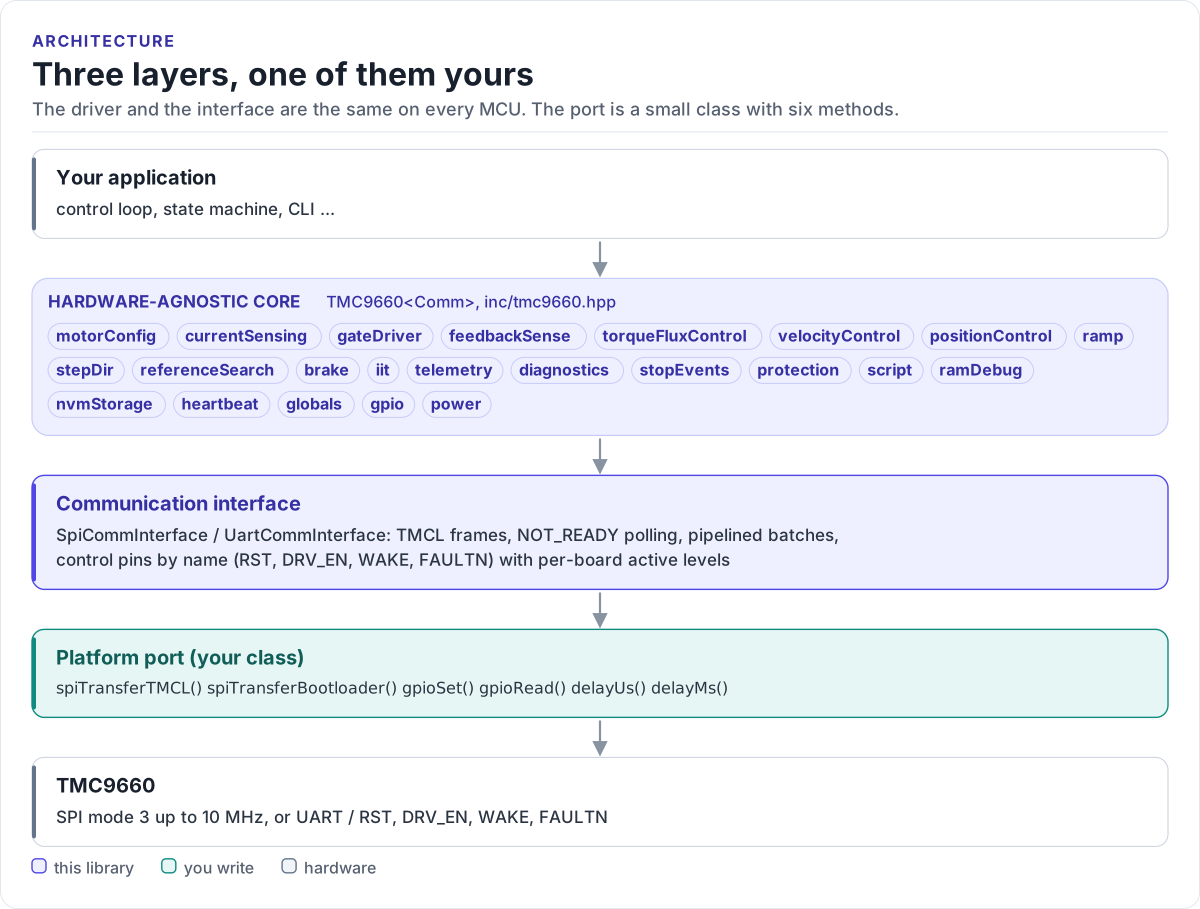
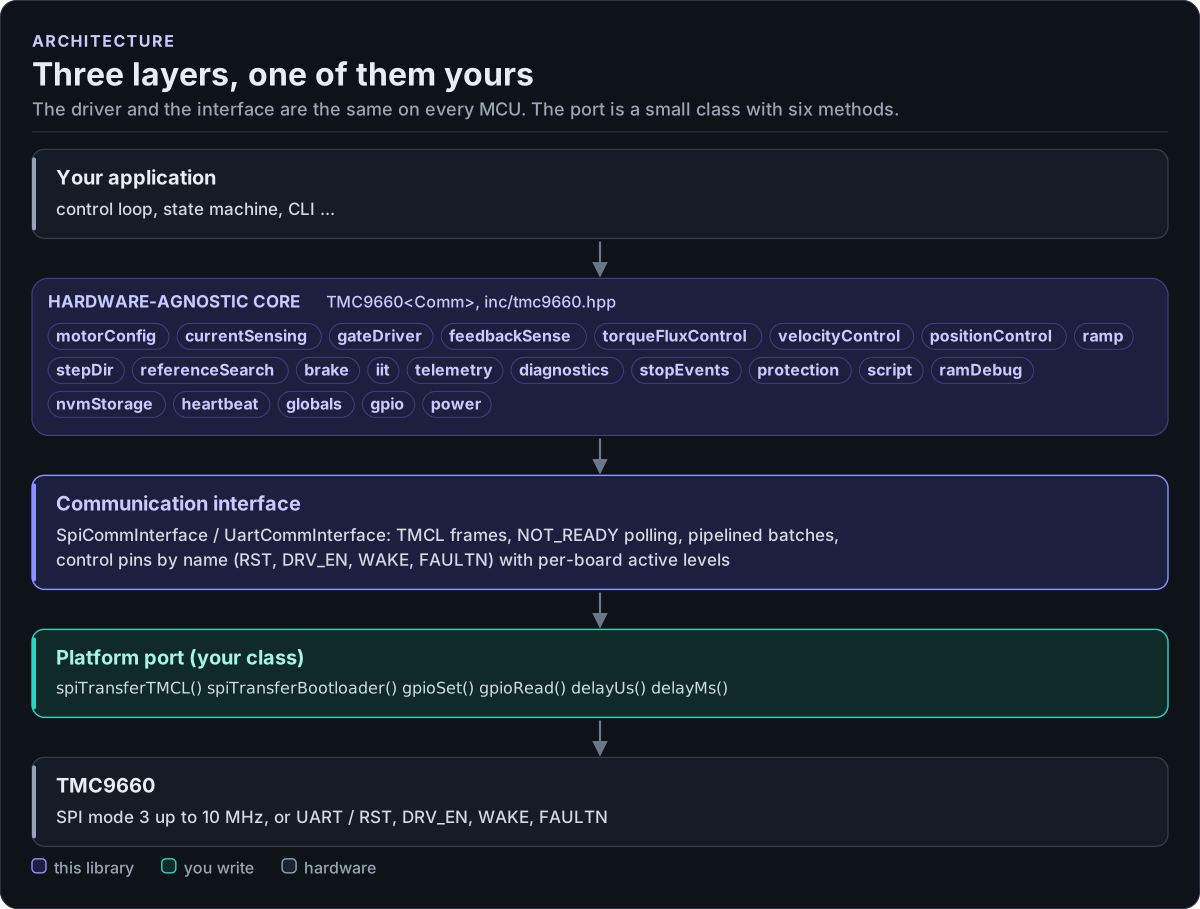
Figure description and sources
From top to bottom. Your application talks to one TMC9660
Drawn from: inc/tmc9660.hpp TMC9660 members; inc/tmc9660_comm_interface.hpp SpiCommInterface; figure module docs/diagrams/figures/driver-layers.py.
The three layers
| Layer | Where | Depends on | You change it when |
|---|---|---|---|
Hardware-agnostic core: TMC9660<Comm> and its subsystems |
inc/tmc9660.hpp, src/tmc9660.ipp |
The interface's methods only | Never, for a new board |
Communication interface: SpiCommInterface, UartCommInterface |
inc/tmc9660_comm_interface.hpp |
Six methods of your port | Never |
| Platform port: your class | Your project | Your SDK | Once per MCU or board (Porting) |
Everything above the port is the same on ESP32, STM32, a Linux host or the unit-test mocks. That is how the host tests run the real driver code without hardware.
How one call reaches the chip
sequenceDiagram
    participant A as Application
    participant V as velocityControl
    participant D as TMC9660 core
    participant I as SpiCommInterface
    participant P as Your port
    A->>V: setTargetVelocityRpm(1000, ctx)
    V->>V: RPM to internal units (pole pairs, sensor)
    V->>D: writeParameter(TARGET_VELOCITY, value)
    D->>I: transferTMCL(SAP frame)
    I->>P: spiTransferTMCL(request)
    I->>P: spiTransferTMCL(reply-request), repeated while NOT_READY
    P-->>I: reply bytes
    I-->>D: TMCLReply (status, value), checksum checked
    D-->>V: true / false
    V-->>A: true / false
Why CRTP
The interface is a class template parameter, not a virtual base class. The compiler sees your port's methods
directly and inlines them; the driver has no vtable, allocates nothing and needs no RTTI. The cost is that the
driver type names the port: TMC9660<MySpi>. Code that has to work with several port types takes the driver as
a template parameter too.
Parameter mode and register mode
The TMC9660 runs in one of two modes, chosen by the bootloader:
- Parameter mode (what this driver drives): the chip's firmware runs FOC and exposes TMCL parameters such as
TARGET_VELOCITYandMAX_TORQUE. The host sends a few hundred bytes a second. - Register mode: the host runs the control loop and writes the motion-control registers itself. The register
maps are in
inc/register_mode/for reference; the driver's API does not use them.
Source map
| Path | Contents |
|---|---|
inc/tmc9660.hpp |
TMC9660<Comm>: subsystems, parameter access, batches, bootloader entry |
src/tmc9660.ipp |
Template implementation, included by the header |
inc/tmc9660_comm_interface.hpp |
Interfaces, TMCL frames, SPI timing and statistics, control pins |
inc/parameter_mode/tmc9660_param_mode_tmcl.hpp |
Every TMCL parameter, command and enum |
inc/bootloader/ |
Bootloader protocol and BootloaderConfig |
inc/tmc9660_units.hpp, inc/tmc9660_diagnostics.hpp |
Unit conversion and diagnostic snapshots |
inc/register_mode/ |
Register-mode maps (reference) |
tests/ |
Host unit tests and the compiled documentation snippets |
examples/esp32/ |
ESP-IDF applications |