Skip to content

Figures

Every figure on this site is drawn by a Python module from facts extracted from the code, so it is rebuilt, not redrawn, when the code changes. CI runs hardfoc-docs figures --check and fails when a committed figure no longer matches the code. Each figure below lists the files it is drawn from.

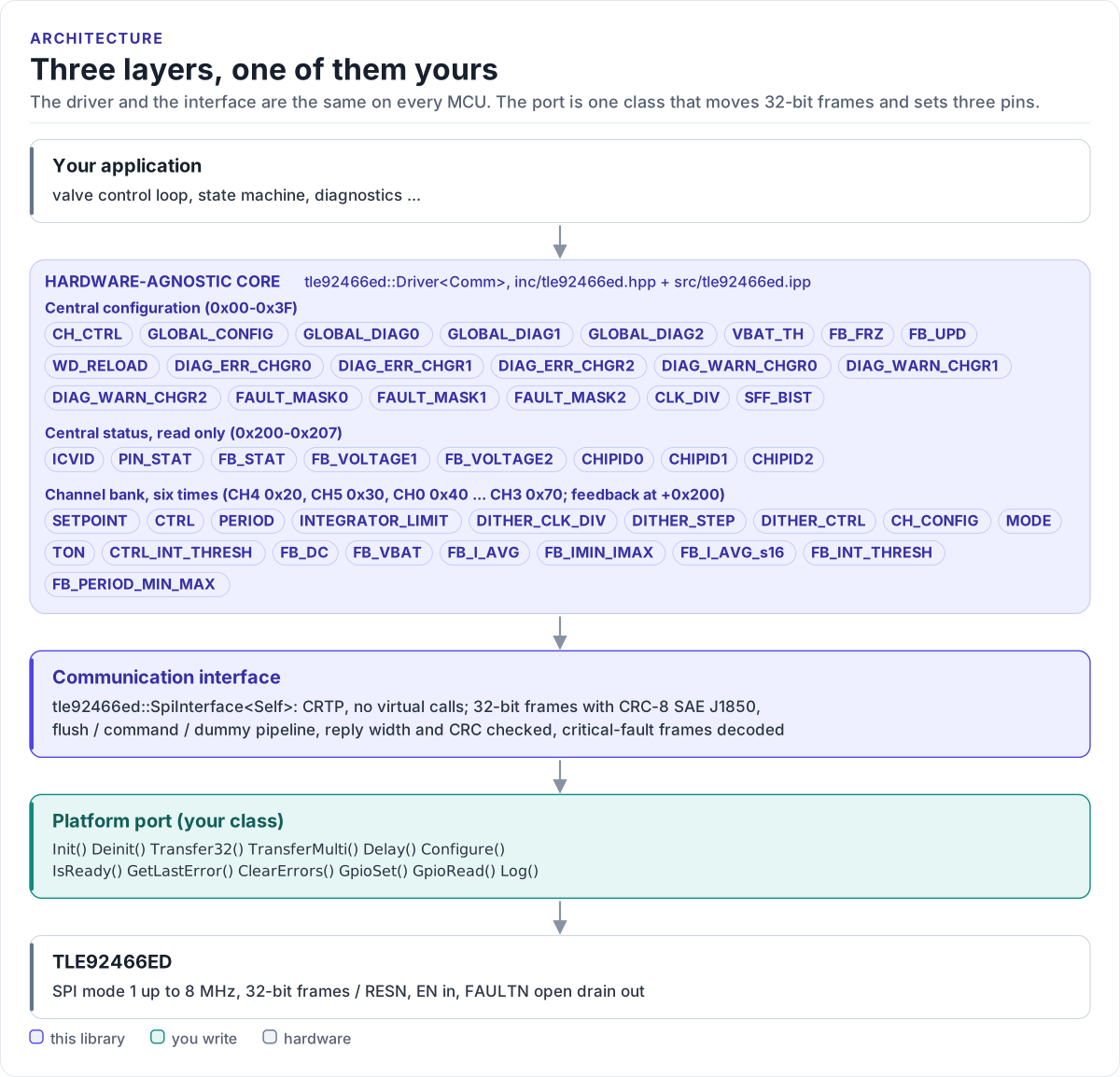
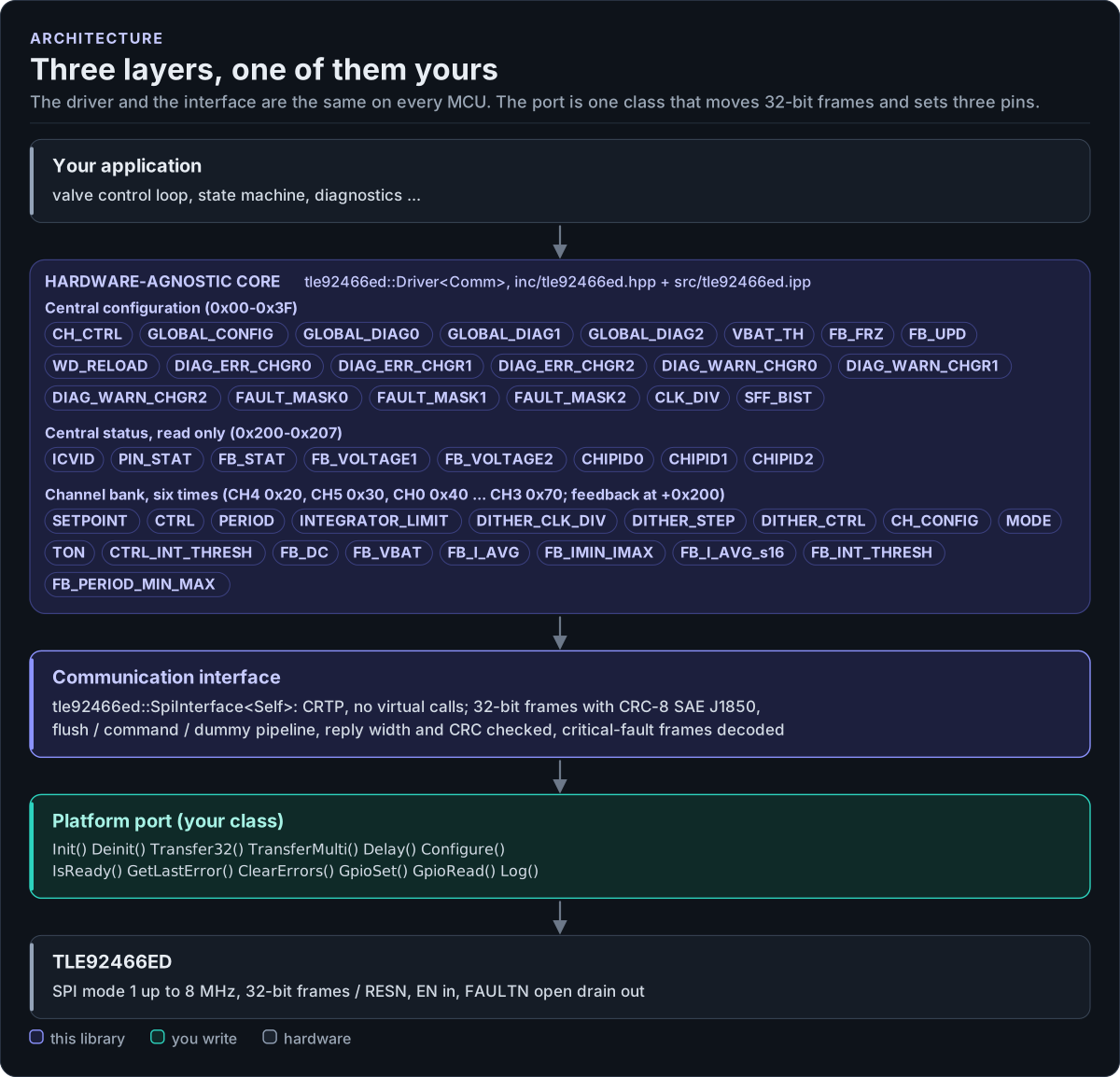
Three layers, one of them yours

Layer diagram: the application calls the hardware-agnostic TLE92466ED driver, which owns the central and per-channel register map, and uses the CRTP SPI interface that frames, checks and pipelines 32-bit transfers, which calls the platform port you write, which drives the SPI bus and the RESN, EN and FAULTN pins of the TLE92466ED.Layer diagram: the application calls the hardware-agnostic TLE92466ED driver, which owns the central and per-channel register map, and uses the CRTP SPI interface that frames, checks and pipelines 32-bit transfers, which calls the platform port you write, which drives the SPI bus and the RESN, EN and FAULTN pins of the TLE92466ED.
Three layers, one of them yours
Figure description and sources

From top to bottom. Your application talks to one Driver object per chip. The core owns the chip's register map (from inc/tle92466ed_registers.hpp): the central configuration and status registers, and the bank of channel registers that repeats for each of the six channels. The communication interface (tle92466ed::SpiInterface in inc/tle92466ed_spi_interface.hpp) is a CRTP base: it builds 32-bit frames with the CRC-8 SAE J1850 byte, runs the one-frame reply pipeline and validates every reply; the methods it dispatches to your class are listed from the header. The platform port is the only code you write. Below it is the chip.

Drawn from: inc/tle92466ed_registers.hpp CentralReg; inc/tle92466ed_registers.hpp ChannelReg; inc/tle92466ed_spi_interface.hpp SpiInterface; figure module docs/diagrams/figures/driver-layers.py.

Figure module: docs/diagrams/figures/driver-layers.py

Drawn from: