Architecture
How the driver is put together: three layers, what each owns, and how one call reaches the chip.
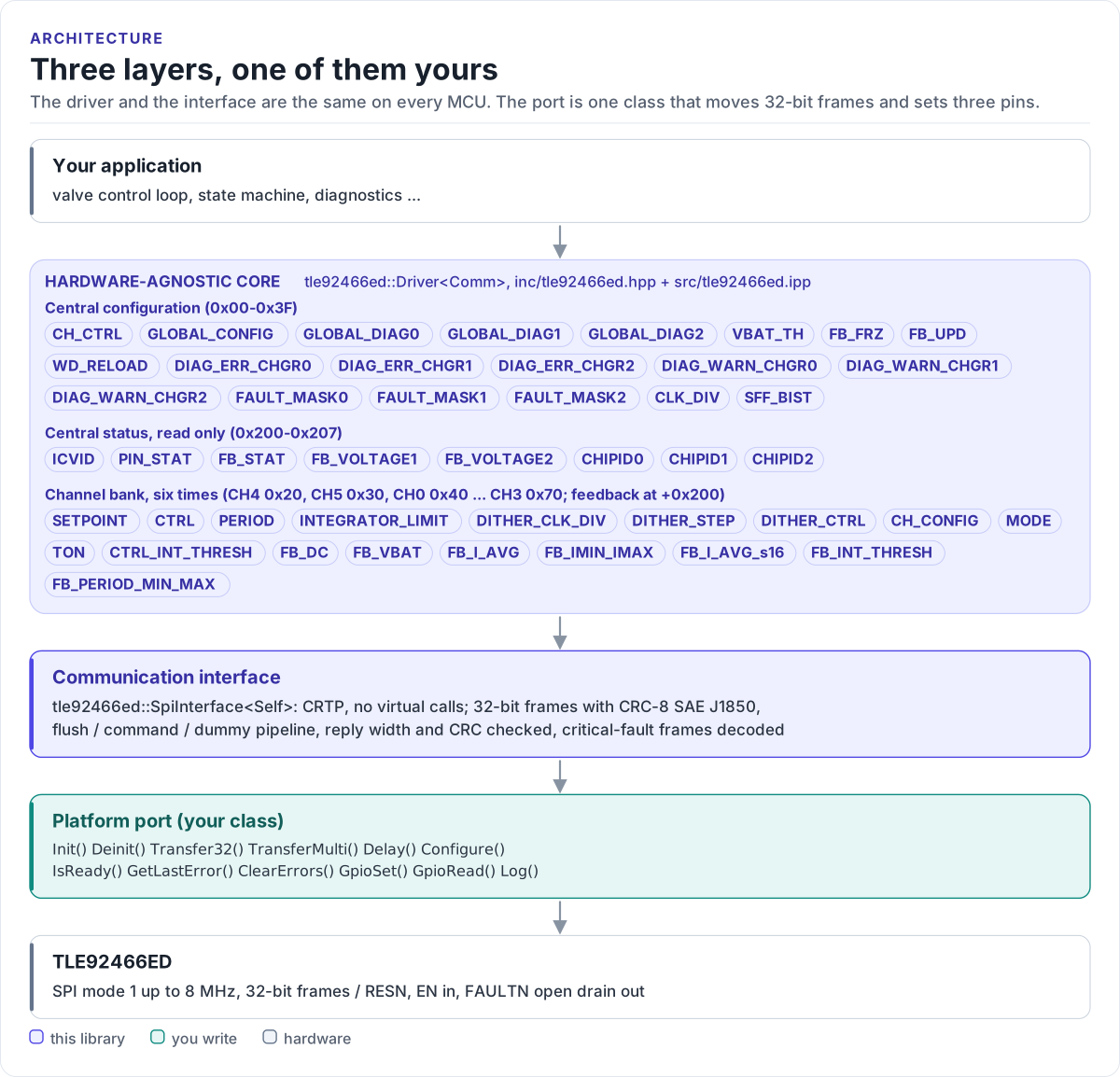
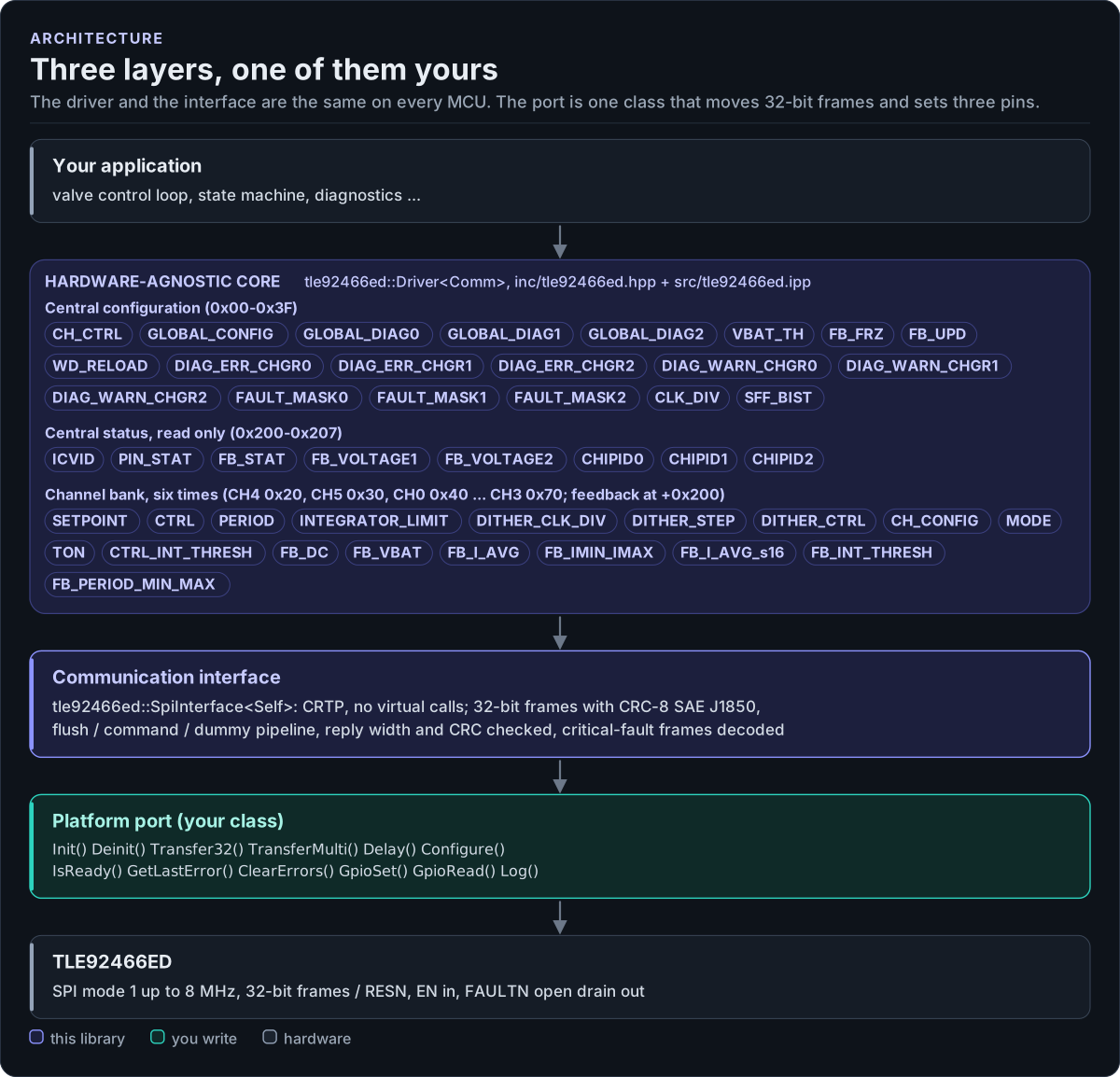
Figure description and sources
From top to bottom. Your application talks to one Driver
Drawn from: inc/tle92466ed_registers.hpp CentralReg; inc/tle92466ed_registers.hpp ChannelReg; inc/tle92466ed_spi_interface.hpp SpiInterface; figure module docs/diagrams/figures/driver-layers.py.
The three layers
| Layer | Where | Depends on | You change it when |
|---|---|---|---|
Hardware-agnostic core: Driver<Comm> |
tle92466ed.hpp |
The interface | Never, for a new board |
Communication interface: SpiInterface<Self> |
tle92466ed_spi_interface.hpp |
Your port's methods | Never |
| Platform port: your class | Your project | Your SDK | Once per MCU or board (Porting) |
Everything above the port is the same on ESP32, STM32, a Linux host or the unit-test model. That is how the host tests run the real driver code without hardware.
What each layer owns
- The core knows the chip: the register map and bit fields, Config and Mission Mode, the channel bank
addresses, setpoint and PWM scaling, the feedback decoding and the fault report. It caches what the chip does
not read back reliably (the channel-enable bits of
CH_CTRL) and checks the mode before calls that need one. - The interface knows the bus protocol: it builds the 32-bit frames, adds the CRC byte, sends the
flush / command / dummy sequence, checks each reply's CRC and width, and records critical-fault frames. It also
offers
ReadMulti(), a pipelined burst of up to 12 reads. - The port knows your hardware: how to clock 32 bits with CSN, how to set two GPIOs and read one, how to wait and where log lines go.
How one call reaches the chip
sequenceDiagram
    participant A as Application
    participant D as Driver core
    participant I as SpiInterface
    participant P as Your port
    A->>D: SetCurrentSetpoint(CH0, 500)
    D->>D: TARGET = 500 x 32767 / 2000 = 8192
    D->>I: Write(CH0 SETPOINT, 8192)
    I->>P: TransferMulti(flush, write frame, dummy)
    P-->>I: three reply words
    I-->>D: status and CRC of the write reply
    D->>I: Read(CH0 SETPOINT)
    I->>P: TransferMulti(flush, read frame, dummy)
    P-->>I: three reply words
    I-->>D: TARGET read back
    D-->>A: success, or an error
SetCurrentSetpoint() reads the setpoint back and retries a write that did not land, up to three times.
Why CRTP
The interface is a class template parameter, not a virtual base class. The compiler sees your port's methods
directly and inlines them; the driver has no vtable, allocates nothing and needs no RTTI. The cost is that the
driver type names the port: Driver<MySpi>. Code that has to work with several port types takes the driver as a
template parameter too.
Errors without exceptions
Every call returns DriverResult<T>, an expected<T, DriverError>: std::expected on C++23, a small polyfill
on C++20. The interface returns CommResult<T> with a CommError, which the core maps to a DriverError
(NoReply to DeviceNotResponding, a critical-fault frame to FaultDetected, and so on). The
API guide lists them.
Source map
| Path | Contents |
|---|---|
inc/tle92466ed.hpp |
Driver<Comm>, configuration and status structures, DriverError |
src/tle92466ed.ipp |
Template implementation, included by the header |
inc/tle92466ed_spi_interface.hpp |
SpiInterface<Self>, SPIFrame, reply modes and status codes, CtrlPin, CommError |
inc/tle92466ed_registers.hpp |
Register addresses, bit fields, scaling helpers, CRC-8 |
inc/tle92466ed_expected.hpp |
expected / unexpected for C++20 |
tests/ |
Host unit tests and the compiled documentation snippets |
examples/esp32/ |
ESP-IDF applications for the ESP32-S3 |
Next: SPI protocol.