Skip to content

Figures

Every figure on this site is drawn by a Python module from facts extracted from the code, so it is rebuilt, not redrawn, when the code changes. CI runs hardfoc-docs figures --check and fails when a committed figure no longer matches the code. Each figure below lists the files it is drawn from.

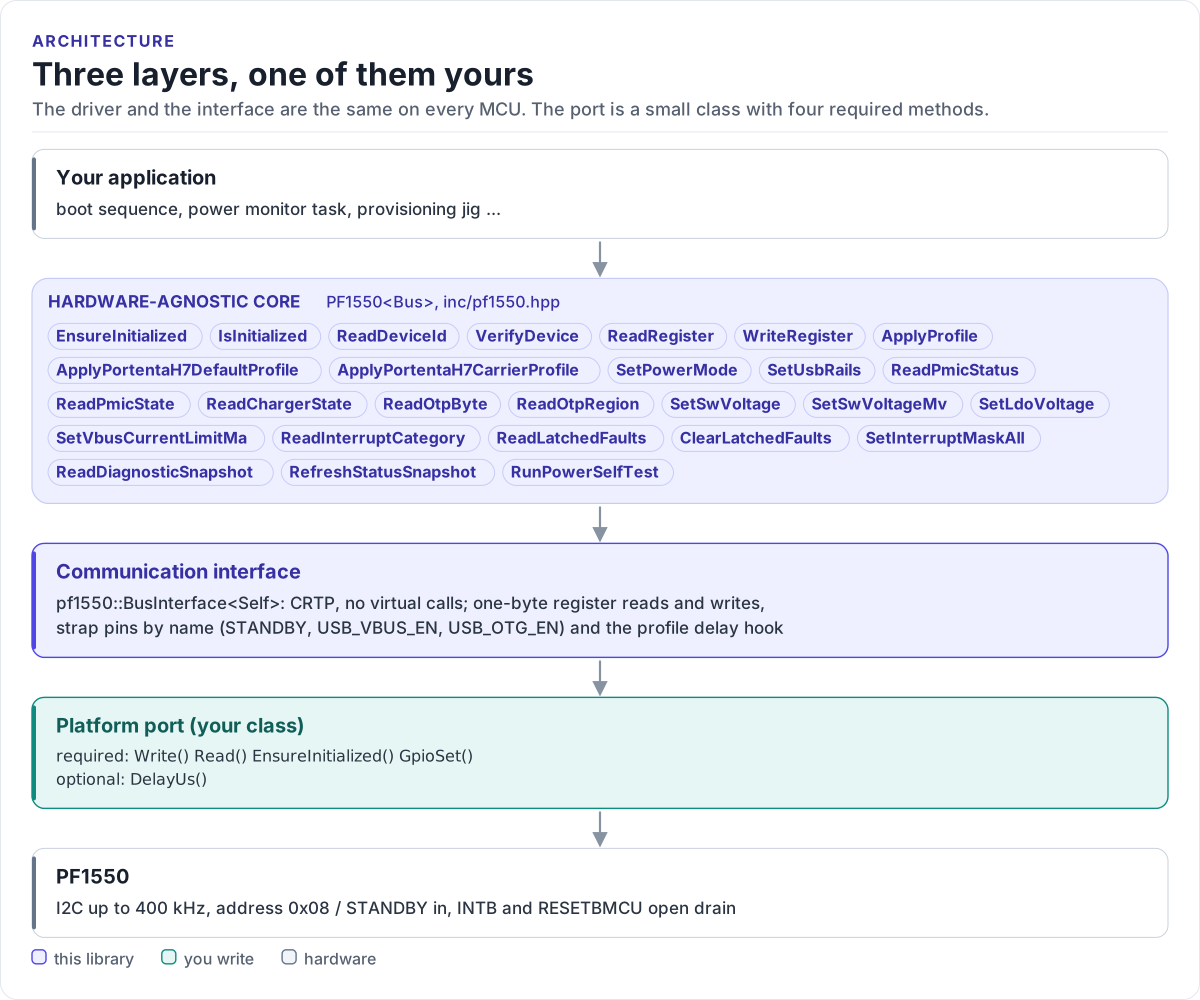
Three layers, one of them yours

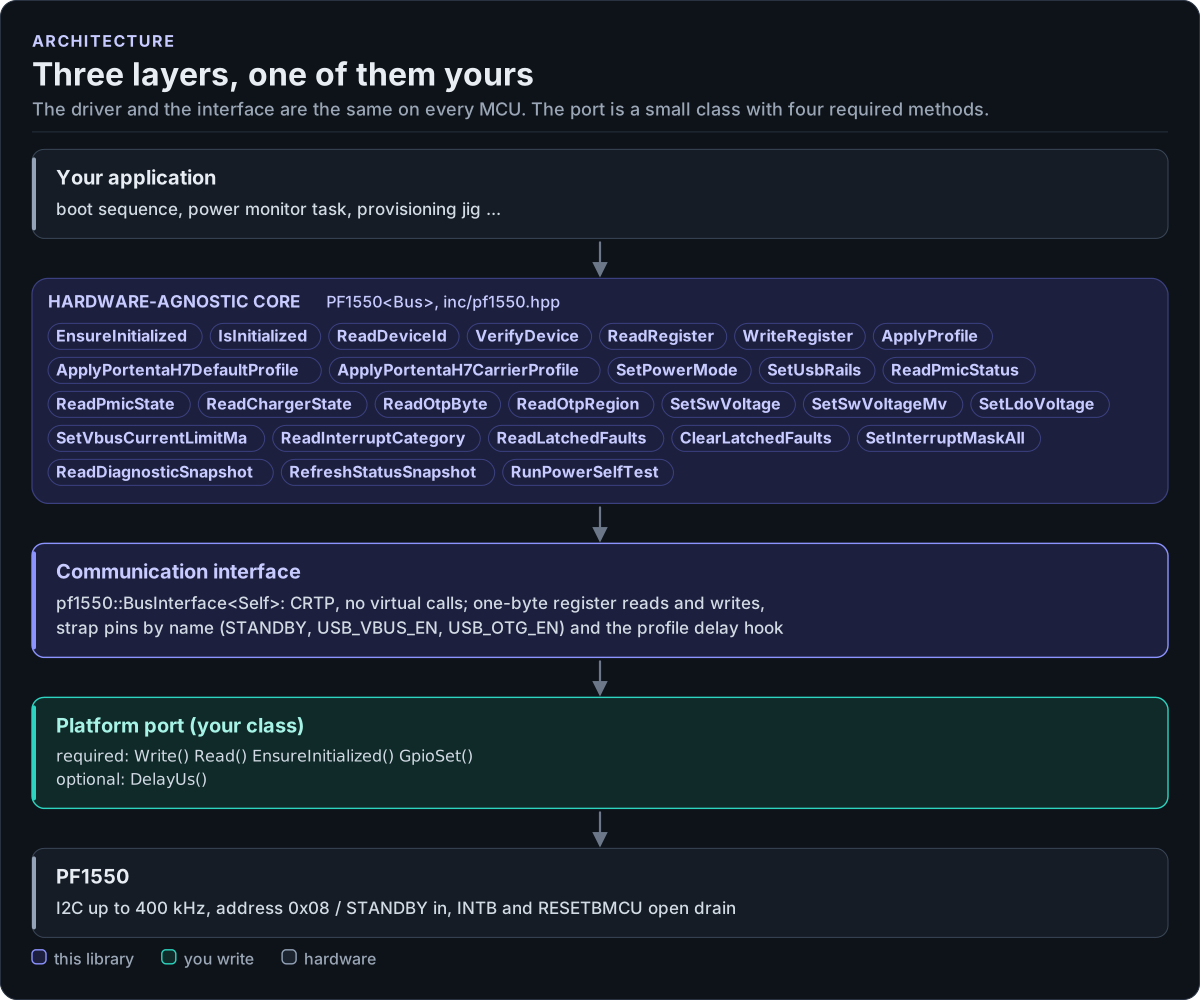
Layer diagram: the application calls the hardware-agnostic PF1550 driver, whose operations read and write the PMIC's registers, which uses the CRTP bus interface, which calls the platform port you write, which drives the I2C bus and the STANDBY and USB strap pins of the PF1550.Layer diagram: the application calls the hardware-agnostic PF1550 driver, whose operations read and write the PMIC's registers, which uses the CRTP bus interface, which calls the platform port you write, which drives the I2C bus and the STANDBY and USB strap pins of the PF1550.
Three layers, one of them yours
Figure description and sources

From top to bottom. Your application talks to one PF1550 object per PMIC. Its public operations (listed from inc/pf1550.hpp) read and write the PF1550's registers: identification, named register sequences (profiles), rail set points, strap pins, OTP, interrupts and diagnostics. The communication interface (pf1550::BusInterface in inc/pf1550_i2c_interface.hpp) is a CRTP base: four methods are required, DelayUs() has a default. The platform port is the only code you write. Below it is the chip.

Drawn from: inc/pf1550.hpp PF1550 public members; inc/pf1550_i2c_interface.hpp BusInterface; figure module docs/diagrams/figures/driver-layers.py.

Figure module: docs/diagrams/figures/driver-layers.py

Drawn from: