Architecture
How the driver is put together: three layers, what each owns, and how one call reaches the chip.
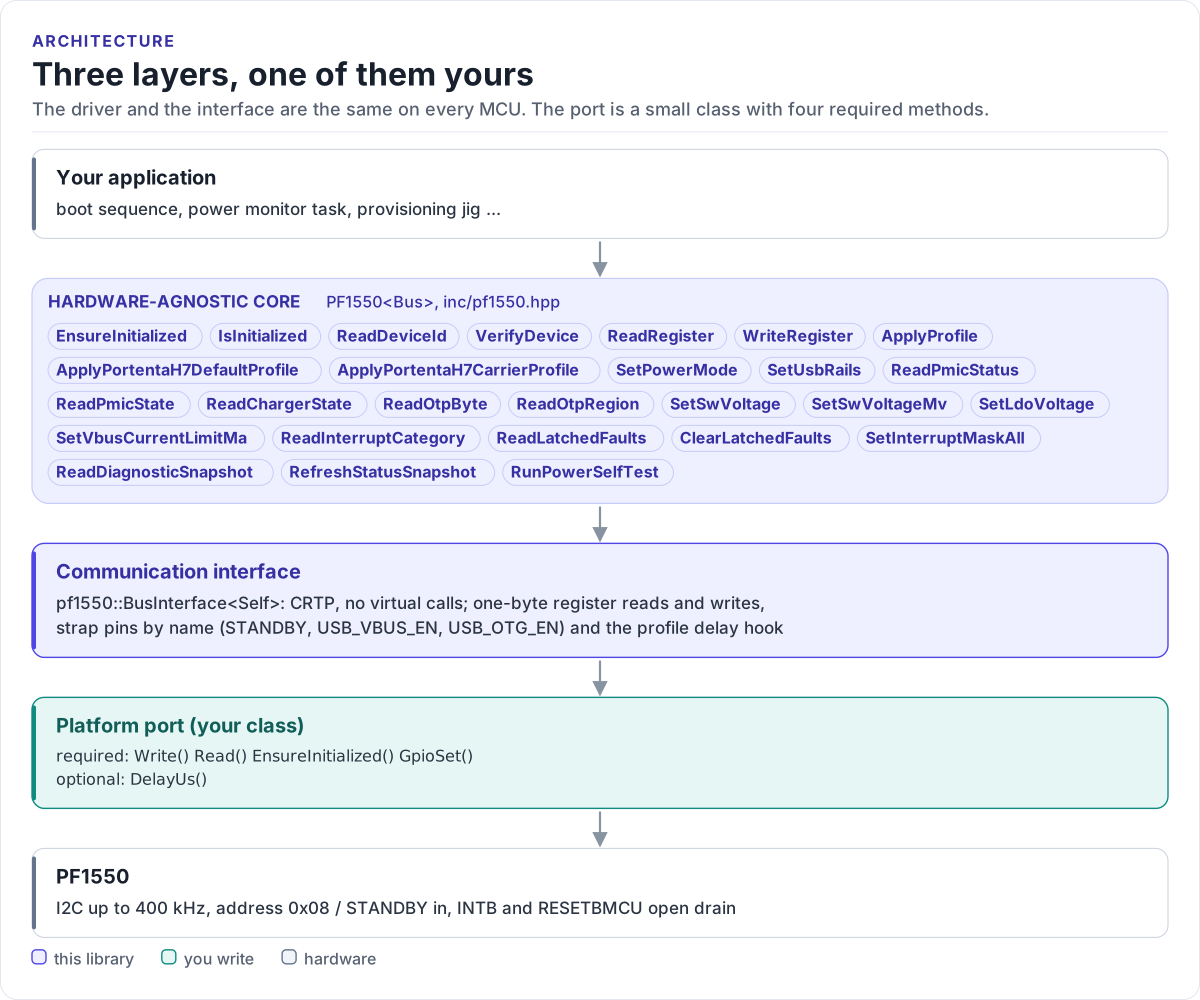
Figure description and sources
From top to bottom. Your application talks to one PF1550
Drawn from: inc/pf1550.hpp PF1550 public members; inc/pf1550_i2c_interface.hpp BusInterface; figure module docs/diagrams/figures/driver-layers.py.
The three layers
| Layer | Where | Depends on | You change it when |
|---|---|---|---|
Hardware-agnostic core: PF1550<Bus> |
inc/pf1550.hpp, src/pf1550.ipp |
The interface's methods only | Never, for a new board |
Communication interface: BusInterface<Self> |
inc/pf1550_i2c_interface.hpp |
Four methods of your port | Never |
| Platform port: your class | Your project | Your SDK | Once per MCU or board (Porting) |
Board knowledge sits beside the core as data, not code: the register sequences in
pf1550_profiles.hpp and the Portenta H7 fault-severity table in
pf1550_diagnostics.hpp. A board that is not a Portenta H7 passes its own table to
ApplyProfile() and classifies faults its own way.
Everything above the port is the same on ESP32, STM32, a Linux host or the unit-test model. That is how the host tests run the real driver code without hardware.
How one call reaches the chip
sequenceDiagram
    participant A as Application
    participant D as PF1550 core
    participant P as Your port
    participant C as PF1550
    A->>D: SetVbusCurrentLimitMa(1500)
    D->>D: 1500 mA to code 0x14, byte 0xA0
    D->>P: Write(0x08, 0x94, [0xA0], 1)
    P->>C: START 0x08+W 0x94 0xA0 STOP
    C-->>P: ACK
    P-->>D: true
    D-->>A: true
A NACK makes the port return false; the core then sets Error::I2cWrite in its sticky error flags and returns
false to the application.
Design choices
- CRTP, not virtual functions. The interface is a class template parameter. The compiler sees your port's
methods directly and inlines them; the driver has no vtable and needs no RTTI. The driver type names the port:
PF1550<MyI2c>. - No heap, no exceptions. Every member is
noexcept. Results come back asboolplus out-parameters; the cause of the last failures stays inGetErrorFlags()until you clear it. - Profiles are tables.
profiles::RegisterWriteis{reg, value, delay_us}. The core applies a table in order and stops at the first failed write, so a profile cannot leave a later rail half-configured without telling you. - Codes, not voltages. Rail setters take the data sheet's register codes (
SwVoltageCode,LdoVoltageCode), because which voltage a code means depends on OTP (see Rails and OTP). The*ToMillivolts()helpers decode them for display. - Header-only.
pf1550.hppincludes the template implementationsrc/pf1550.ipp; there is nothing to compile or link.
Source map
| Path | Contents |
|---|---|
inc/pf1550.hpp |
PF1550<Bus>: identification, registers, profiles, rails, straps, OTP, interrupts, diagnostics |
src/pf1550.ipp |
Template implementation, included by the header |
inc/pf1550_i2c_interface.hpp |
BusInterface<Self>, CtrlPin, GpioSignal, PowerMode |
inc/pf1550_registers.hpp |
Register addresses, bit fields, voltage-code enums, OTP keys |
inc/pf1550_voltage_tables.hpp |
Code to millivolt and milliamp conversions, state decoders, compile-time checks |
inc/pf1550_profiles.hpp |
RegisterWrite and the two Portenta H7 profiles |
inc/pf1550_diagnostics.hpp |
DiagnosticSnapshot, FaultFlags, SelfTestResult, Portenta H7 severity table |
tests/ |
Host unit tests and the compiled documentation snippets |
examples/esp32/ |
ESP-IDF applications for the ESP32-C6 |