Quickstart
Read a temperature from your MCU: wire a divider, write a small ADC port class, call two driver functions.
1. Wire it
The thermistor sits between the ADC node and ground; the series resistor between the supply and the node.
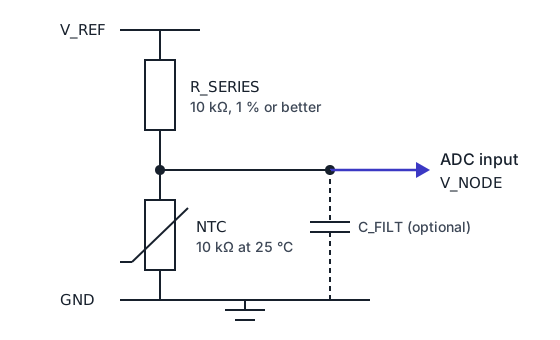
| From | To | Notes |
|---|---|---|
| 3.3 V | R_SERIES | 10 kΩ, 1 % or better; the supply value goes in reference_voltage |
| R_SERIES | ADC input | The divider node |
| ADC input | NTC | NTCG163JF103FT1S or any 10 kΩ NTC |
| NTC | GND | Same ground as the ADC |
Keep the node voltage inside the ADC's input range. With 3.3 V and 10 kΩ / 10 kΩ it is 1.65 V at 25 °C and moves toward 0 V as the sensor heats. The Hardware page covers resistor choice, filtering and self-heating.
2. Add the driver
Add the repository as a submodule and link the hf_ntc_thermistor CMake target.
Installation covers CMake and ESP-IDF.
git submodule add https://github.com/hardfoc/hf-ntc-thermistor-driver.git external/hf-ntc-thermistor-driver
3. Write the port
The port is the only platform code. It brings the ADC up and returns a channel's voltage and raw count. Replace
the two platform_* calls with your SDK's.
class MyAdc : public ntc::AdcInterface<MyAdc> {
public:
  static constexpr uint8_t kChannels = 7;       // ADC1 channels 0..6 on this MCU
  static constexpr uint8_t kBits = 12;
  static constexpr float kFullScaleV = 3.3F;    // input range at the chosen attenuation

  [[nodiscard]] bool IsInitialized() const { return ready_; }

  // Bring the ADC up once; later calls return true at once.
  bool EnsureInitialized() {
    if (!ready_) {
      ready_ = platform_adc_init();
    }
    return ready_;
  }

  [[nodiscard]] bool IsChannelAvailable(uint8_t channel) const { return channel < kChannels; }

  ntc::AdcError ReadChannelCount(uint8_t channel, uint32_t* count) {
    uint32_t mv = 0;
    return read(channel, count, &mv);
  }

  // The driver reads volts: return the calibrated voltage at the pin, not count * Vref / 4095.
  ntc::AdcError ReadChannelV(uint8_t channel, float* voltage_v) {
    uint32_t raw = 0;
    uint32_t mv = 0;
    const ntc::AdcError err = read(channel, &raw, &mv);
    if (err == ntc::AdcError::Success) {
      *voltage_v = static_cast<float>(mv) / 1000.0F;
    }
    return err;
  }

  [[nodiscard]] float GetReferenceVoltage() const { return kFullScaleV; }
  [[nodiscard]] uint8_t GetResolutionBits() const { return kBits; }

  // Optional: the driver waits sample_delay_ms between averaged samples through this.
  void DelayMs(uint32_t ms) { platform_delay_ms(ms); }

private:
  ntc::AdcError read(uint8_t channel, uint32_t* raw, uint32_t* mv) {
    if (!ready_) {
      return ntc::AdcError::NotInitialized;
    }
    if (!IsChannelAvailable(channel)) {
      return ntc::AdcError::InvalidChannel;
    }
    if (!platform_adc_read(channel, *raw, *mv)) {
      return ntc::AdcError::ReadFailed;
    }
    return ntc::AdcError::Success;
  }

  bool ready_ = false;
};
Return the calibrated voltage at the pin from ReadChannelV(): the driver computes the resistance from it.
Porting explains each method.
4. Read the temperature
#include "ntc_thermistor.hpp"

#include <cstdio>

int read_board_temperature(MyAdc& adc, float& celsius) {
  ntc_config_t cfg = GetDefaultNtcConfig();   // NTCG163JF103FT1S: 10 kOhm at 25 C, B 3435 K
  cfg.adc_channel = 2;                        // 1. the ADC input on the divider node
  cfg.series_resistance = 10000.0F;           // 2. the resistor from the supply to the node
  cfg.reference_voltage = 3.3F;               // 3. the supply of the divider

  NtcThermistor<MyAdc> ntc(cfg, &adc);
  if (!ntc.Initialize()) {                    // 4. ADC up, channel present, config valid
    return -1;
  }
  const NtcError err = ntc.ReadTemperatureCelsius(&celsius);  // 5. volts -> ohms -> C
  if (err != NtcError::Success) {
    std::printf("NTC: %s\n", NtcThermistor<MyAdc>::GetErrorString(err));
    return -2;
  }
  return 0;
}
What each step does:
adc_channelselects the input your port reads.series_resistanceis the resistor between the supply and the node, in ohms.reference_voltageis the divider's supply voltage. The driver solves RNTC = RSERIES · V / (VREF − V) with it.Initialize()checks the configuration, brings the ADC up and checks the channel.ReadTemperatureCelsius()reads the voltage, converts it and checks the result againstmin_temperature/max_temperature(−40 °C to +125 °C by default).
This example is built by the host CI, so it compiles against the current headers.
If it does not work
| Symptom | First thing to check |
|---|---|
Initialize() returns false |
EnsureInitialized() and IsChannelAvailable() in your port; a zero or negative value in the config |
Temperature conversion failed |
The node reads 0 V (thermistor shorted) or the supply (thermistor open) |
| A few degrees off at every temperature | reference_voltage or series_resistance differ from the board |
| Reading moves the wrong way | Thermistor and series resistor swapped (Hardware) |
Next
- API guide: averaging, filtering, calibration and error handling.
- Configuration: every field of
ntc_config_t, and other thermistors. - Conversion methods: how accurate the Beta equation is for this part.