Architecture
How the driver is put together: three layers, what each owns, and how one reading reaches the ADC.
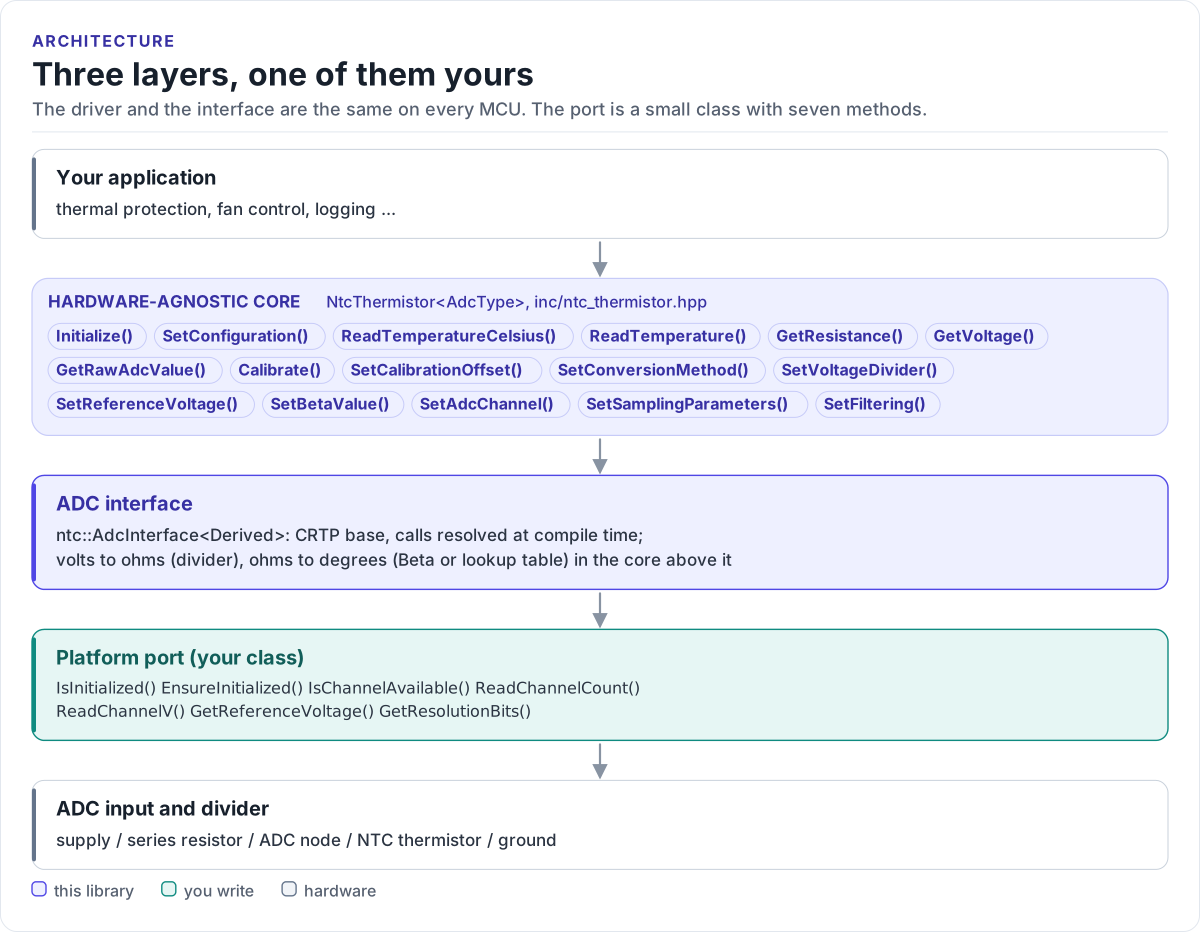
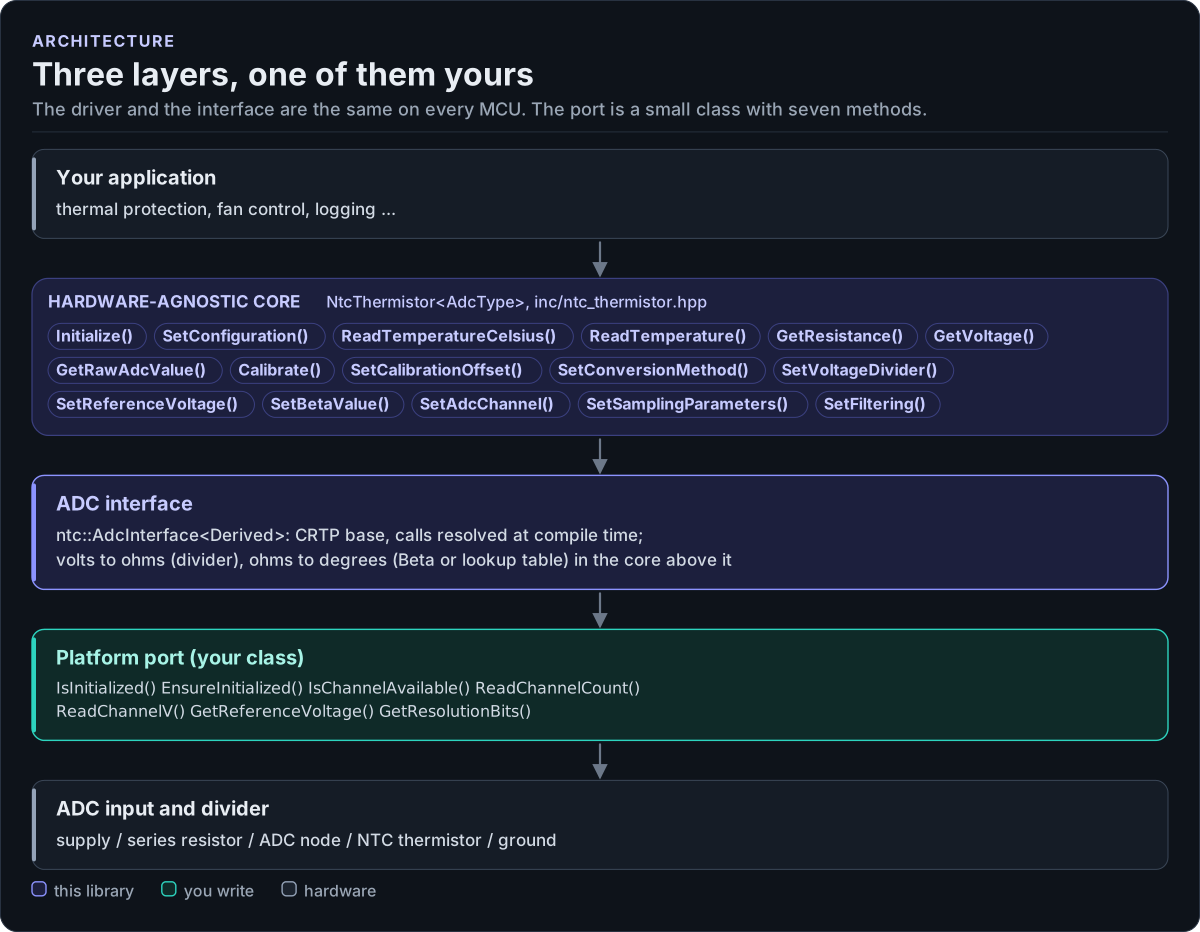
Figure description and sources
From top to bottom. Your application talks to one NtcThermistor
Drawn from: inc/ntc_thermistor.hpp NtcThermistor public calls; inc/ntc_adc_interface.hpp AdcInterface; figure module docs/diagrams/figures/driver-layers.py.
The three layers
| Layer | Where | You change it when |
|---|---|---|
Core: NtcThermistor<AdcType>, conversions |
inc/ntc_thermistor.hpp, src/ |
Never, for a new board |
ADC interface: ntc::AdcInterface<Derived> |
inc/ntc_adc_interface.hpp |
Never |
| Platform port: your class | Your project | Once per MCU or board (Porting) |
The core depends only on the port's methods; the port depends only on your SDK. Everything above the port is the same on ESP32, STM32, a Linux host or the unit-test model. That is how the host tests run the real driver code without hardware.
How one reading reaches the ADC
sequenceDiagram
    participant A as Application
    participant D as NtcThermistor
    participant C as NTC:: conversions
    participant P as Your port
    A->>D: ReadTemperatureCelsius(&c)
    loop sample_count times
        D->>P: ReadChannelV(adc_channel, &v)
        P-->>D: AdcError::Success, volts
    end
    D->>C: CalculateThermistorResistance(v, V_REF, R_SERIES)
    C-->>D: ohms
    D->>C: ConvertResistanceToTemperatureBeta(ohms, R25, B)
    C-->>D: degrees C
    D->>D: + offset, EMA filter, min/max check
    D-->>A: NtcError::Success, c
Why CRTP
ntc::AdcInterface takes your class as a template parameter instead of declaring virtual functions. The
compiler sees your port's methods directly and inlines them: the ADC path has no vtable, allocates nothing and
needs no RTTI. The driver type names the port, NtcThermistor<MyAdc>.
NtcThermistor only calls the methods by name, so any class with the same seven methods works; deriving from
ntc::AdcInterface documents the contract and keeps the port from being copied. NtcThermistor itself has a
virtual destructor, so each driver object carries one vtable pointer.
Namespaces
| Name | Namespace | Contents |
|---|---|---|
NtcThermistor, ntc_config_t, ntc_reading_t, NtcError, NtcType |
global | The driver and its types |
ntc::AdcInterface, ntc::AdcError |
ntc |
The port's base class and its errors |
NTC::Convert..., NTC::Calculate..., NTC::Constants |
NTC |
Free conversion functions and constants |
Source map
| Path | Contents |
|---|---|
inc/ntc_thermistor.hpp |
NtcThermistor<AdcType>: reading, configuration, calibration, utilities |
src/ntc_thermistor.ipp |
Template implementation, included by the header |
inc/ntc_adc_interface.hpp |
ntc::AdcInterface<Derived> and ntc::AdcError |
inc/ntc_types.hpp |
ntc_config_t, ntc_reading_t, NtcError, NtcType, defaults |
inc/ntc_conversion.hpp, src/ntc_conversion.cpp |
Beta, Steinhart-Hart, divider and validation functions |
inc/ntc_lookup_table.hpp, src/ntc_lookup_table.cpp |
Lookup tables and search (details) |
tests/ |
Host unit tests and the compiled documentation snippets |
examples/esp32/ |
ESP-IDF test application |