Architecture
How the driver is put together: three layers, what each owns, and how one call reaches the chip.
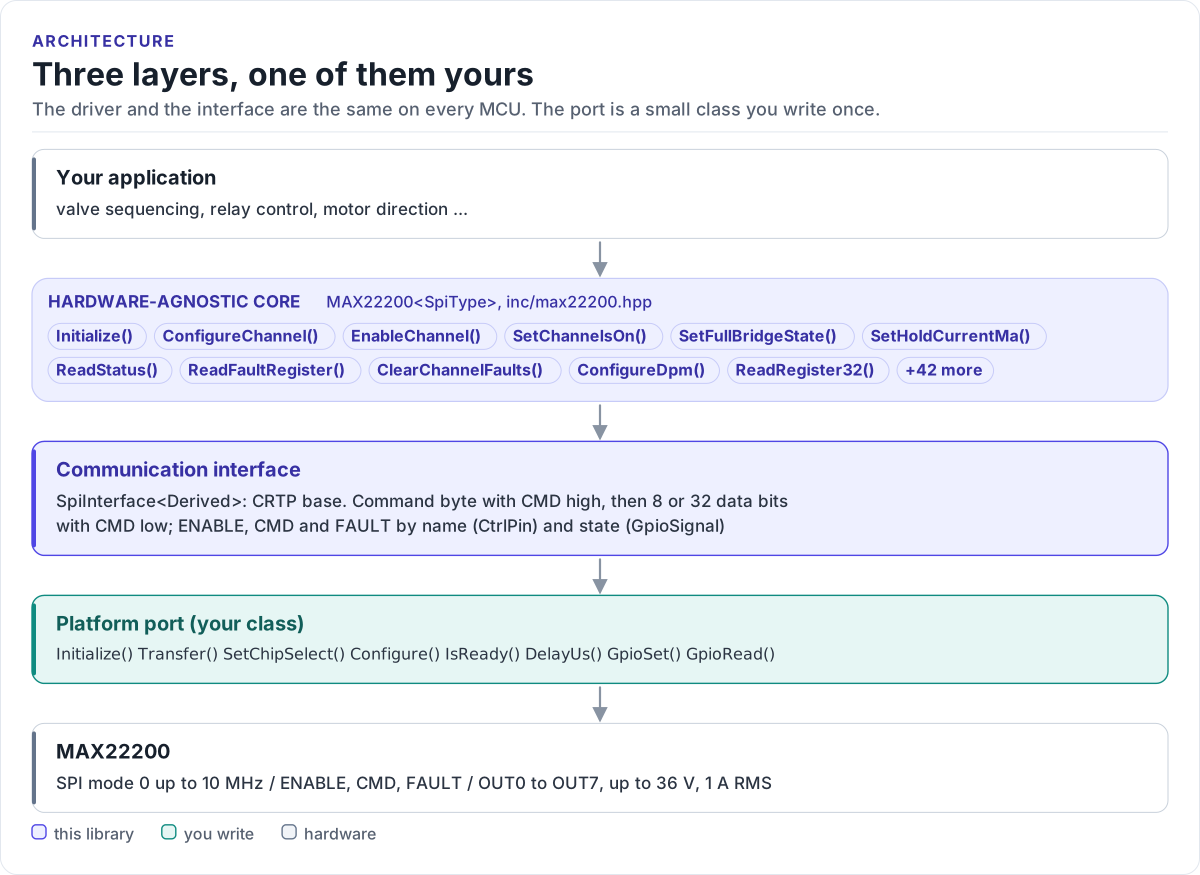
Figure description and sources
From top to bottom. Your application talks to one MAX22200
Drawn from: inc/max22200.hpp MAX22200 public calls; inc/max22200_spi_interface.hpp SpiInterface; figure module docs/diagrams/figures/driver-layers.py.
The three layers
| Layer | Where | You change it when |
|---|---|---|
Hardware-agnostic core: MAX22200<SpiType> |
inc/max22200.hpp, src/max22200.ipp |
Never, for a new board |
Communication interface: SpiInterface<Derived> |
inc/max22200_spi_interface.hpp |
Never |
| Platform port: your class | Your project | Once per MCU or board (Porting) |
Everything above the port is the same on ESP32, STM32, a Linux host or the unit-test model. That is how the host tests run the real driver code without hardware.
How one call reaches the chip
sequenceDiagram
    participant A as Application
    participant D as MAX22200 core
    participant P as Your port
    participant C as MAX22200 chip
    A->>D: ConfigureChannel(0, cfg)
    D->>D: check channel, IFS, SRC vs fCHOP
    D->>D: mA to HIT/HOLD (x 127 / IFS), ms to HIT_T (x fCHOP / 40)
    D->>P: GpioSet(CMD, ACTIVE)
    D->>P: Transfer({0x82}, 1 byte)
    P->>C: CSB low, command byte, CSB high
    C-->>P: STATUS[7:0]
    D->>P: GpioSet(CMD, INACTIVE)
    D->>P: Transfer(4 bytes, LSB first)
    P->>C: CSB low, CFG_CH0, CSB high
    D-->>A: DriverStatus::OK
Why CRTP
The interface is a class template parameter, not a virtual base class. The compiler sees your port's methods
directly and inlines them; the driver has no vtable, allocates nothing and needs no RTTI. The cost is that the
driver type names the port: MAX22200<MySpi>. Code that has to work with several port types takes the driver as
a template parameter too.
State the driver keeps
The driver holds a reference to your port, never a copy, and a few values in the object:
| State | Why |
|---|---|
BoardConfig |
IFS and optional current and duty limits for every unit conversion |
| Cached STATUS | ONCH for the 8-bit channel writes, FREQM for HIT-time and duty conversions |
| Last fault byte | STATUS[7:0] from the most recent command byte (GetLastFaultByte()) |
DriverStatistics |
Transfer and failure counters |
The STATUS cache is refreshed by ReadStatus(), WriteStatus() and Initialize(). If something else writes
STATUS (a raw WriteRegister32(), another task), call ReadStatus() before the next EnableChannel(): the 8-bit
ONCH write uses the cached mask for the channels you did not name.
Errors without exceptions
Every call that touches the chip returns max22200::DriverStatus:
| Value | Meaning |
|---|---|
OK |
Done |
INVALID_PARAMETER |
Channel above 7, pair above 3, IFS of 0, SRC at 50 kHz or more, a value out of range; nothing is written |
COMMUNICATION_ERROR |
Your Transfer() or GpioRead() returned false, or Initialize() saw COMER three times |
INITIALIZATION_ERROR |
Your Initialize() or Configure() returned false |
HARDWARE_FAULT and TIMEOUT exist in the enum but no call returns them. Chip faults (overcurrent, open load) are
not errors of the call: read them with ReadStatus() and ReadFaultRegister().
Source map
| Path | Contents |
|---|---|
inc/max22200.hpp |
MAX22200<SpiType>: every public call |
src/max22200.ipp |
Template implementation, included by the header |
inc/max22200_spi_interface.hpp |
SpiInterface<Derived>, CtrlPin, GpioSignal |
inc/max22200_types.hpp |
ChannelConfig, StatusConfig, FaultStatus, DpmConfig, BoardConfig, enums, conversions |
inc/max22200_registers.hpp |
Register banks, command byte, bit fields |
tests/ |
Host unit tests and the compiled documentation snippets |
examples/esp32/ |
ESP-IDF applications |