Architecture
How the driver is put together: three layers, what each owns, and how one call reaches a servo.
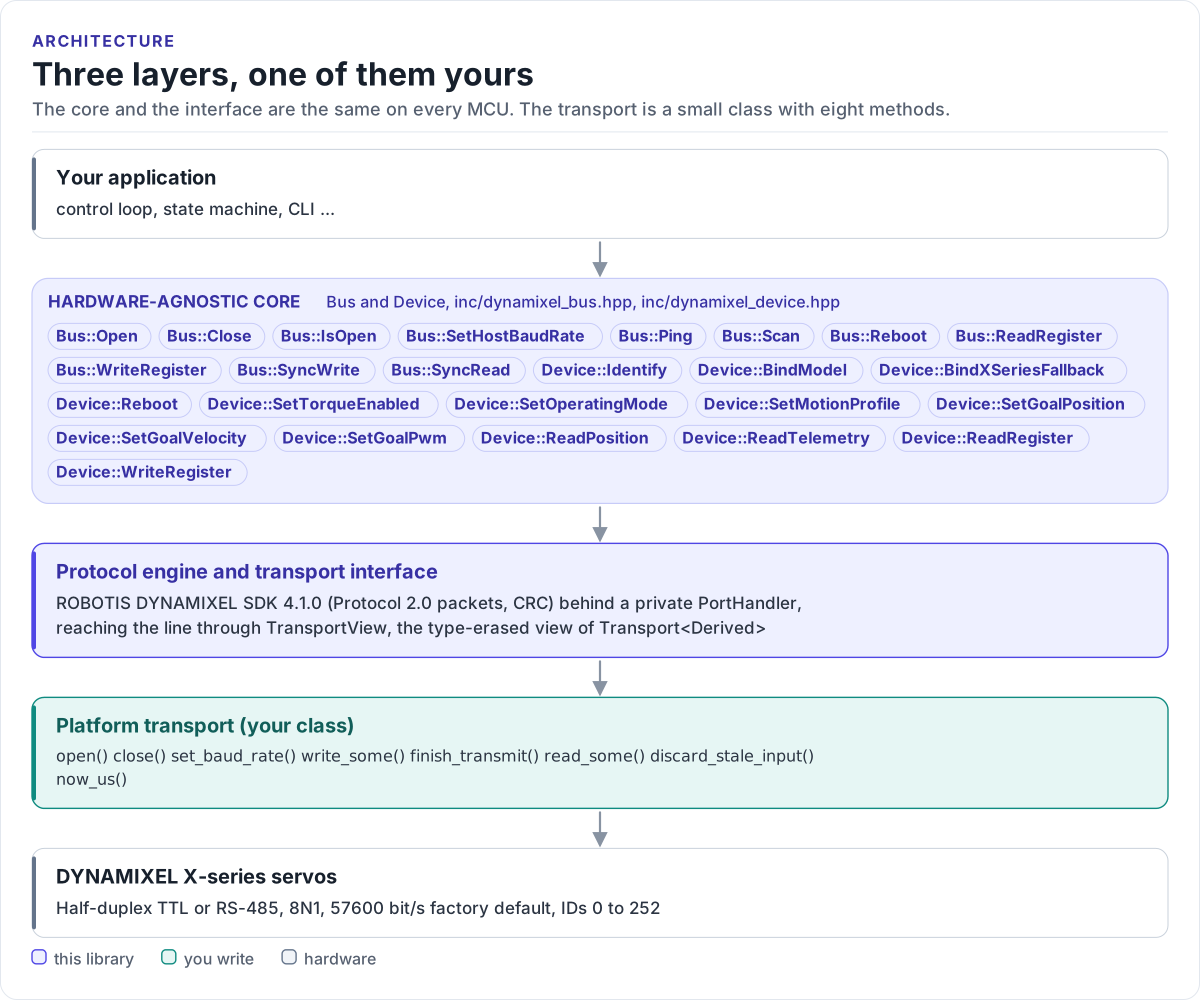
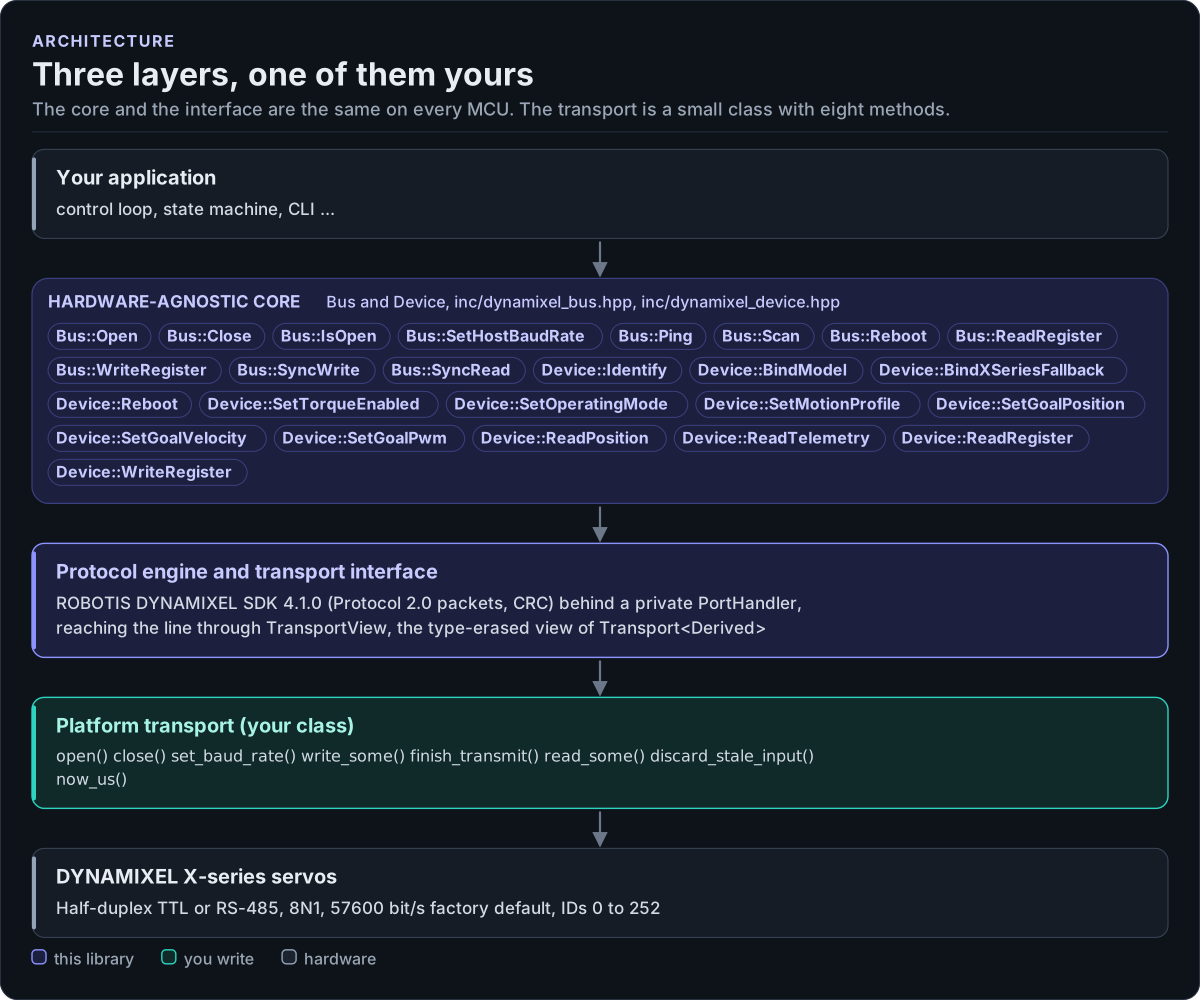
Figure description and sources
From top to bottom. Your application talks to one Bus per serial line and one Device per servo; the public members listed are the Bus and Device methods from inc/dynamixel_bus.hpp and inc/dynamixel_device.hpp. The bus encodes and decodes Protocol 2.0 packets with the ROBOTIS DYNAMIXEL SDK, behind a private PortHandler adapter, and reaches the line through TransportView, the type-erased view of a Transport
Drawn from: inc/dynamixel_bus.hpp Bus members; inc/dynamixel_device.hpp Device members; inc/dynamixel_transport.hpp Transport hooks; figure module docs/diagrams/figures/driver-layers.py.
The three layers
| Layer | Where | You change it |
|---|---|---|
Core: Bus, Device, model catalog |
inc/, src/ |
Never, for a new board |
Protocol engine and interface: the SDK, TransportView |
src/backend/, inc/dynamixel_transport.hpp |
Never |
| Platform transport: your class | Your project | Once per MCU (Porting) |
Everything above the transport is the same on ESP32, STM32, a Linux host or the test fake. That is how the host tests run the real SDK without a servo.
How one call reaches a servo
sequenceDiagram
    participant A as Application
    participant D as Device
    participant B as Bus + SDK
    participant T as Your transport
    A->>D: SetGoalPosition(2048)
    D->>D: check model and mode
    D->>B: WriteRegister(116, 4 bytes)
    B->>T: discard_stale_input()
    B->>T: write_some(), finish_transmit()
    B->>T: read_some() until status or timeout
    T-->>B: status packet
    B-->>D: DriverResult
    D-->>A: DriverResult
The SDK's packet handler builds the packet and checks the reply; the private PortHandler adapter translates its
clearPort(), writePort() and readPort() calls into the transport calls above.
Design choices
- The SDK does the protocol. The driver does not reimplement Protocol 2.0: it compiles four SDK source files
(packet handler, group handler, sync read, sync write) and gives the SDK a private
PortHandlerthat talks to your transport. Public headers never include the SDK. SDK integration has the details. - CRTP transport, type-erased bus. Your transport derives from
Transport<Derived>, so hook calls are resolved at compile time.Bustakes aTransportView(a pointer and a table of function pointers) instead of a template parameter, soBusandDeviceare ordinary classes compiled once insrc/. - Ownership. The transport outlives the bus; the bus outlives its devices.
Busis movable, not copyable. - Nothing happens in a constructor. Constructing a
Busor aDevicesends nothing.Identify()only reads. Torque, mode, ID and baud changes are always explicit calls. - One owner per bus.
Busis not thread-safe: the SDK'sis_using_flag is not a lock. Give each bus one task, or guard every call with one mutex (hf-core'sDynamixelHandlertakes anRtosMutex).
Source map
| Path | Contents |
|---|---|
inc/dynamixel.hpp |
Umbrella header, version functions |
inc/dynamixel_bus.hpp, src/dynamixel_bus.cpp |
Bus: open, ping, scan, register access, sync read and write |
inc/dynamixel_device.hpp, src/dynamixel_device.cpp |
Device: identify, torque, mode, goals, telemetry |
inc/dynamixel_model.hpp |
ModelDescriptor, the X-series register map, the catalog, Telemetry |
inc/dynamixel_transport.hpp |
Transport<Derived>, TransportView, TransportConfig |
inc/dynamixel_types.hpp |
DriverError, DriverResult, CommDetail, policies, OperatingMode |
src/backend/port_handler_adapter.hpp |
The private SDK PortHandler over TransportView |
src/dynamixel_status.cpp |
MapCommCode(): SDK COMM_* codes to DriverError |
external/DynamixelSDK |
ROBOTIS DYNAMIXEL SDK 4.1.0 (submodule) |
tests/host/, tests/docs/ |
Host tests and the compiled documentation snippets |
examples/esp32/, examples/host/ |
ESP-IDF applications, host ping example |