Platform overview
The layers of the HardFOC platform, the repository that holds each one, and the path one call takes from a manager to the chip.
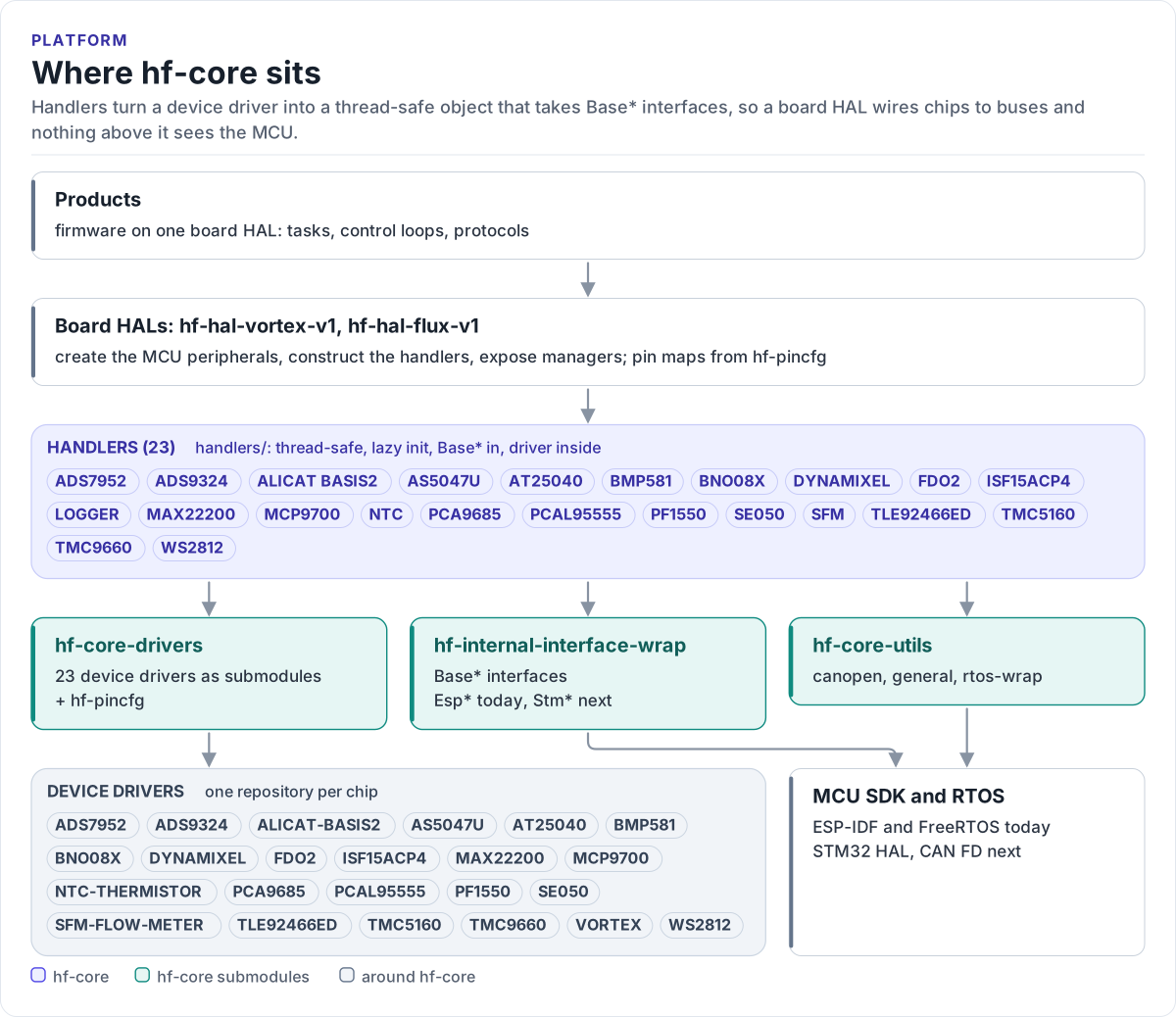
Figure description and sources
From the bottom up. Each device driver is its own repository and talks to its chip through a small CRTP interface; hf-core-drivers collects them as submodules, together with hf-internal-interface-wrap (the Base* interfaces and their ESP32 and STM32 implementations) and hf-pincfg. hf-core-utils collects the RTOS wrapper, the general utilities and the CANopen helpers. hf-core's handlers sit on top of those three: each one wraps one driver behind a thread-safe API that takes Base* interfaces. A board HAL creates the MCU peripherals, constructs the handlers it needs and exposes managers; a product is firmware on one board HAL. The driver list is read from cmake/hf_core_build_settings.cmake and the handler list from handlers/.
Drawn from: cmake/hf_core_build_settings.cmake driver and utility paths; handlers/ handler folders; figure module docs/diagrams/figures/platform-layers.py.
Layers
| Layer | Repository | What it holds | Knows the MCU? |
|---|---|---|---|
| Product | product firmware repositories | Tasks, control loops, protocols | No |
| Board HAL | hf-hal-vortex-v1, hf-hal-flux-v1 | Creates the buses and pins, constructs the handlers, exposes managers | Yes, in its platform files only |
| Handlers | hf-core handlers/ |
One thread-safe class per device family over Base* interfaces |
No |
| Device drivers | hf-core-drivers external/ |
One repository per chip, CRTP interface, no heap | No |
| Interfaces | hf-internal-interface-wrap (in hf-core-drivers internal/) |
BaseSpi, BaseI2c, BaseUart, BaseCan, BaseGpio, BaseAdc, ... and their Esp* / Stm* implementations |
Only the implementations |
| Pin maps | hf-pincfg (in hf-core-drivers internal/) |
Functional pin tables per board | Board-specific |
| Utilities | hf-core-utils: hf-utils-rtos-wrap, hf-utils-general, hf-utils-canopen | RTOS wrapper, containers and filters, CANopen frames | Only the RTOS backends |
hf-core pins one commit of hf-core-drivers and one of hf-core-utils as submodules, so a HAL that pins hf-core gets a set of drivers, interfaces and utilities that were built and tested together.
One call, through the layers
A HAL manager reads the rotor angle from the AS5047U. Only the last step knows it runs on an ESP32.
sequenceDiagram
  participant M as HAL manager
  participant H as As5047uHandler
  participant D as AS5047U driver
  participant A as As5047uSpiAdapter
  participant S as BaseSpi (EspSpi on ESP32)
  M->>H: visitDriver([](auto& d) { return d.GetAngle(); })
  H->>H: lock the handler mutex, EnsureInitialized()
  H->>D: GetAngle()
  D->>A: transfer(tx, rx, len), static dispatch
  A->>S: Transfer(tx, rx, len)
  S-->>D: frame with CRC (retried on a CRC error)
  D-->>M: 14-bit angle, mutex released
Design choices
| Choice | Why |
|---|---|
| Drivers are CRTP templates, handlers are plain classes | The driver dispatch costs nothing; the handler gives HAL code one non-template type per chip |
Handlers take Base* references and never own them |
The HAL decides bus sharing and lifetime; a test passes a mock |
| Lazy initialisation | Constructing a handler never touches the bus, so construction order does not matter at boot |
| One recursive mutex per handler, optional shared bus mutex | Methods may call each other; devices on one bus can share a lock |
Raw function pointers with void* user_data for low-level callbacks |
No std::function and no heap on interrupt paths |
| The host build is part of CI | It is the proof that everything above the interfaces is free of vendor headers |
Source map
| Path | Contents |
|---|---|
handlers/<chip>/ |
One handler: its CRTP adapter(s), the handler class, wrappers that expose it as BaseGpio, BaseAdc, BaseTemperature |
handlers/common/ |
HandlerCommon.h (delays, log routing), PlatformMutexBackend.h, the CANopen bridge |
handlers/logger/ |
The Logger singleton and the per-MCU backend factories |
cmake/hf_core_build_settings.cmake |
The build entry point for every consumer |
CMakeLists.txt, CMakePresets.json |
The host build |
tests/host/ |
Host unit tests, mocks (mocks/) and the test harness (support/) |
tests/docs/ |
The code on these pages, compiled and run by the host build |
examples/esp32/ |
ESP32 test applications, one per handler or utility |
hf-core-drivers/, hf-core-utils/ |
Submodules |
Next: Handler model.