HardFOC core library
HardFOC Core
The layer between the HardFOC device drivers and a board HAL. hf-core wraps each driver in a thread-safe
handler that takes Base* interfaces, collects the MCU interfaces, RTOS wrappers and utilities, and
builds and tests all of it on a host machine with no MCU toolchain.
A device driver knows its chip and nothing else: it talks through a small CRTP interface and leaves locking, bring-up order and bus sharing to its user. A board HAL knows its pins and buses. hf-core is what sits between them, so that every HAL wires a TMC9660 or a BNO08x the same way and no code above the HAL includes an MCU SDK.
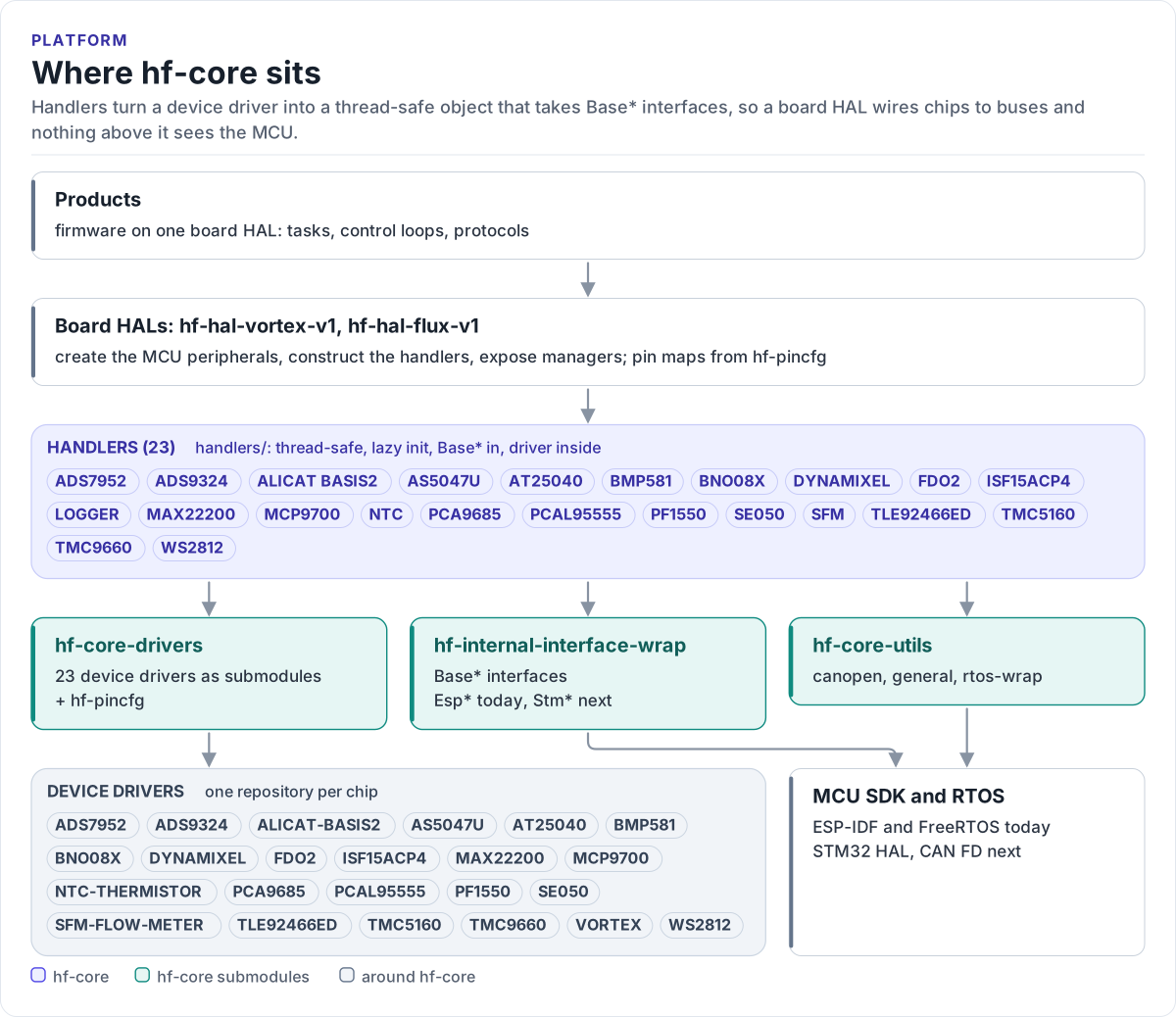
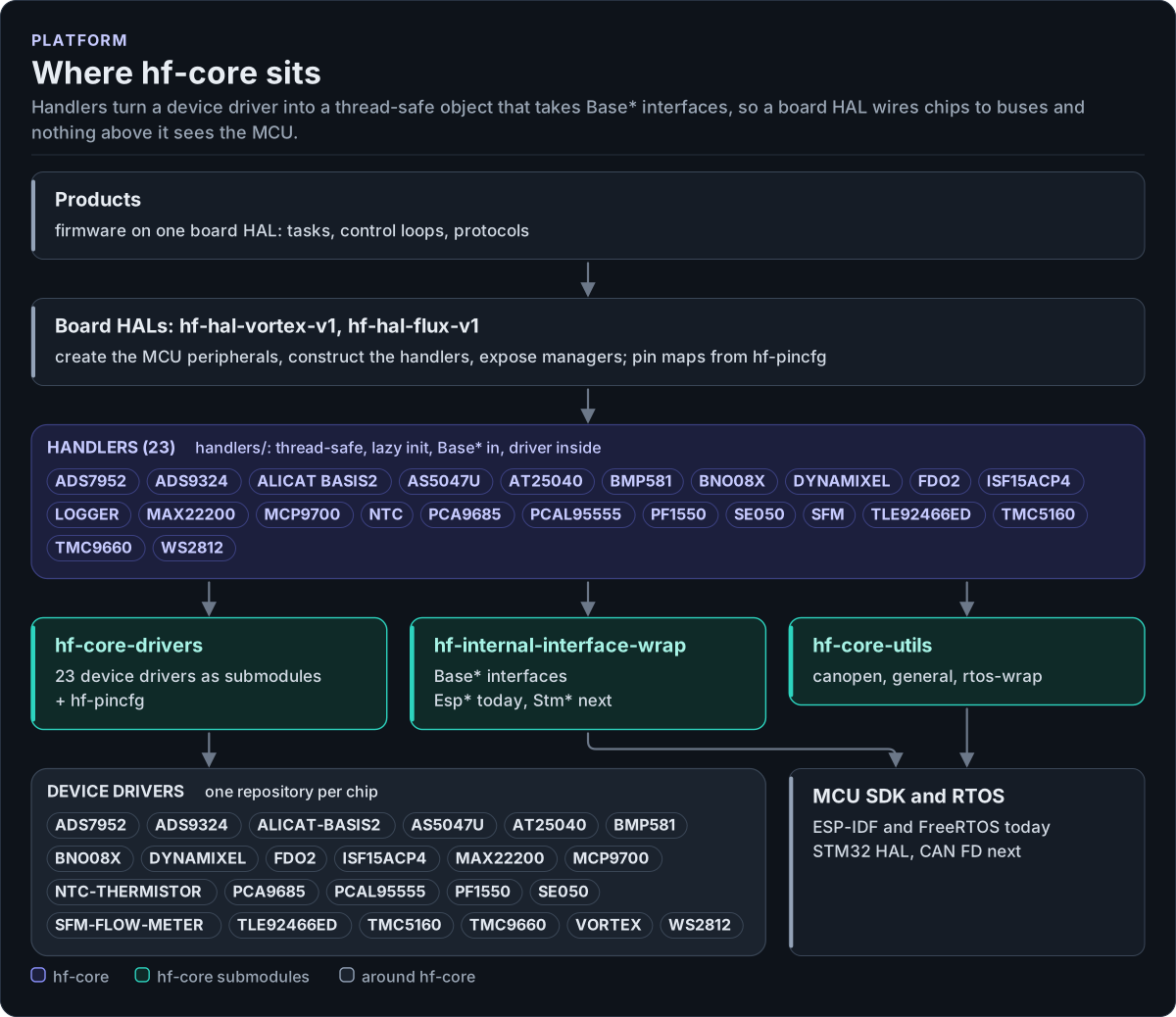
Figure description and sources
From the bottom up. Each device driver is its own repository and talks to its chip through a small CRTP interface; hf-core-drivers collects them as submodules, together with hf-internal-interface-wrap (the Base* interfaces and their ESP32 and STM32 implementations) and hf-pincfg. hf-core-utils collects the RTOS wrapper, the general utilities and the CANopen helpers. hf-core's handlers sit on top of those three: each one wraps one driver behind a thread-safe API that takes Base* interfaces. A board HAL creates the MCU peripherals, constructs the handlers it needs and exposes managers; a product is firmware on one board HAL. The driver list is read from cmake/hf_core_build_settings.cmake and the handler list from handlers/.
Drawn from: cmake/hf_core_build_settings.cmake driver and utility paths; handlers/ handler folders; figure module docs/diagrams/figures/platform-layers.py.
What you get
- 23 handlers, one per device family. Each takes
BaseSpi,BaseI2c,BaseUart,BaseGpioorBaseAdcreferences, initialises its driver on first use and serialises calls with a recursive mutex. See Handlers. - One CMake file for every consumer.
cmake/hf_core_build_settings.cmaketurnsHF_CORE_ENABLE_*switches into sources, include directories, ESP-IDF requirements and compile definitions. See Integration and Feature switches. - A host build with mocks.
HF_CORE_MCU=NONE,HF_CORE_RTOS=NONE: handlers, drivers and utilities compile and run on Linux or macOS against scriptable fakes of theBase*interfaces. See Host build and mocks. - Threads and locking without the RTOS in your code.
RtosMutex,MutexLockGuard,BaseThreadand the OS abstraction map to FreeRTOS on target and to a no-op backend with a fake clock on the host. See Threading and RTOS. - CANopen helpers on
BaseCan. Frame builders and parsers for NMT, SDO, heartbeat, emergency and CiA 402, and a bridge to anyBaseCan. See CANopen. - A checked MCU boundary. Only the interface implementations and a short list of files may include vendor headers; the host build proves the rest is portable. See MCU boundary.
Used by
| Repository | Uses hf-core for |
|---|---|
| hf-hal-vortex-v1 | Vortex V1: TMC9660, AS5047U, BNO08x, PCAL95555, PCA9685, NTC and WS2812 handlers, the Vortex driver, CANopen |
| hf-hal-flux-v1 | Flux V1: ADS7952, MCP9700, NTC, TLE92466ED, MAX22200, Alicat BASIS-2, FDO2 and WS2812 handlers, CANopen |
| hf-utils-and-drivers | Superseded by hf-core; kept for older projects |
Where to go next
-
Add hf-core to a project and drive a handler in 20 lines.
-
The layers, the repositories and how one call travels through them.
-
Every handler, its driver, its interfaces and its switch.
-
Build and test without hardware, from hf-core or from a HAL.