Architecture
How the driver is put together: three layers, what each owns, and how one call reaches the instrument.
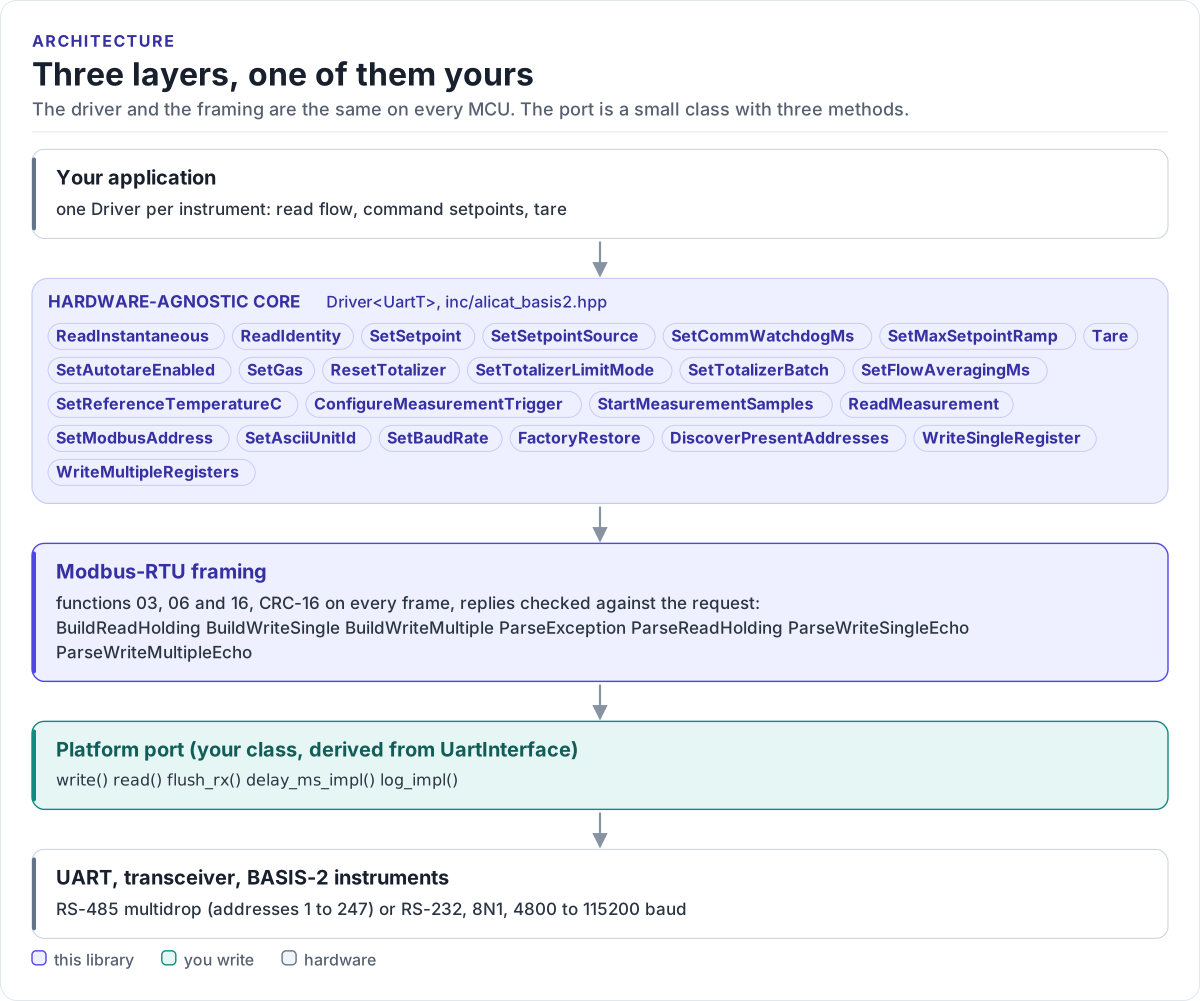
Figure description and sources
From top to bottom. Your application holds one Driver
Drawn from: inc/alicat_basis2.hpp Driver members; inc/alicat_basis2_modbus.hpp frame builders; inc/alicat_basis2_uart_interface.hpp UartInterface; figure module docs/diagrams/figures/driver-layers.py.
The three layers
| Layer | Where | You change it |
|---|---|---|
Hardware-agnostic core: Driver<UartT> |
inc/alicat_basis2.hpp |
Never, for a new board |
Modbus-RTU framing: alicat_basis2::modbus |
inc/alicat_basis2_modbus.hpp |
Never |
| Platform port: your class | Your project | Once per MCU or board (Porting) |
The core depends only on the port's methods; the framing depends on nothing. The port derives from
UartInterface in inc/alicat_basis2_uart_interface.hpp and calls
your SDK.
Everything above the port is the same on ESP32, STM32, a Linux host or the unit-test mock. That is how the host tests run the real driver code without hardware.
How one call reaches the instrument
sequenceDiagram
    participant A as Application
    participant D as Driver
    participant M as modbus
    participant P as Your port
    A->>D: SetSetpoint(2.5)
    D->>D: 2.5 x 1000 = 2500, split into two registers
    D->>M: BuildWriteMultiple(addr, 2053, regs, 2)
    M-->>D: 13-byte frame with CRC-16
    D->>P: flush_rx()
    D->>P: write(frame)
    D->>P: read(rx, 3, timeout)
    P-->>D: address, 0x10, register high byte
    Note over D: bit 7 of 0x10 clear: a normal reply (an exception reply would end 2 bytes later)
    D->>P: read(rx + 3, 5, timeout)
    P-->>D: the other 5 reply bytes (or fewer on timeout)
    D->>M: ParseWriteMultipleEcho(rx, addr, 2053, 2)
    M-->>D: DriverError::None
    D-->>A: DriverResult<void> ok
Every public call is one or more of these exchanges: flush, write the request, read the reply header and then the rest of the reply with the timeout, check it. A broadcast (address 0) write returns as soon as the request is written; no instrument replies to it.
Why CRTP
The port is a class template parameter, not a virtual base class. The compiler sees your port's methods
directly and inlines them; the driver has no vtable, allocates nothing and needs no RTTI. The cost is that the
driver type names the port: Driver<MyUart>. Code that has to work with several port types takes the driver as
a template parameter too.
Results, not exceptions
Every call returns DriverResult<T> (a value and a DriverError) or a bare DriverError, and is noexcept.
DriverResult converts to bool, so if (auto r = meter.Tare(); !r) works. ToString(DriverError) gives a
stable name for logs without allocating. The API guide lists what each error means.
One driver per address
A Driver holds a reference to the port, one Modbus address and one timeout: three members, no buffers that
outlive a call. Several drivers can share one port, one per instrument on a multidrop bus. The driver does not
lock anything; one task must own the bus, or a mutex must guard every call (Porting).
Source map
| Path | Contents |
|---|---|
inc/alicat_basis2.hpp |
Driver<UartT>: live data, identity, setpoint, tare, totalizer, measurement, bus configuration, raw access |
inc/alicat_basis2_types.hpp |
DriverError, DriverResult<T>, Gas, FlowUnits, BaudRate, decoded data structs, constants |
inc/alicat_basis2_registers.hpp |
Every register address the driver uses (alicat_basis2::reg) |
inc/alicat_basis2_modbus.hpp |
Frame builders and parsers for functions 03, 06 and 16, CRC-16 |
inc/alicat_basis2_uart_interface.hpp |
UartInterface<Derived>, the CRTP base of the port |
inc/alicat_basis2_version.h.in |
Version header template, filled in at configure time |
tests/ |
Host unit tests and the compiled documentation snippets |
examples/esp32/ |
ESP-IDF applications |