Skip to content

Figures

Every figure on this site is drawn by a Python module from facts extracted from the code, so it is rebuilt, not redrawn, when the code changes. CI runs hardfoc-docs figures --check and fails when a committed figure no longer matches the code. Each figure below lists the files it is drawn from.

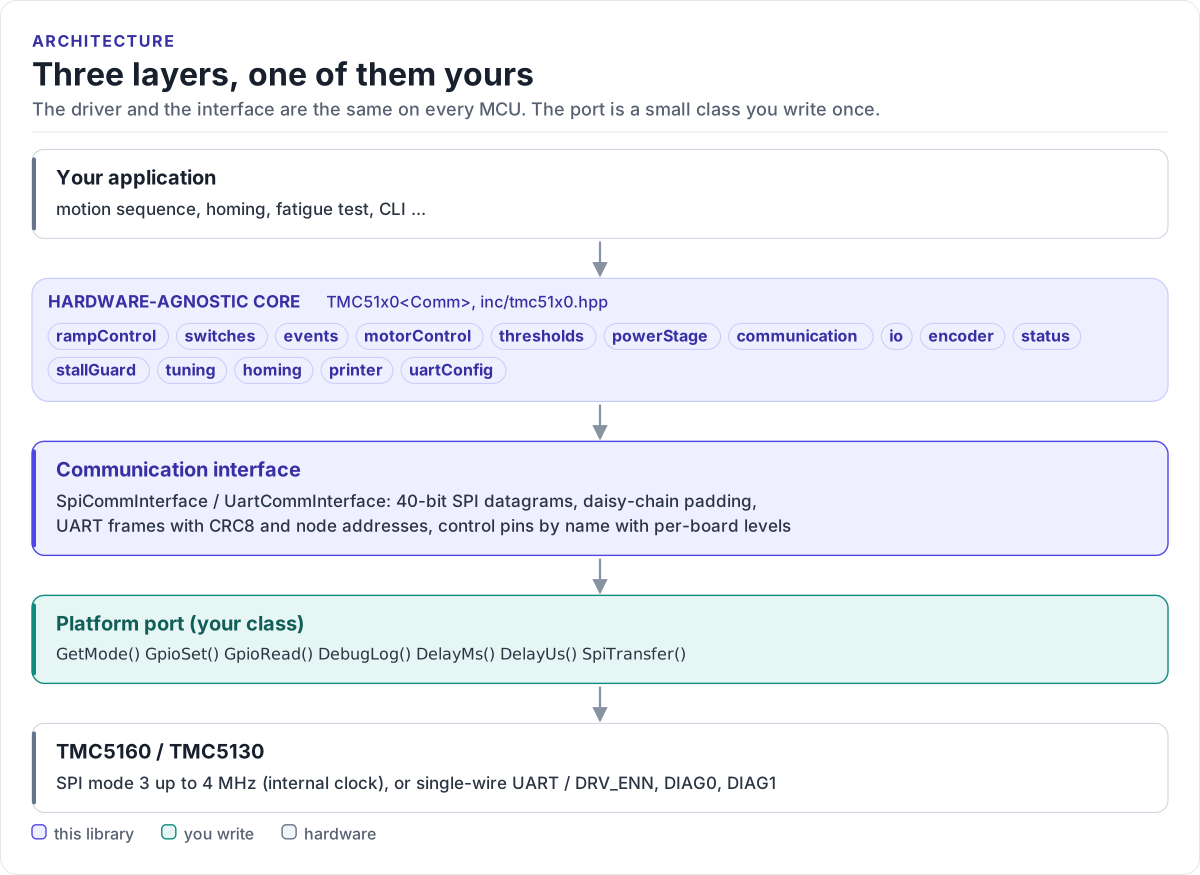
Three layers, one of them yours

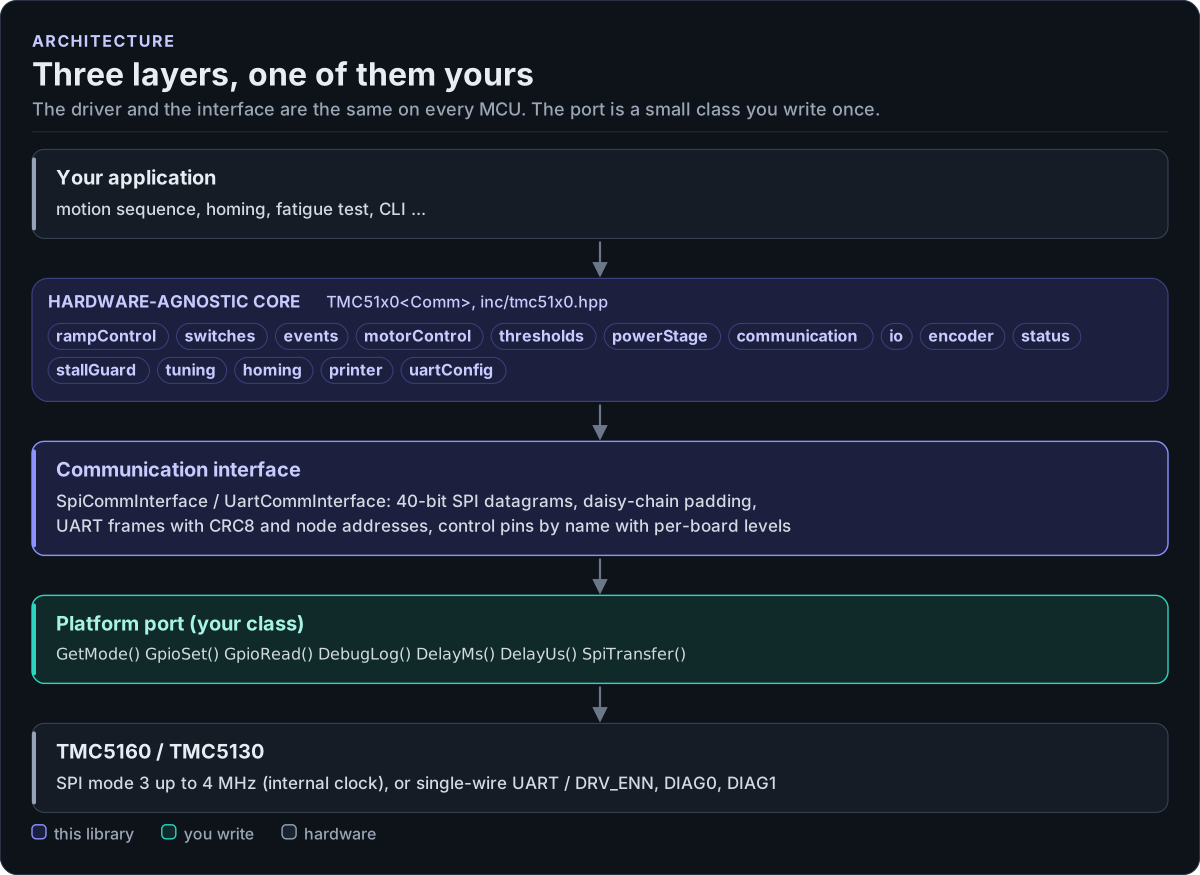
Layer diagram: the application calls the hardware-agnostic TMC51x0 driver and its subsystems, which use the SPI or UART communication interface, which calls the platform port you write, which drives the SPI bus or single-wire UART and the DRV_ENN pin of the TMC5160 or TMC5130.Layer diagram: the application calls the hardware-agnostic TMC51x0 driver and its subsystems, which use the SPI or UART communication interface, which calls the platform port you write, which drives the SPI bus or single-wire UART and the DRV_ENN pin of the TMC5160 or TMC5130.
Three layers, one of them yours
Figure description and sources

From top to bottom. Your application talks to one TMC51x0 object per chip, whose public members are the chip's subsystems (listed from inc/tmc51x0.hpp). Each subsystem turns a call in physical units into register reads and writes. The communication interface (SpiCommInterface or UartCommInterface in inc/tmc51x0_comm_interface.hpp) builds the 40-bit SPI datagrams or CRC-checked UART frames, handles daisy-chain padding and node addresses. The platform port is the only code you write: the methods the interface calls on it, read from the header. Below it is the TMC5160 or TMC5130.

Drawn from: inc/tmc51x0.hpp TMC51x0 members; inc/tmc51x0_comm_interface.hpp SpiCommInterface; figure module docs/diagrams/figures/driver-layers.py.

Figure module: docs/diagrams/figures/driver-layers.py

Drawn from: