Architecture
How the driver is put together: three layers, what each owns, and how one call reaches the sensor.
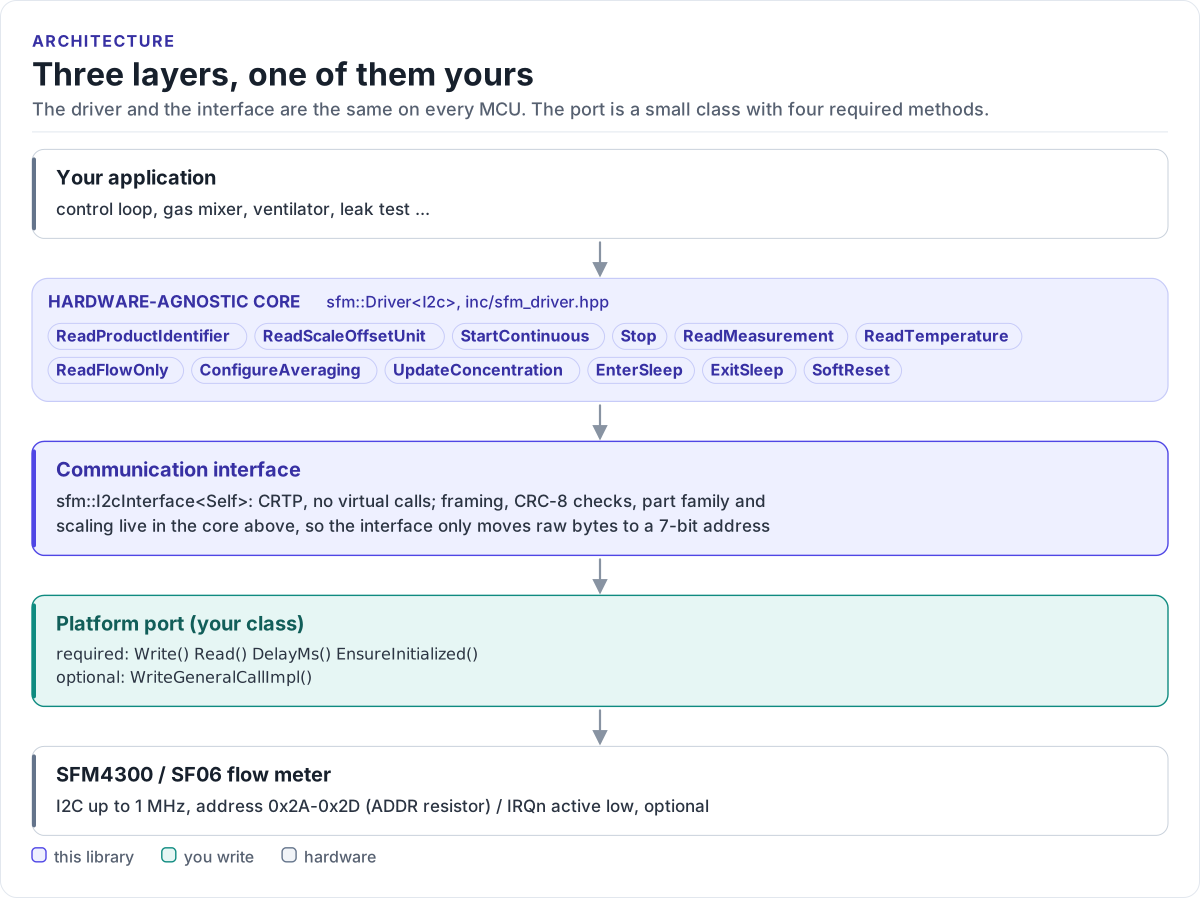
Figure description and sources
From top to bottom. Your application talks to one sfm::Driver
Drawn from: inc/sfm_driver.hpp Driver public commands; inc/sfm_i2c_interface.hpp I2cInterface; figure module docs/diagrams/figures/driver-layers.py.
The three layers
| Layer | Where | Depends on | You change it when |
|---|---|---|---|
Hardware-agnostic core: sfm::Driver<I2cT> |
inc/sfm_driver.hpp, inc/sfm_types.hpp, inc/sfm_commands.hpp |
The interface's methods only | Never, for a new board |
Communication interface: sfm::I2cInterface<Derived> |
inc/sfm_i2c_interface.hpp |
Four methods of your port, one optional | Never |
| Platform port: your class | Your project | Your SDK | Once per MCU or board (Porting) |
Everything above the port is the same on ESP32, STM32, a Linux host or the unit-test fake. That is how the host tests run the real driver code without hardware.
How one call reaches the sensor
sequenceDiagram
    participant A as Application
    participant D as sfm::Driver
    participant P as Your port
    participant S as SFM4300
    A->>D: StartContinuous(Gas::Air)
    D->>D: gas allowed for this variant?
    D->>P: Write(0x2A, 36 61 36 08 CRC)
    P->>S: scaling request for air
    D->>P: Read(0x2A, 9 bytes)
    S-->>P: scale, offset, unit + CRCs
    P-->>D: bytes, CRCs checked
    D->>P: Write(0x2A, 36 08)
    D->>P: DelayMs(12)
    D-->>A: DriverResult<void> ok
    A->>D: ReadMeasurement()
    D->>P: Read(0x2A, 9 bytes)
    P-->>D: flow, temperature, status
    D-->>A: Measurement in slm
What the core keeps
The driver object holds a handful of values between calls, and no buffers:
| State | Set by | Used for |
|---|---|---|
| Address | Constructor, SetAddress() |
Every transfer |
Part family (Sf06 or Sfx6000) |
Constructor, ReadProductIdentifier(), AssumeVariant() |
Which start code means which gas; frame layout; which commands exist |
| Variant | ReadProductIdentifier(), AssumeVariant() |
Which gases are calibrated (SupportsGas()) |
| Scaling of the active gas | StartContinuous() |
Raw counts to slm in every read |
| Active gas, measuring flag | StartContinuous(), Stop(), SoftReset() |
ActiveGas(), Measuring() |
Why CRTP
The interface is a class template parameter, not a virtual base class. The compiler sees your port's methods
directly and inlines them; the driver has no vtable, allocates nothing and needs no RTTI. The optional
WriteGeneralCallImpl() is detected at compile time: a port without it still compiles, and SoftReset() returns
NotSupported. The cost is that the driver type names the port: sfm::Driver<MyI2c>.
Results instead of exceptions
Every command returns sfm::DriverResult<T>: a value and an error (sfm::DriverError). It converts to
bool, so if (!r) is the check. ToString(error) gives a stable name for logs. The
API guide lists what each error means.
Source map
| Path | Contents |
|---|---|
inc/sfm.hpp |
Umbrella header, GetDriverVersion() |
inc/sfm_driver.hpp |
sfm::Driver<I2cT>: commands, framing, decoding |
inc/sfm_i2c_interface.hpp |
sfm::I2cInterface<Derived> |
inc/sfm_types.hpp |
Results, errors, families, gases, variants, readings, status word |
inc/sfm_commands.hpp |
Addresses, command codes, timing, CRC-8 |
tests/ |
Host unit tests and the compiled documentation snippets |
examples/esp32/ |
ESP-IDF applications and the ESP-IDF I2C port |