Architecture
The model the library implements: abstract interfaces above, one implementation per platform below, and the rules every interface follows.
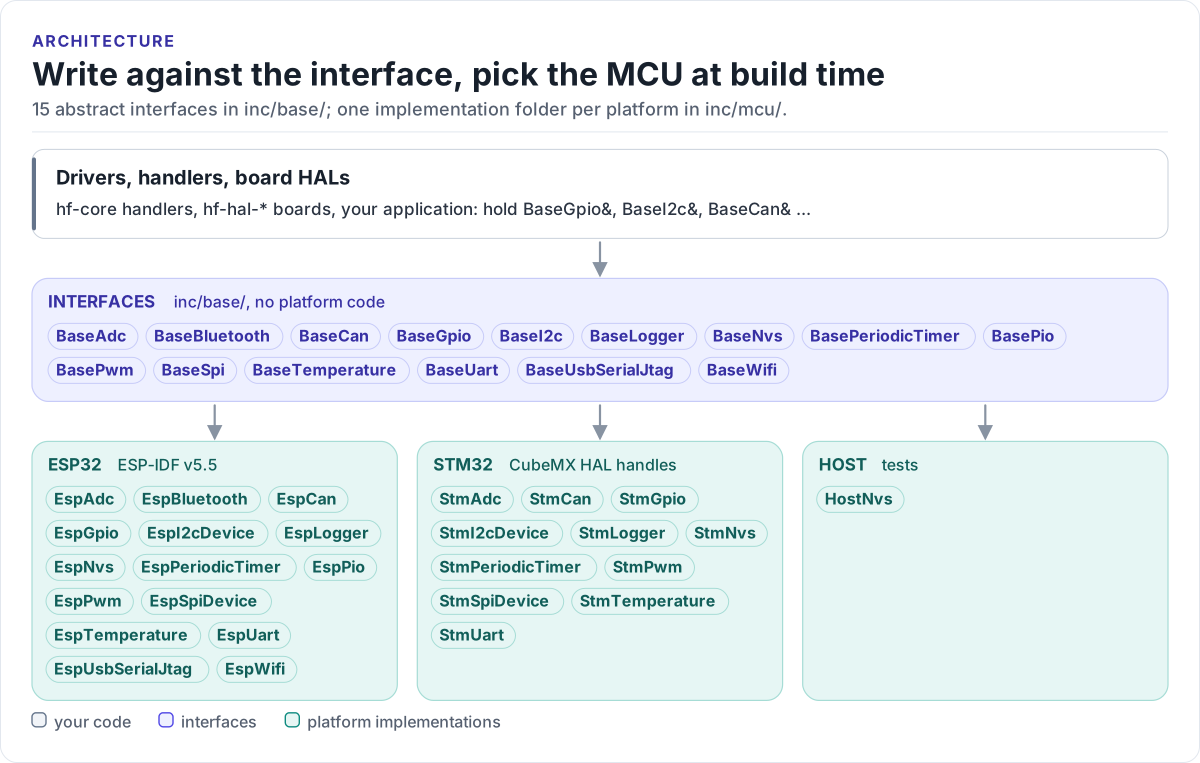
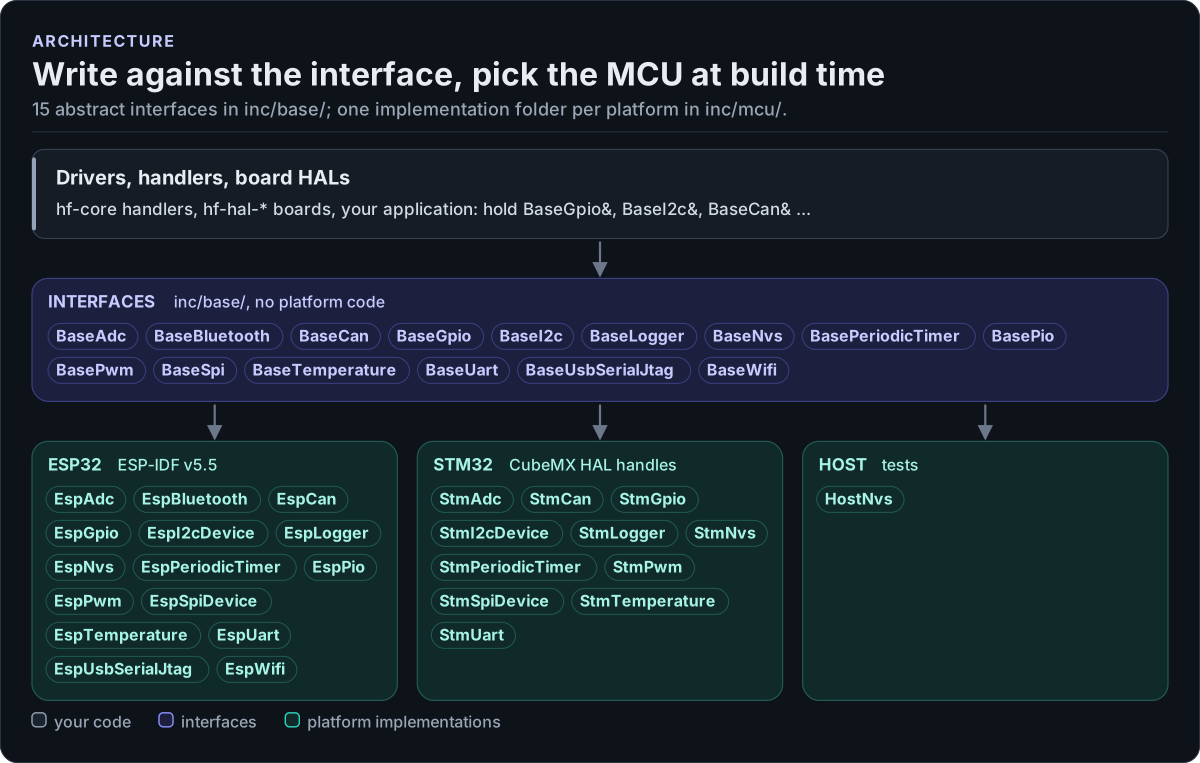
Figure description and sources
From top to bottom. Drivers, handlers and board HALs hold references to the abstract Base* classes (listed from inc/base/). Each platform folder under inc/mcu/ implements them with that platform's SDK: ESP32 classes over ESP-IDF, STM32 classes over STM32Cube HAL handles, and host classes for tests. The application picks one platform at build time; nothing above the interface line changes.
Drawn from: inc/base Base classes; inc/mcu implementations; figure module docs/diagrams/figures/interface-layers.py.
Layers
| Layer | Files | Knows about |
|---|---|---|
| Interfaces | inc/base/: BaseGpio, BaseI2c, BaseCan, ... and HardwareTypes.h |
C++ standard headers only |
| ESP32 implementations | inc/mcu/esp32/, src/mcu/esp32/ |
ESP-IDF v5.5 drivers, FreeRTOS |
| STM32 implementations | inc/mcu/stm32/, src/mcu/stm32/ |
STM32Cube HAL handles |
| Host implementations | inc/mcu/host/ |
C++ standard library |
| Utilities | inc/utils/ |
Interfaces and PlatformMutex |
Code above the interfaces (drivers, hf-core handlers, board HALs) includes
only inc/base/ headers and holds references such as BaseSpi&. The board's start-up code is the one place that
names a platform class.
One call through the layers
sequenceDiagram
    participant H as Handler (hf-core)
    participant B as BaseSpi
    participant E as EspSpiDevice
    participant I as ESP-IDF spi_master
    H->>B: Transfer(tx, rx, 4, 10)
    B->>E: virtual dispatch
    E->>E: lock, check initialised and length
    E->>I: spi_device_transmit()
    I-->>E: esp_err_t
E-->>H: hf_spi_err_t::SPI_SUCCESS (statistics updated)Lifecycle
Every interface follows the same three steps.
- Construct with a configuration. The constructor stores it and touches no hardware, so objects can be globals or members created before the scheduler starts.
- Initialise with
EnsureInitialized()(idempotent) orInitialize(). Operations on an object that was never initialised return the interface's*_ERR_NOT_INITIALIZED. - Use, and optionally
Deinitialize()/EnsureDeinitialized()to release the peripheral.
The interfaces are non-copyable. Platform objects that share a peripheral (several SPI or I2C devices on one bus)
are created by a bus object, EspSpiBus / EspI2cBus, which owns them and returns BaseSpi* / BaseI2c*.
Errors
Each interface has its own enum class of error codes, defined once as an X-macro list
(HF_CAN_ERR_LIST, HF_GPIO_ERR_LIST, ...) that also generates a constexpr to-string function:
| Interface | Error type | To string |
|---|---|---|
BaseGpio |
hf_gpio_err_t |
HfGpioErrToString() |
BaseI2c |
hf_i2c_err_t |
HfI2CErrToString() |
BaseSpi |
hf_spi_err_t |
HfSpiErrToString() |
BaseCan |
hf_can_err_t |
HfCanErrToString() |
BaseAdc |
hf_adc_err_t |
HfAdcErrToString() |
BaseUart |
hf_uart_err_t |
HfUartErrToString() |
BaseNvs |
hf_nvs_err_t |
HfNvsErrToString() |
Code 0 is always success (GPIO_SUCCESS, CAN_SUCCESS, ...). Optional features that a platform does not
have return a "not supported" code (CAN_ERR_UNSUPPORTED_OPERATION, GPIO_ERR_NOT_SUPPORTED, ...)
from the base class default rather than failing to link. No interface throws; every method is noexcept.
Statistics and diagnostics
Most interfaces keep counters in the base class (hf_can_statistics_t, hf_gpio_statistics_t, ...) and expose
them through GetStatistics() / GetDiagnostics(), reset with ResetStatistics() / ResetDiagnostics(). They
are for monitoring; control decisions use the return codes.
Threads
Platform classes guard their state with PlatformMutex (inc/utils/PlatformMutex.h).
The mutex delegates to a backend chosen at compile time:
| Build | Backend | Effect |
|---|---|---|
| This repository alone, host tests | NullMutexBackend |
Every lock compiles to nothing |
| Inside hf-core | PlatformMutexBackend.h from hf-core, found with __has_include |
Real RTOS mutexes |
So a standalone build gives no locking: share an object between tasks only when a backend is configured, or serialise the calls yourself. Callbacks registered with CAN, GPIO interrupts and timers run in interrupt or timer context; keep them short and hand work to a task (for CAN, through the RX ring; see CAN).
MCU selection
inc/utils/McuSelect.h turns one target macro into a family and capability macros.
Under ESP-IDF it is set from CONFIG_IDF_TARGET_*; elsewhere define exactly one HF_TARGET_MCU_* (CMake -D
wins over the file). Selecting none or two is a compile error. The list is in Integration.
Design choices
- Virtual interfaces, not templates. A board passes the same
BaseGpio&to drivers in different libraries without templating them all on the platform. The cost is one indirect call per operation. - No exceptions, no RTTI. The ESP-IDF component builds with
-fno-exceptions -fno-rtti. - Buffers at set-up. The CAN RX ring and TX queue are allocated in
EspCan::Initialize(), never in the interrupt that fills them. - One header per interface. A driver that needs only SPI includes only
BaseSpi.handHardwareTypes.h.
Next: API guide.