Initialisation
Flux::EnsureInitialized() brings every manager up, one at a time, in a fixed order. Call it once, early in
app_main(), before you touch any manager.
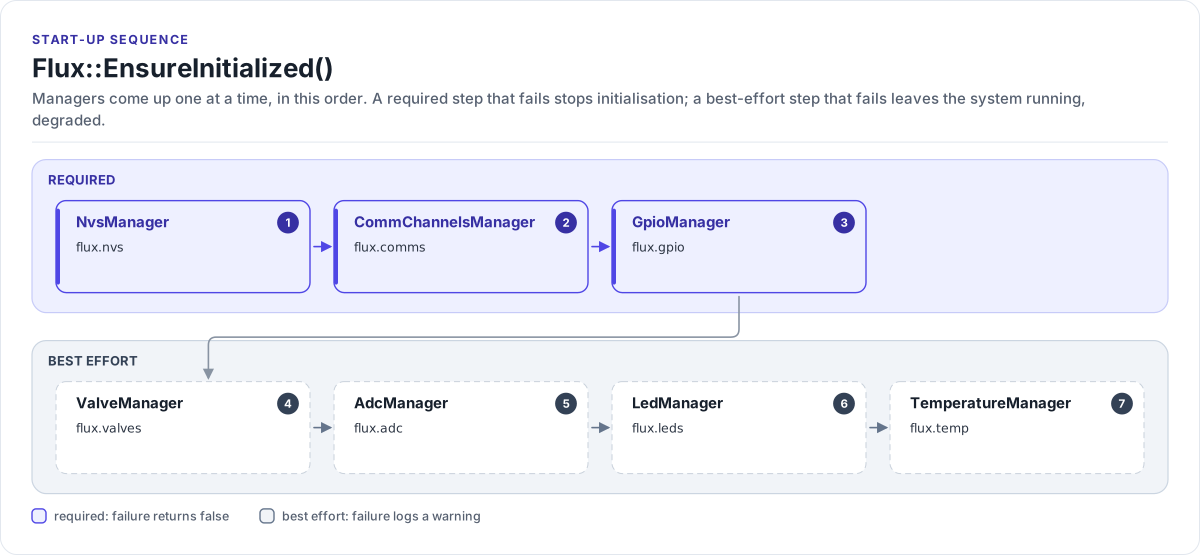
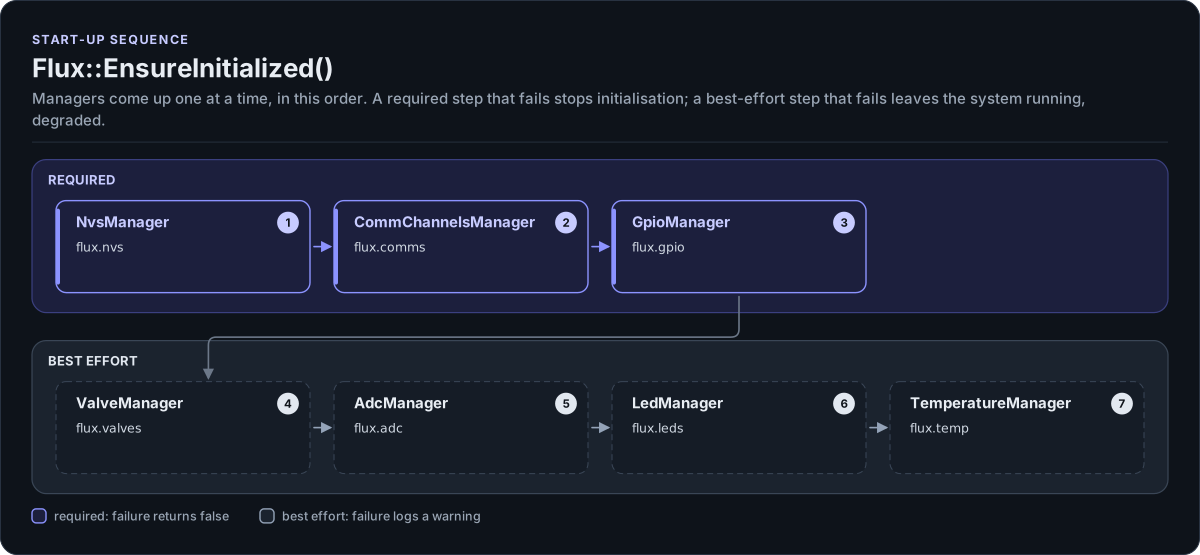
Figure description and sources
Left to right, then the second row. The facade initialises the managers one at a time, in the order of the calls in its init function. The first group is required: if any of them fails, EnsureInitialized() returns false and the application should not continue. The second group is best effort: a failure there is logged as a warning, the manager stays unavailable and the system reports itself as degraded, so a bench with only some chips fitted still comes up. The order and the required / best-effort split are read from the init function, which returns false only in the required branches.
Drawn from: lib/api/Flux.cpp Flux::InitializeAllComponents; figure module docs/diagrams/figures/init-order.py.
The order
From Flux.cpp
(Flux::InitializeAllComponents); do not edit.
| Step | Manager | Member | If it fails |
|---|---|---|---|
| 1 | NvsManager |
flux.nvs |
initialisation fails (EnsureInitialized() returns false) |
| 2 | CommChannelsManager |
flux.comms |
initialisation fails (EnsureInitialized() returns false) |
| 3 | GpioManager |
flux.gpio |
initialisation fails (EnsureInitialized() returns false) |
| 4 | ValveManager |
flux.valves |
warning; the system runs degraded |
| 5 | AdcManager |
flux.adc |
warning; the system runs degraded |
| 6 | LedManager |
flux.leds |
warning; the system runs degraded |
| 7 | TemperatureManager |
flux.temp |
warning; the system runs degraded |
The order follows the dependencies: storage first, so configuration and calibration are available early; then the
buses; then the GPIO pins the valve drivers need; then the managers that use them. TemperatureManager comes after
AdcManager because the NTC and MCP9700 sensors are read through ADC channels.
What happens when a step fails
- Required steps (NVS, comms, GPIO). If one fails,
EnsureInitialized()logs the failure, stops and returnsfalse.IsInitialized()staysfalse, and callingEnsureInitialized()again retries from the start. - Best-effort steps (valves, ADC, LEDs, temperature). A failure is logged as a
WARNrow in the start-up table and the manager stays unavailable; the remaining steps still run andEnsureInitialized()returnstrue. Checkflux.valves.IsInitialized()(or the diagnostics) before relying on a best-effort manager.
This lets a bench with only some chips fitted, or with the 24 V valve supply off, still come up and log.
Inside every manager the rule is the opposite: a manager fails closed (ADR 0005).
Its EnsureInitialized() succeeds only when every part it is responsible for came up; otherwise it stays
uninitialised, refuses its operations and records the reason in GetManagerError().
| Manager | Must all come up |
|---|---|
NvsManager |
The flux, flux_cal and flux_cfg namespaces |
CommChannelsManager |
The valve SPI bus and both valve chip selects (the pressure bus and CAN are reported, not required) |
GpioManager |
Every GPIO-category pin of the pin map |
ValveManager |
Both driver ICs: TLE92466ED and MAX22200 |
AdcManager |
The MCU ADC (if the pin map uses it) and every ADS7952 in the pin map |
LedManager |
The WS2812 strip |
TemperatureManager |
At least one sensor; runs degraded (initialised, error recorded, IsDegraded()) when one of the die sensor, NTC and MCP9700 is missing |
Each manager still tries every part, so the log and Flux::CollectDiagnostics() name every missing one, and part
readiness stays queryable after a failure (valves.IsBankReady(), adc.IsAds7952Ready(),
temp.IsSensorReady(), comms.IsPressureBusReady()). A valve bank that came up while the other did not is
reachable through its handler accessor for diagnosis, never through the channel calls.
Calling a manager directly
Every manager also has its own EnsureInitialized(), and the managers that depend on others call those first (for
example ValveManager calls CommChannelsManager and GpioManager). So code that uses one manager on its own
works, but going through Flux::EnsureInitialized() gives you the logged start-up table and the system diagnostics.
Start-up log
A healthy start prints one row per step, with its time:
  1  NVS             OK      ...
  2  Comms           OK      ...
  3  GPIO            OK      ...
  4  Valves          OK      ...
  5  ADC             OK      ...
  6  LEDs            OK      ...
  7  Temp            OK      ...
Flux API initialized in ... ms
FAIL marks a required step that failed, WARN a best-effort step that failed.
Shutting down
Flux::Shutdown() de-initialises the managers in reverse order (temperature, LEDs, ADC, valves, GPIO, comms, NVS).
ValveManager::Deinitialize() turns every channel off before it releases the driver handlers. A failed manager can
be retried: its EnsureInitialized() releases whatever the failed attempt left up and starts again.