HardFOC core library
HardFOC Core Drivers
Every HardFOC device driver and the platform layer they run on, collected as git submodules at pinned commits. One repository to add to a project; each driver keeps its own repository, tests and documentation site.
A product needs a dozen drivers that must agree on one platform interface and move together.
hf-core-drivers pins a set of driver commits that build together, plus the two platform repositories they share:
the MCU interface layer and the board pin maps. hf-core consumes it and
compiles only the drivers a board turns on.
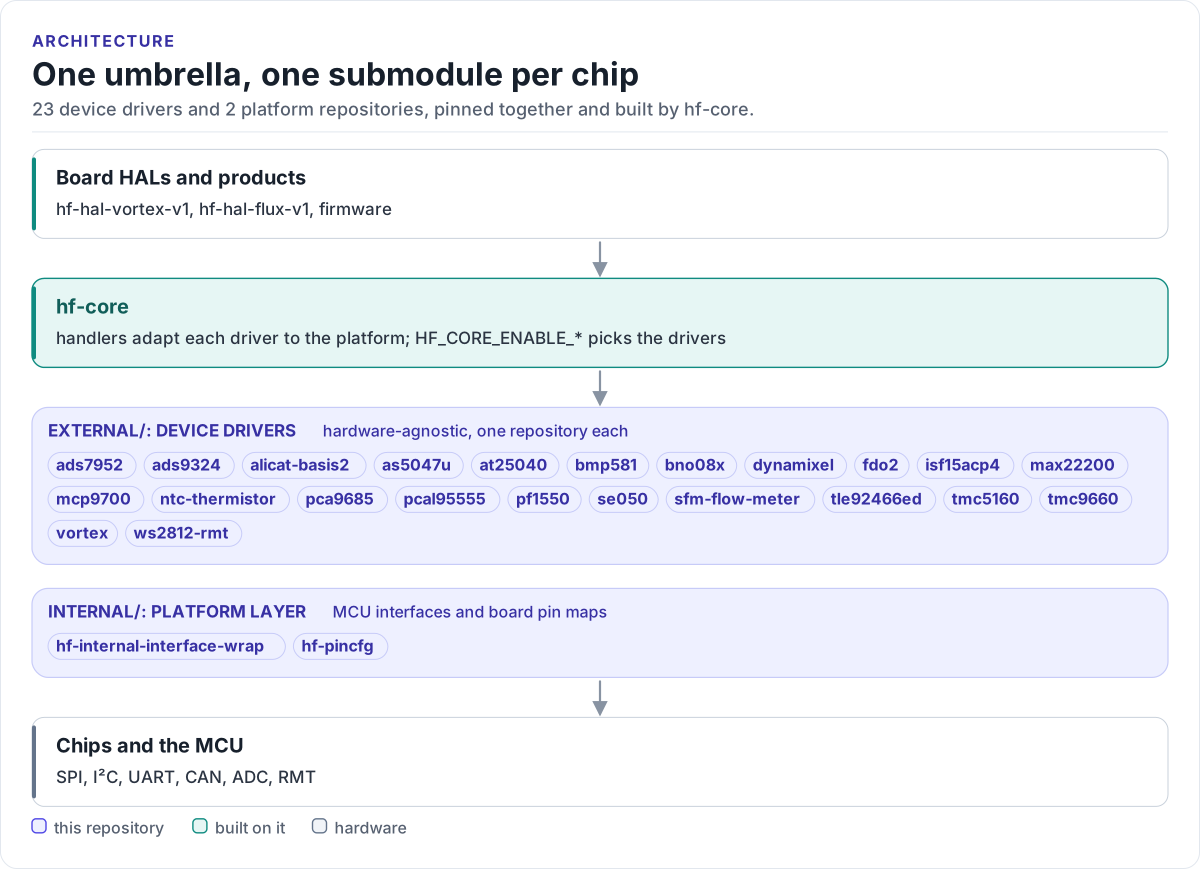
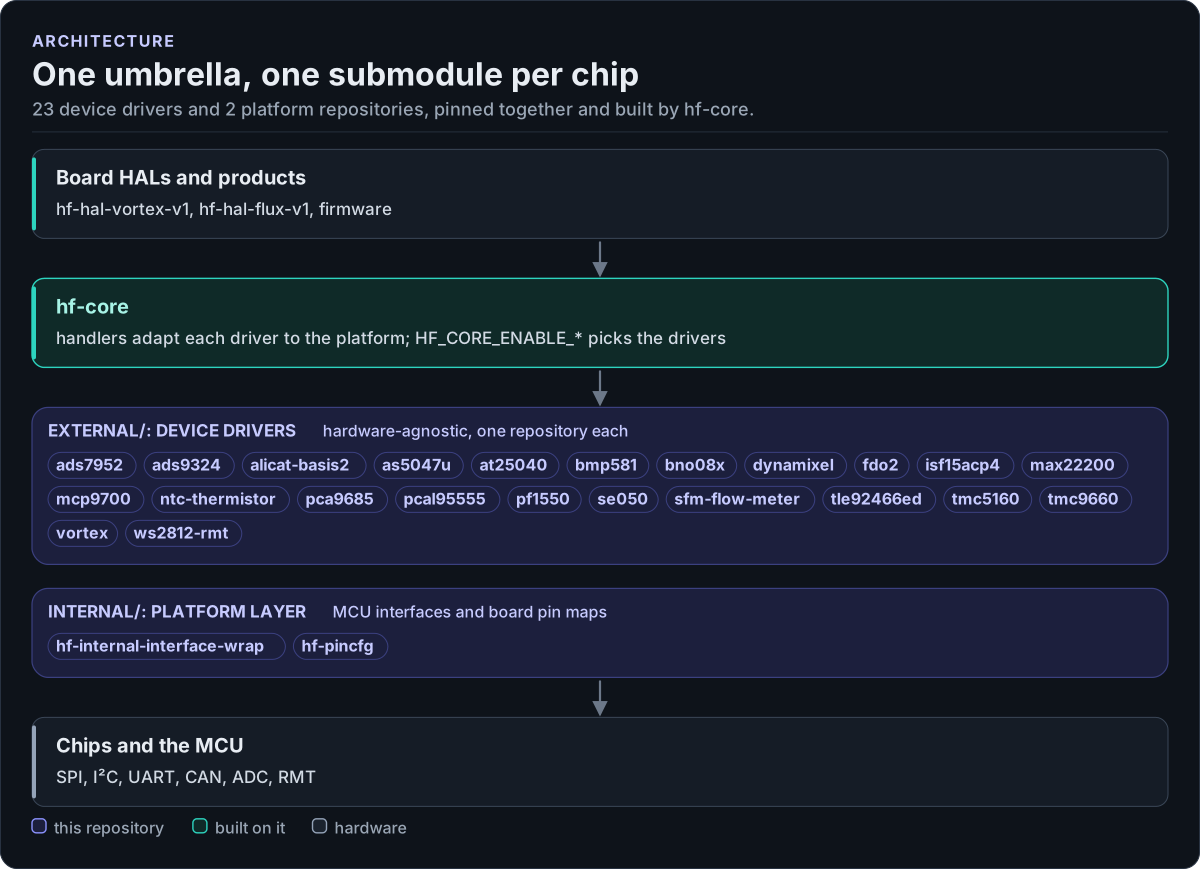
Figure description and sources
From top to bottom. Board HALs and products build on hf-core, whose handlers adapt each driver to the platform. hf-core-drivers holds the device drivers under external/ (one per repository, names read from .gitmodules) and the platform layer under internal/. The drivers talk to the chips through interfaces that the platform layer implements for the MCU.
Drawn from: .gitmodules submodule paths; figure module docs/diagrams/figures/umbrella.py.
What you get
- One submodule per chip. Motor controllers, solenoid drivers, encoders, IMUs, ADCs, sensors, expanders, PMIC, EEPROM and secure element. See the driver catalogue.
- A platform layer.
internal/hf-internal-interface-wrap(MCU peripheral interfaces) andinternal/hf-pincfg(board pin maps). See Platform layer. - Drivers with no platform code. Each driver talks to a small interface class; the board provides it. See How a driver is built.
- Pinned, reviewed versions. A submodule bump is a pull request here. See Updating submodules.
- One coding standard. Naming, errors, memory and documentation rules shared by every driver. See Coding standards.
Where to go next
-
A card per chip with its bus and documentation site.
-
Add the umbrella, turn drivers on in hf-core.
-
The interface layer and pin maps every driver builds on.
-
Bump a driver, check it, open the pull request.