Porting
Run the driver on a new MCU by writing one class: the communication interface for your bus.
The driver never calls your SDK directly. It calls nine methods on a class you derive from
bno08x::CommInterface<Self> (in inc/bno08x_comm_interface.hpp). The base
class uses CRTP: the calls are resolved at compile time, so there are no virtual functions and no vtable.
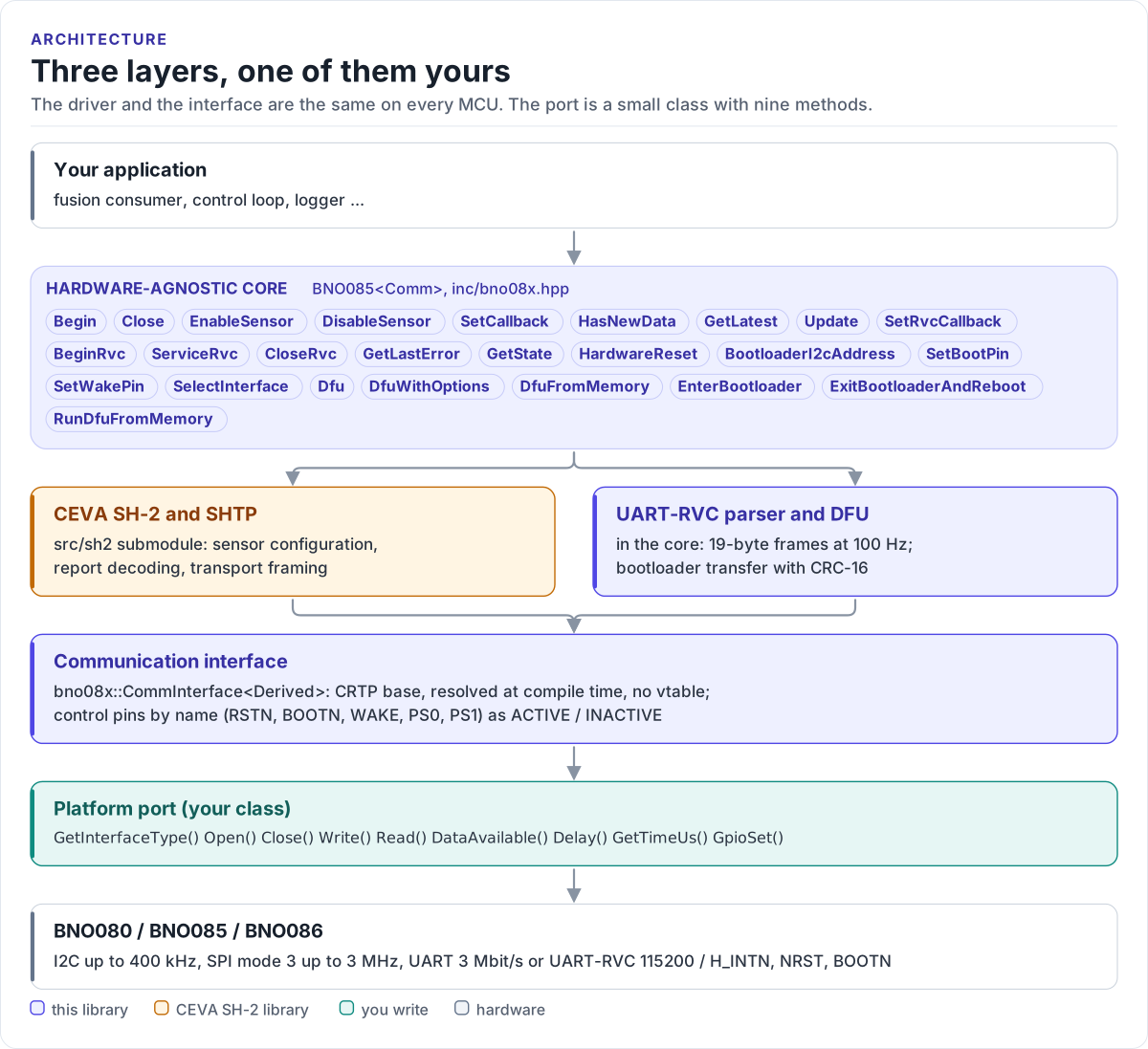
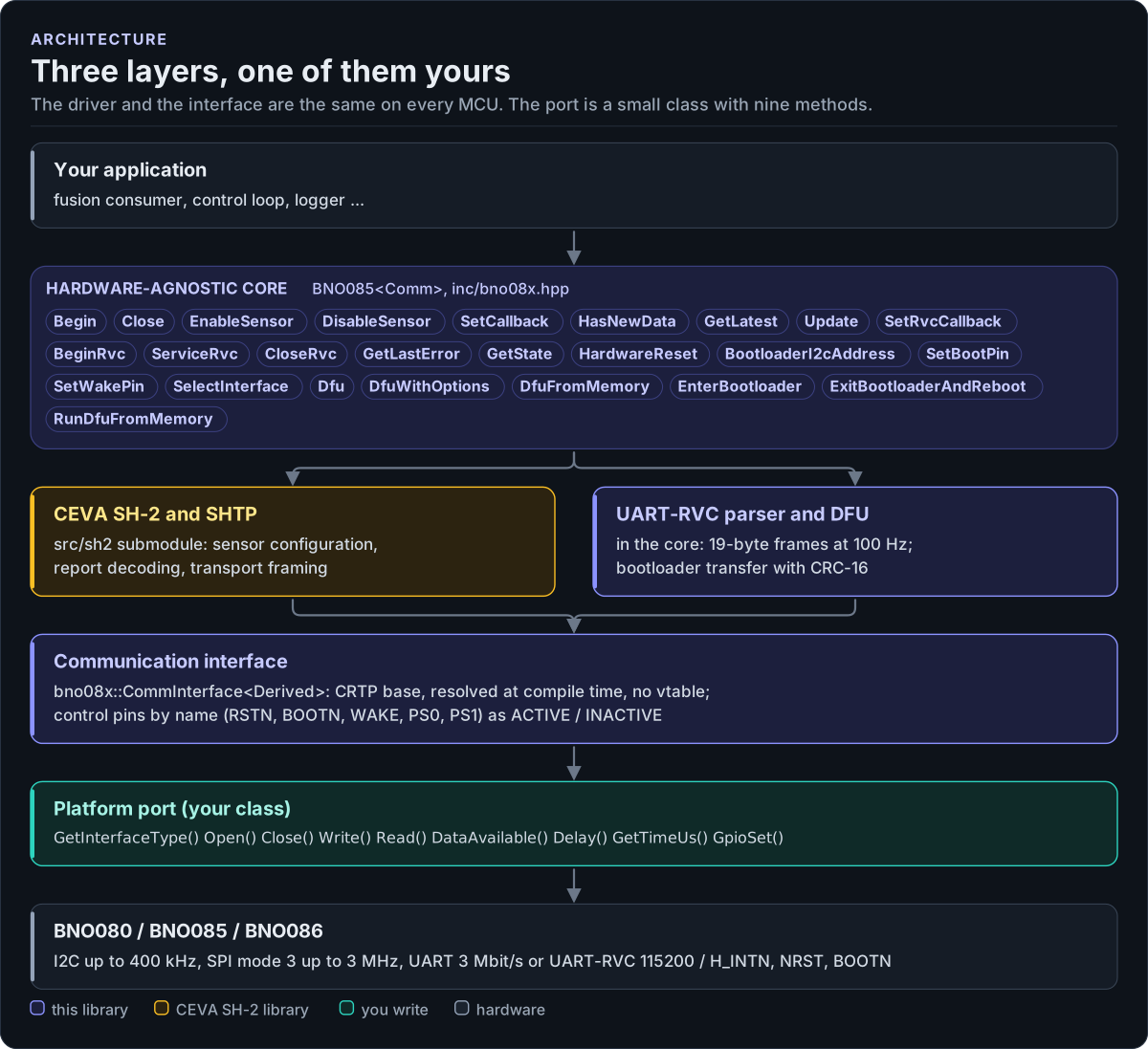
Figure description and sources
From top to bottom. Your application talks to one BNO085
Drawn from: inc/bno08x.hpp BNO085 public members; inc/bno08x_comm_interface.hpp CommInterface; figure module docs/diagrams/figures/driver-layers.py.
What you implement
| Method | Called by | Contract |
|---|---|---|
GetInterfaceType() |
Begin(), BeginRvc(), the DFU calls |
Return I2C, SPI, UART or UARTRVC; it decides which calls are allowed |
Open() |
Begin(), BeginRvc(), the bootloader helpers, DFU |
Initialise the bus and pins. May be called again while open: return true without re-initialising |
Close() |
Close(), CloseRvc(), the end of a DFU transfer |
Release the bus |
Write(data, length) |
SH-2 library, DFU | Send one SHTP transfer (or DFU packet). Return the bytes accepted, 0 if the bus is busy, negative on error |
Read(data, length) |
SH-2 library, RVC parser, DFU | SH-2: return one complete SHTP transfer, header included, or 0 when there is none. RVC: return whatever bytes have arrived, without blocking |
DataAvailable() |
your port, usually inside Read() |
true when H_INTN is low; true always when there is no interrupt line |
Delay(ms) |
reset and bootloader sequences | Block for at least ms milliseconds |
GetTimeUs() |
SH-2 timestamps and timeouts, RVC timestamps | A monotonic 32-bit microsecond counter; wrapping is fine |
GpioSet(pin, signal) |
HardwareReset(), SetBootPin(), SetWakePin(), SelectInterface(), the bootloader helpers |
Drive RSTN, BOOTN, WAKE, PS0, PS1; ignore pins the board does not wire. Return true, or false on a GPIO error |
GpioSetActive(pin) and GpioSetInactive(pin) come with the base class.
GPIO errors
Return false from GpioSet() when your SDK reports a GPIO failure; a pin the board does not wire is not a
failure, so return true for it. The driver passes the status on: HardwareReset(), SetBootPin(),
SetWakePin() and SelectInterface() return false, and EnterBootloader() / ExitBootloaderAndReboot() fail
with SH2_ERR_IO and close the port again. HardwareReset() stops at the failing pin, so it does not wait out a
reset that never happened.
Return a bool, not your SDK's status code: the driver rejects any other return type at compile time, so an
esp_err_t (where 0 is success) cannot be read as true. A port written for the earlier contract, with a void
GpioSet(), still compiles; the driver treats it as never failing. Close() and Delay() stay void: the
driver has nothing to recover when either goes wrong, so log it in the port.
I2C port
class MyI2c : public bno08x::CommInterface<MyI2c> {
public:
  static constexpr int kIntnGpio = 17;      // H_INTN, active low
  static constexpr int kRstnGpio = 16;      // NRST, active low
  static constexpr int kBootnGpio = 18;     // BOOTN, active low (optional, for firmware updates)

  BNO085Interface GetInterfaceType() noexcept {
    return BNO085Interface::I2C;
  }

  // Called by Begin() and the bootloader helpers, possibly more than once: initialise once.
  bool Open() noexcept {
    if (!open_) {
      open_ = platform_i2c_open(400000); // standard 100 kHz or fast 400 kHz
    }
    return open_;
  }

  void Close() noexcept {
    platform_i2c_close();
    open_ = false;
  }

  // One SHTP transfer from the SH-2 library. Return the bytes accepted, or a negative value.
  int Write(const uint8_t* data, uint32_t length) noexcept {
    return platform_i2c_write(address_, data, length) ? static_cast<int>(length) : -1;
  }

  // Return one complete SHTP transfer (header included), 0 when the hub has nothing to send.
  int Read(uint8_t* data, uint32_t length) noexcept {
    if (!DataAvailable()) {
      return 0;
    }
    uint8_t header[4];
    if (!platform_i2c_read(address_, header, sizeof(header))) {
      return -1;
    }
    uint32_t transfer = (header[0] | (header[1] << 8)) & 0x7FFFU; // bit 15: continuation flag
    if (transfer == 0) {
      return 0; // empty transfer
    }
    if (transfer > length) {
      transfer = length;
    }
    // A new read starts again at the header, so read the whole transfer.
    return platform_i2c_read(address_, data, transfer) ? static_cast<int>(transfer) : -1;
  }

  // H_INTN low: the hub has a transfer waiting.
  bool DataAvailable() noexcept {
    return !platform_gpio_read(kIntnGpio);
  }

  void Delay(uint32_t ms) noexcept {
    platform_delay_ms(ms);
  }
  uint32_t GetTimeUs() noexcept {
    return platform_micros();
  }

  // ACTIVE means "function asserted": low on NRST and BOOTN. PS0/PS1 are strapped to GND for I2C.
  // Return false on a GPIO error; a pin the board does not wire is not an error.
  bool GpioSet(bno08x::CtrlPin pin, bno08x::GpioSignal signal) noexcept {
    const bool active = signal == bno08x::GpioSignal::ACTIVE;
    switch (pin) {
    case bno08x::CtrlPin::RSTN:
      return platform_gpio_write(kRstnGpio, !active);
    case bno08x::CtrlPin::BOOTN:
      return platform_gpio_write(kBootnGpio, !active);
    case bno08x::CtrlPin::WAKE:
    case bno08x::CtrlPin::PS0:
    case bno08x::CtrlPin::PS1:
      break; // not wired on this board
    }
    return true;
  }

  // Optional, for firmware updates: the driver moves the port to the bootloader address (0x28 /
  // 0x29) for the transfer and back to the application address afterwards.
  uint8_t GetI2cAddress() noexcept {
    return address_;
  }
  bool SetI2cAddress(uint8_t addr7) noexcept {
    address_ = addr7;
    return true;
  }

private:
  bool open_ = false;
  uint8_t address_ = 0x4A; // SA0 low; 0x4B with SA0 high
};
Rules the transfer must follow:
- Plain transactions. One START ... STOP per call, no register address, no repeated start.
- Read the length, then the transfer. Bits 0 to 14 of the 4-byte SHTP header are the transfer length, header included; bit 15 marks a continuation. On I2C every read starts at the header again, so read 4 bytes, then the whole length. A zero length is an empty transfer (BNO086 sends them when it has nothing): return 0.
- Gate on H_INTN. Reading when the hub has nothing makes a BNO085 stretch the clock until it does.
- Return a negative value only for a bus failure. The SH-2 library handles protocol errors.
- Address hooks for firmware updates.
GetI2cAddress()returns the 7-bit address the port talks to andSetI2cAddress(addr)changes it, also while the bus is open. They are optional (detected at compile time); with them the DFU calls reach the bootloader at0x28/0x29and restore your address afterwards.
UART-RVC port
class MyRvcUart : public bno08x::CommInterface<MyRvcUart> {
public:
  static constexpr int kRstnGpio = 16; // NRST, active low (optional)

  BNO085Interface GetInterfaceType() noexcept {
    return BNO085Interface::UARTRVC;
  }

  bool Open() noexcept {
    return platform_uart_open(115200);
  }
  void Close() noexcept {
    platform_uart_close();
  }

  // RVC is transmit-only on the sensor side: the driver never writes.
  int Write(const uint8_t* /*data*/, uint32_t /*length*/) noexcept {
    return 0;
  }

  // Non-blocking: whatever the UART has received, up to length bytes. ServiceRvc() calls it until
  // it returns 0.
  int Read(uint8_t* data, uint32_t length) noexcept {
    return platform_uart_read(data, length);
  }

  // No interrupt line in RVC mode.
  bool DataAvailable() noexcept {
    return true;
  }

  void Delay(uint32_t ms) noexcept {
    platform_delay_ms(ms);
  }
  uint32_t GetTimeUs() noexcept {
    return platform_micros();
  }

  bool GpioSet(bno08x::CtrlPin pin, bno08x::GpioSignal signal) noexcept {
    if (pin == bno08x::CtrlPin::RSTN) {
      return platform_gpio_write(kRstnGpio, signal != bno08x::GpioSignal::ACTIVE);
    }
    return true; // only NRST is wired
  }
};
ServiceRvc() calls Read(&byte, 1) until it returns 0, so Read() must not block. Give the UART a receive
buffer of a few frames (19 bytes each, one every 10 ms) so nothing is lost between calls.
SPI and UART-SHTP ports
Report SPI or UART from GetInterfaceType() and keep the Read() contract (one complete SHTP transfer, or
0). Reference ports for ESP-IDF: esp32_bno08x_spi_bus.hpp
and esp32_bno08x_uart_bus.hpp, run by the spi_polling and
uart_shtp_polling examples. Both implement SH-2 only: the bootloader talks its own byte protocol
on these buses (no SHTP framing), which the reference ports do not switch to, so run firmware updates over I2C
with them.
- Mode 3 (CPOL = 1, CPHA = 1), MSB first, at most 3 MHz (datasheet sections 1.2.4.2 and 6.5.2).
- PS0/WAKE on a GPIO, high with PS1 from before reset until the first H_INTN (that selects SPI), then the
active-low wake.
GpioSet()mapsCtrlPin::PS0(active high) andCtrlPin::WAKE(active low) to that pin. Read(): when H_INTN is low, assert CS, clock the 4-byte header, then the rest of the transfer in the same CS assertion; a transfer longer than the buffer is finished later as a continuation (section 1.3.1).Write(): drive WAKE low, wait for H_INTN (about 150 µs, figure 6-12), then one full-duplex transfer. The hub may send at the same time; keep those bytes and return them from the nextRead(). Return 0 while such bytes are unread: the SH-2 library then reads and retries.
- 3 Mbit/s, 8N1, with the BNO08x external 32.768 kHz clock or crystal (section 1.2.3).
- Every transfer is framed: flag
0x7E, protocol ID (0x01SHTP,0x00control), the payload with0x7Eand0x7Dsent as0x7D, byte ^ 0x20, flag0x7E. Before each frame send the Buffer Status Query7E 00 7Eand wait until the hub reports enough free space (a control frame with a 16-bit little-endian count). Send host bytes at least 100 µs apart (section 1.2.3.1). bno08x_shtp_uart.hppdoes the framing without platform code:EncodeFrame()for writes andFrameDecoderfor every received byte. Return 0 fromWrite()while you wait for the buffer status; the SH-2 library keeps callingRead()meanwhile.
Control-pin levels
GpioSignal::ACTIVE means "function asserted". On the BNO08x that is a low level for NRST, BOOTN and WAKE, and a
high level (logic 1) for PS0 and PS1. Your GpioSet() applies the board's levels; inverters or level shifters
change them.
| Pin | ACTIVE level on the chip | Board without the pin |
|---|---|---|
RSTN |
low | Tie NRST to the board reset; HardwareReset() then only waits |
BOOTN |
low | Pull up through 10 kΩ; no firmware updates |
WAKE |
low | Not needed on I2C or UART |
PS0, PS1 |
high | Strap them (Hardware) |
Reference implementation
The ESP32 examples use esp32_bno08x_bus.hpp, an ESP-IDF
i2c_master port with H_INTN, NRST and the I2C address hooks,
esp32_bno08x_spi_bus.hpp for SPI,
esp32_bno08x_uart_bus.hpp for UART-SHTP and
esp32_uart_rvc_bus.hpp for UART-RVC. Start from them for an
ESP-IDF target. The I2C reference reads the whole 1024-byte buffer on every
Read(); the header-first read on this page moves far fewer bytes.
Check your port
- Build it: both ports on this page are compiled by the host CI from
tests/docs/, with the driver instantiated over them. - Watch H_INTN after
HardwareReset(): it goes low about 94 ms after NRST rises when the strapping is right. Begin()returnstrue: the SH-2 library received the hub's reset message and a reply to a command.- Enable
RotationVectorat 10 ms and count reports for a second: about 100 means reads keep up.
Threads
The driver is not thread-safe, and the CEVA SH-2 library keeps one global session: a second object's Begin()
fails with BNO08X_ERR_SH2_SESSION_IN_USE while one is open. Give the sensor one owner task that calls
Update(), or guard every call on the driver object (and its port) with one mutex.