Skip to content

Figures

Every figure on this site is drawn by a Python module from facts extracted from the code, so it is rebuilt, not redrawn, when the code changes. CI runs hardfoc-docs figures --check and fails when a committed figure no longer matches the code. Each figure below lists the files it is drawn from.

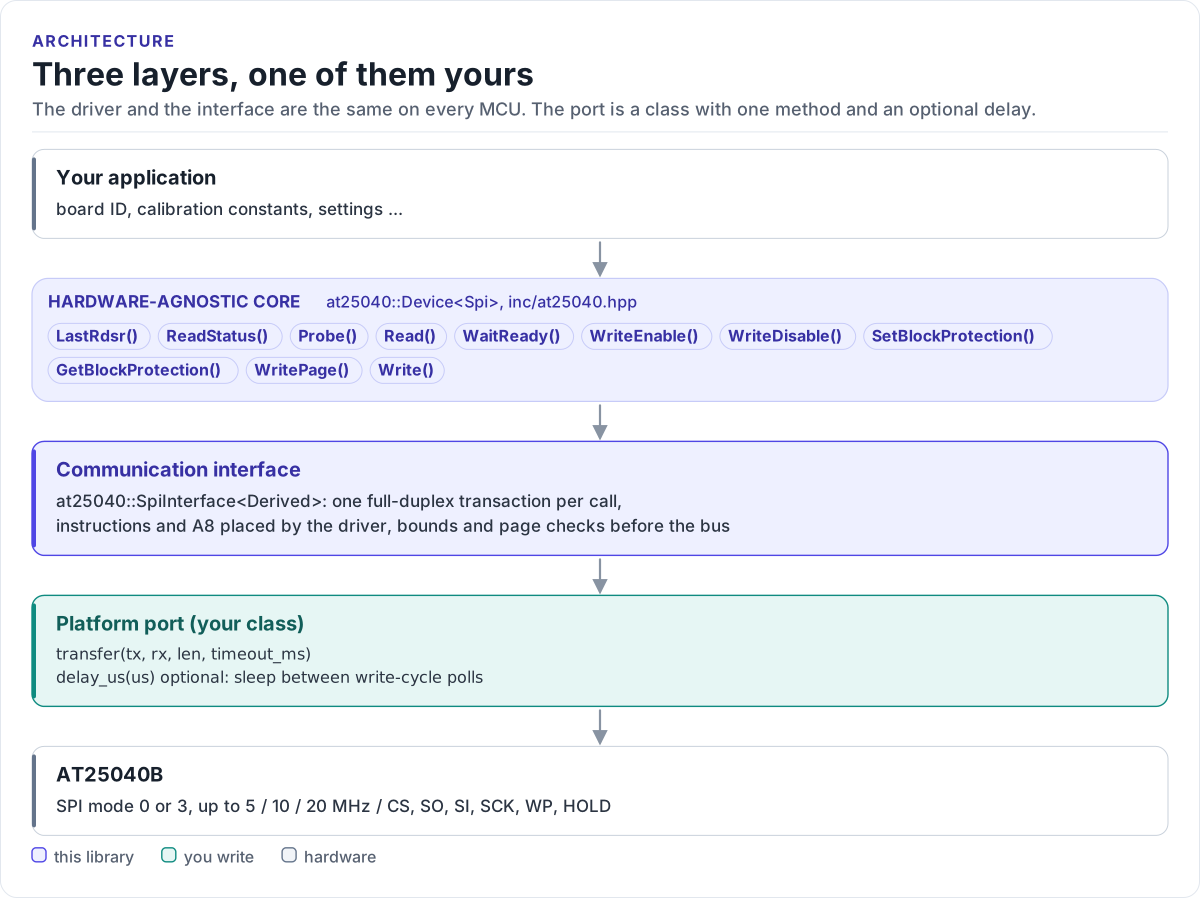
Three layers, one of them yours

Layer diagram: the application calls the hardware-agnostic AT25040 Device and its member functions, which use the CRTP SPI interface, which calls the one transfer method of the platform port you write, which drives the SPI bus and chip select of the AT25040B.Layer diagram: the application calls the hardware-agnostic AT25040 Device and its member functions, which use the CRTP SPI interface, which calls the one transfer method of the platform port you write, which drives the SPI bus and chip select of the AT25040B.
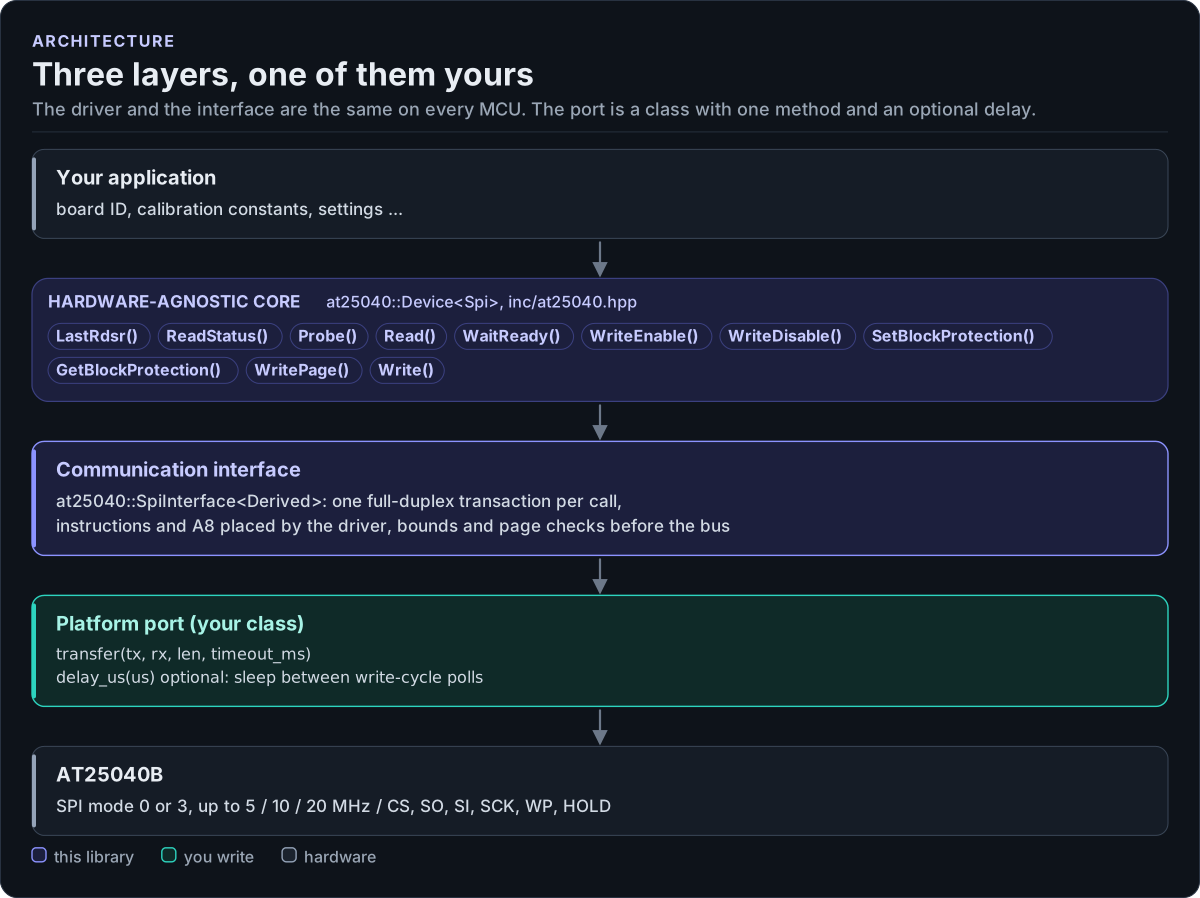
Three layers, one of them yours
Figure description and sources

From top to bottom. Your application talks to one at25040::Device object, whose public member functions (listed from inc/at25040.hpp) turn a call into AT25040 instructions: RDSR, WREN, READ and WRITE with A8 in the opcode. The communication interface (at25040::SpiInterface in inc/at25040_spi_interface.hpp) is a CRTP contract with one method. The platform port is the only code you write: a class whose transfer() runs one SPI transaction with chip select held low, and optionally delay_us() for the write-cycle wait. Below it is the hardware.

Drawn from: inc/at25040.hpp Device members; inc/at25040_spi_interface.hpp SpiInterface; figure module docs/diagrams/figures/driver-layers.py.

Figure module: docs/diagrams/figures/driver-layers.py

Drawn from: