Architecture
How the driver is put together: three layers, what each owns, and how one call reaches the chip.
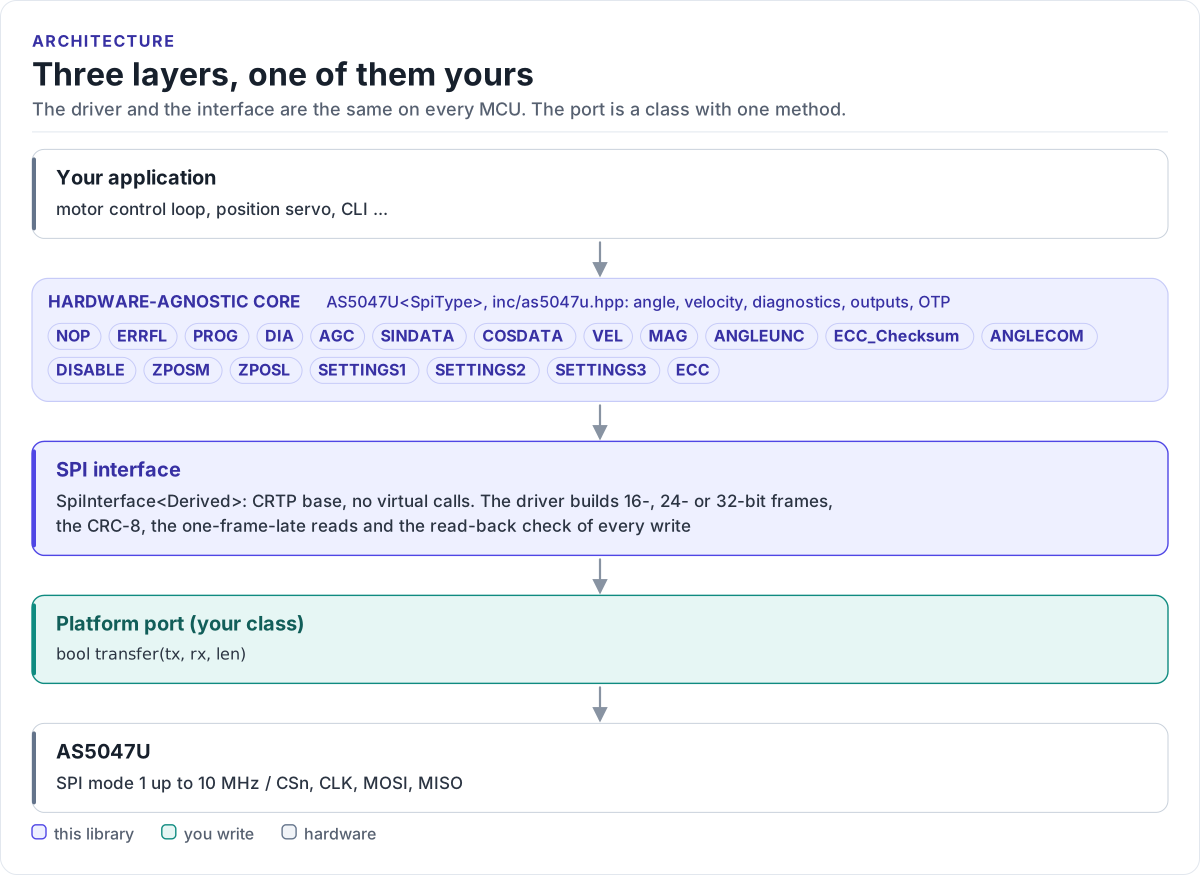
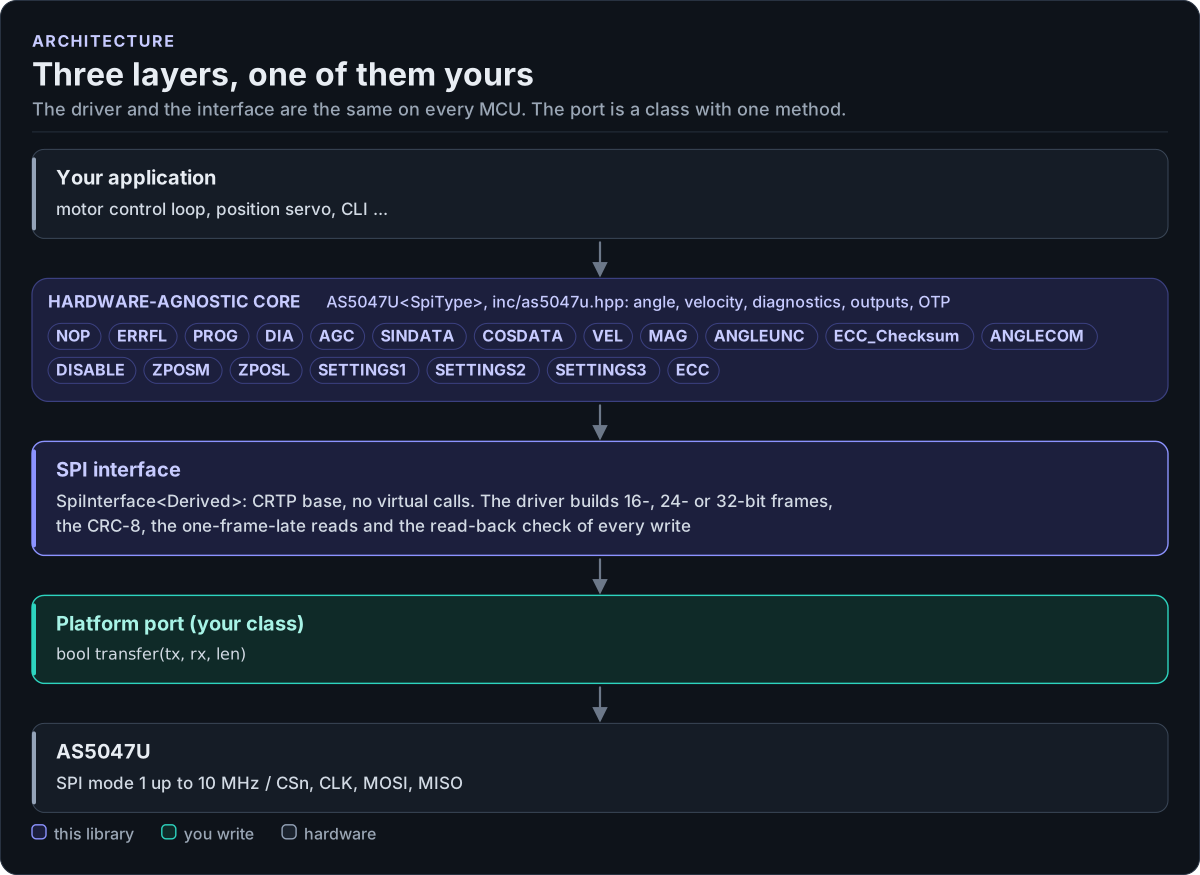
Figure description and sources
From top to bottom. Your application talks to one AS5047U
Drawn from: inc/as5047u_registers.hpp register structs; inc/as5047u_spi_interface.hpp SpiInterface; figure module docs/diagrams/figures/driver-layers.py.
The three layers
| Layer | Where | You change it |
|---|---|---|
Core: AS5047U<SpiType>, typed registers |
inc/as5047u.hpp and the headers beside it |
Never, for a new board |
SPI interface: SpiInterface<> |
as5047u_spi_interface.hpp |
Never |
| Platform port: your class | Your project | Once per MCU or board (Porting) |
The core depends only on the port's transfer(). Everything above the port is the same on ESP32, STM32, a Linux host or the unit-test model of the chip. That is
how the host tests run the real driver code without hardware.
How one call reaches the chip
sequenceDiagram
    participant A as Application
    participant D as AS5047U driver
    participant P as Your port
    participant C as AS5047U
    A->>D: SetDirection(false)
    D->>P: transfer(read SETTINGS2), transfer(NOP)
    P->>C: two frames
    D->>P: transfer(read ERRFL), transfer(NOP)
    Note over D: ERRFL into the sticky flags
    D->>D: set DIR = 1 in the SETTINGS2 struct
    D->>P: transfer(write command), transfer(data), transfer(NOP)
    P->>C: three frames
    C-->>D: new SETTINGS2 content on the last frame
    D-->>A: true if it matches what was written
Each setter is a read-modify-write of one register, so it leaves the other fields of that register as they were.
If a transfer() returns false, or a reply the driver uses has a wrong CRC, the call stops at that frame and
returns false; when that happens during the read, nothing is written.
Why CRTP
The interface is a class template parameter, not a virtual base class. The compiler sees your port's
transfer() directly and can inline it; the driver has no vtable, allocates nothing and needs no RTTI. The
cost is that the driver type names the port: AS5047U<MySpi>. Code that has to work with several port types
takes the driver as a template parameter too.
Names and namespaces
| Name | Kind | Where |
|---|---|---|
as5047u::AS5047U<SpiType> |
The driver | inc/as5047u.hpp |
as5047u::SpiInterface<Derived> |
The port's base class | inc/as5047u_spi_interface.hpp |
as5047u::AngleUnit, as5047u::VelocityUnit |
Units for GetAngle() and GetVelocity() |
inc/as5047u.hpp |
FrameFormat, FilterPreset |
Global enums | inc/as5047u_types.hpp |
AS5047U_Error |
Global enum of ERRFL flags | inc/as5047u.hpp |
AS5047U_REG::* |
One struct per register, with ADDRESS, value and bits |
inc/as5047u_registers.hpp |
AS5047U_CFG::* |
Compile-time defaults | inc/as5047u_config.hpp |
Source map
| Path | Contents |
|---|---|
inc/as5047u.hpp |
AS5047U<SpiType>: the public API, unit helpers, version |
src/as5047u.ipp |
Template implementation, included by the header |
inc/as5047u_registers.hpp |
Every register as a struct with bit fields and enums |
inc/as5047u_spi_interface.hpp |
The CRTP SPI interface |
inc/as5047u_types.hpp, inc/as5047u_config.hpp |
Frame format and filter enums, compile-time defaults |
cmake/hf_as5047u_build_settings.cmake |
Target name, include directories, version |
tests/ |
Host unit tests and the compiled documentation snippets |
examples/esp32/ |
ESP-IDF applications |