Skip to content

Figures

Every figure on this site is drawn by a Python module from facts extracted from the code, so it is rebuilt, not redrawn, when the code changes. CI runs hardfoc-docs figures --check and fails when a committed figure no longer matches the code. Each figure below lists the files it is drawn from.

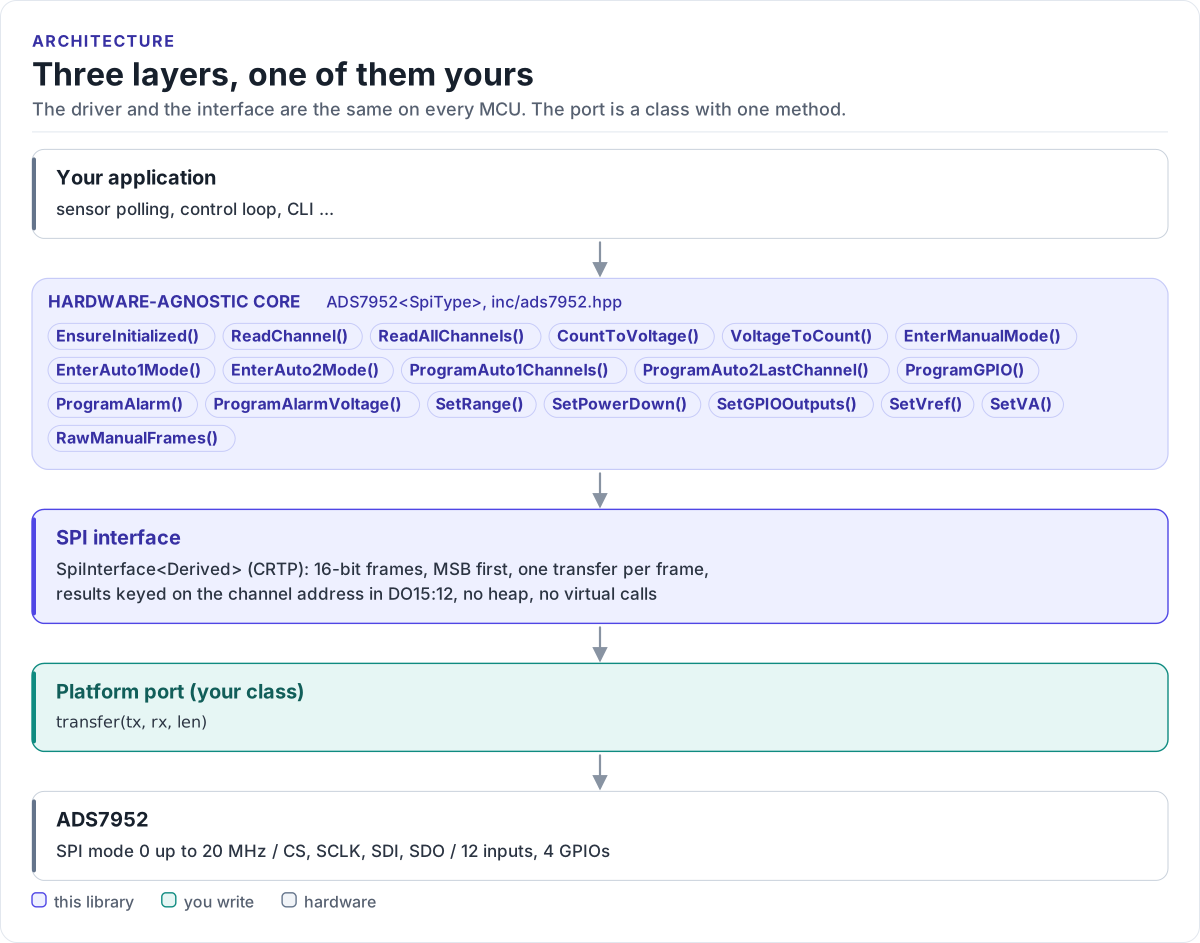
Three layers, one of them yours

Layer diagram: the application calls the hardware-agnostic ADS7952 driver, which builds 16-bit command frames and calls the CRTP SPI interface, which calls the one transfer method of the platform port you write, which drives the SPI bus of the ADS7952.Layer diagram: the application calls the hardware-agnostic ADS7952 driver, which builds 16-bit command frames and calls the CRTP SPI interface, which calls the one transfer method of the platform port you write, which drives the SPI bus of the ADS7952.
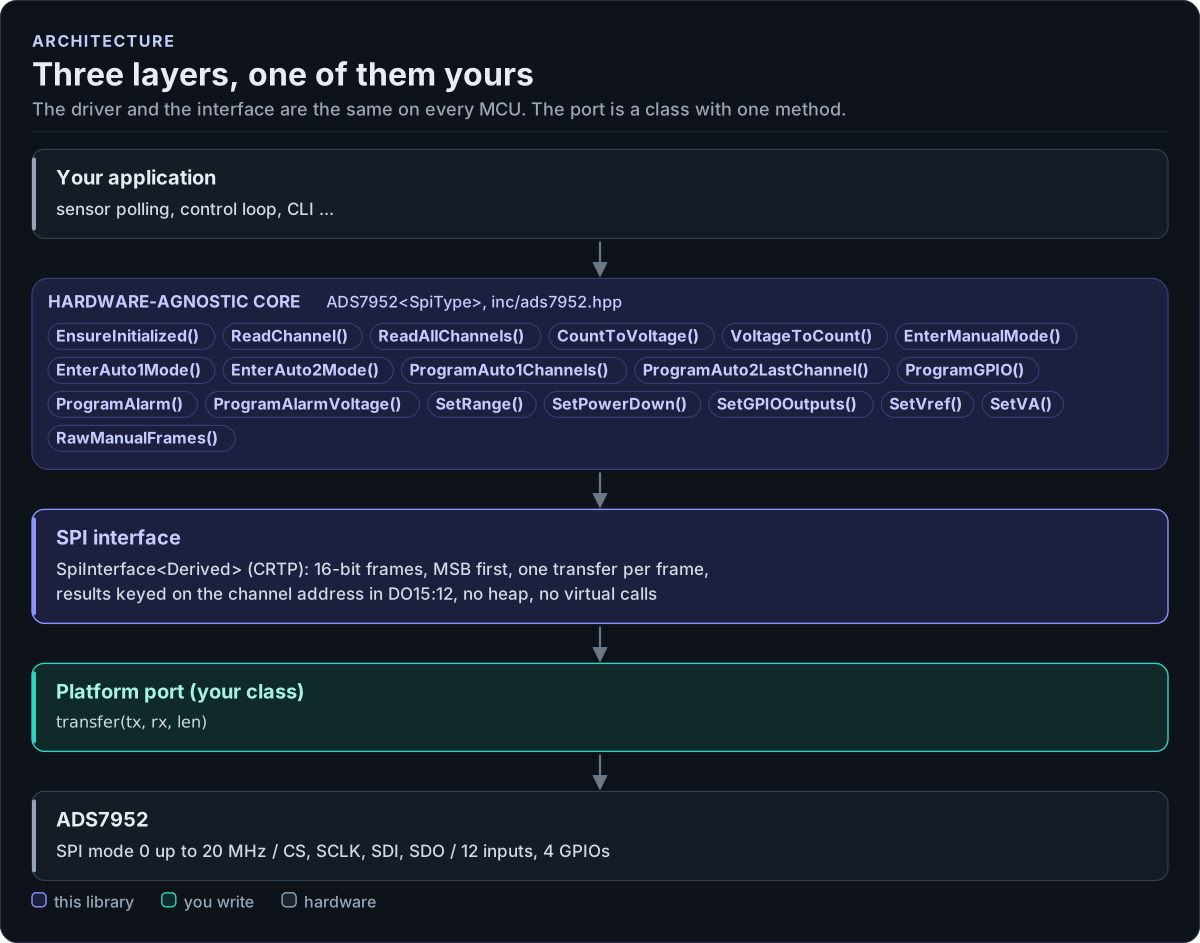
Three layers, one of them yours
Figure description and sources

From top to bottom. Your application talks to one ADS7952 object, whose public calls (listed from inc/ads7952.hpp) read channels, switch modes and program sequences, alarms and GPIOs. The core builds the 16-bit command words, keys every result on the channel address in DO15:12 and converts counts to volts. It reaches the bus through the CRTP SpiInterface (inc/ads7952_spi_interface.hpp), whose one method the platform port implements: a full-duplex transfer with chip select held low. Below it is the hardware.

Drawn from: inc/ads7952.hpp ADS7952 public calls; inc/ads7952_spi_interface.hpp SpiInterface; figure module docs/diagrams/figures/driver-layers.py.

Figure module: docs/diagrams/figures/driver-layers.py

Drawn from: