Architecture
How the driver is put together: three layers, what each owns, and how one call reaches the chip.
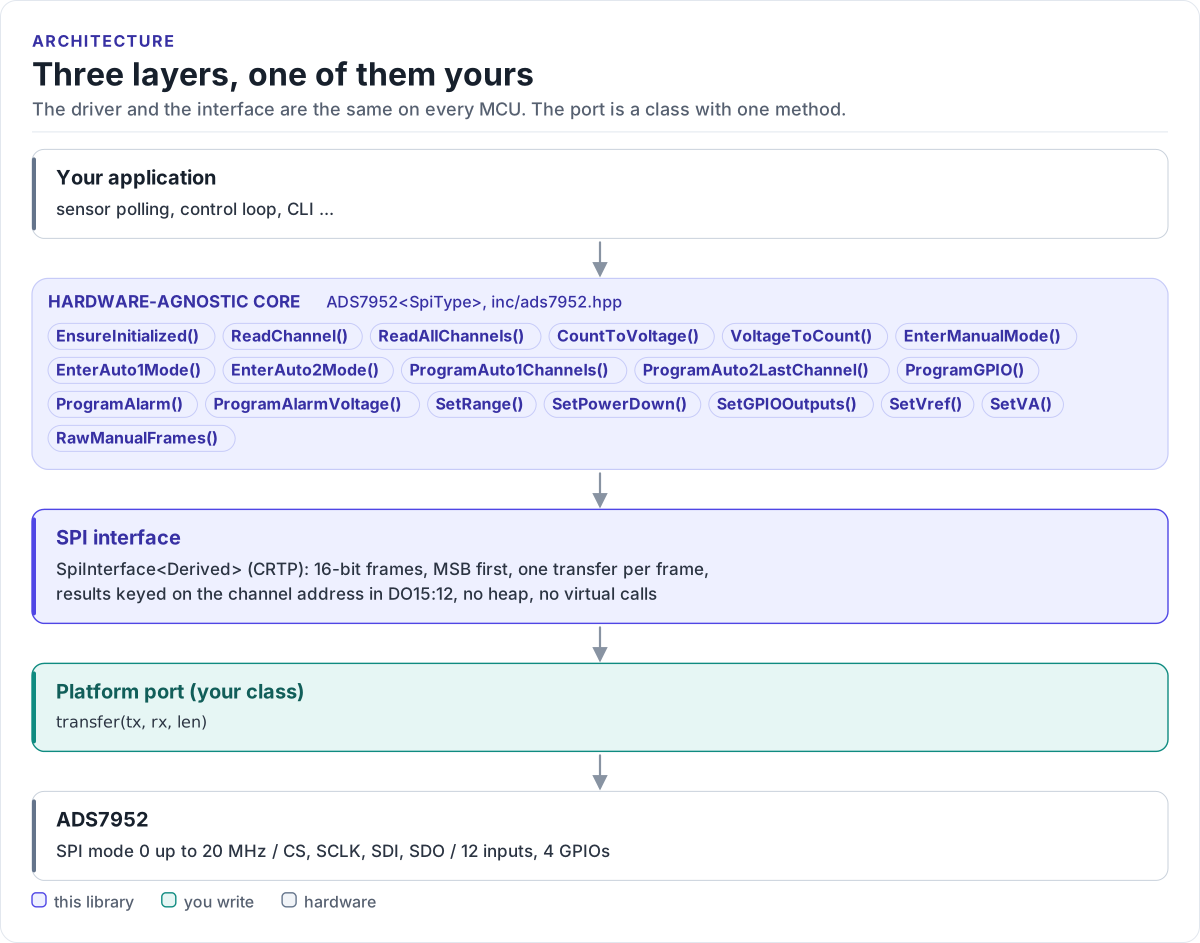
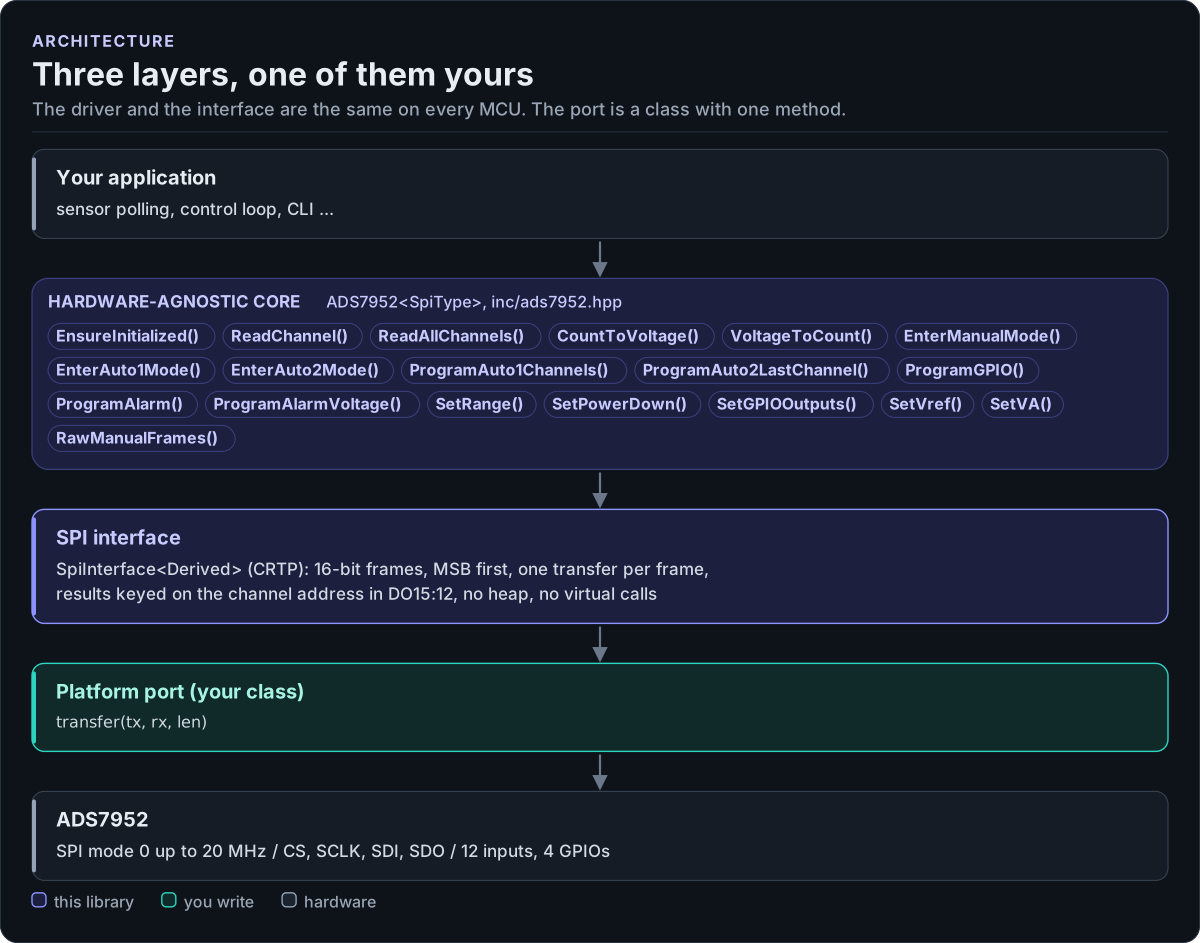
Figure description and sources
From top to bottom. Your application talks to one ADS7952
Drawn from: inc/ads7952.hpp ADS7952 public calls; inc/ads7952_spi_interface.hpp SpiInterface; figure module docs/diagrams/figures/driver-layers.py.
The three layers
| Layer | Where | Depends on | You change it when |
|---|---|---|---|
Hardware-agnostic core: ADS7952<SpiType> |
inc/ads7952.hpp, src/ads7952.ipp |
The port's transfer() |
Never, for a new board |
SPI interface: SpiInterface<Derived> |
inc/ads7952_spi_interface.hpp |
The port's transfer() |
Never |
| Platform port: your class | Your project | Your SDK | Once per MCU or board (Porting) |
Everything above the port is the same on ESP32, STM32, a Linux host or the unit-test model. That is how the host tests run the real driver code without hardware.
How one call reaches the chip
sequenceDiagram
    participant A as Application
    participant D as ADS7952 core
    participant P as Your port
    participant C as ADS7952 chip
    A->>D: ReadChannel(3)
    D->>D: check initialised, channel < 12
    D->>P: transfer(MANUAL | CH3 | range, power, GPIO bits)
    P->>C: 16 clocks, CS low
    C-->>D: stale reply (discarded)
    loop until DO15:12 == 3, at most MANUAL_READ_MAX_FRAMES
        D->>P: transfer(CONTINUE)
        P->>C: 16 clocks, CS low
        C-->>D: DO15:12 channel, DO11:0 count
    end
    D->>D: count to volts with the active reference
    D-->>A: ReadResult{count, voltage, channel, error}
Design choices
- CRTP, not a virtual base. The port is a template parameter, so the compiler calls
transfer()directly and can inline it; there is no vtable and no RTTI. The cost is that the driver type names the port:ADS7952<MySpi>. - No heap, no exceptions. The driver holds a reference to your port and a few bytes of state (mode, range,
masks, reference voltages). Every call is
noexcept. - Synchronous and imperative. Each call sends its frames and returns; there is no state machine or background task. The driver is not thread-safe: give each chip one owner, or guard calls with a mutex.
- Address-keyed results. The chip tags every reply with its channel, so the driver matches on the tag instead of trusting a frame count (Modes and the frame pipeline).
- State mirrored in software. The chip has no readable registers. The driver remembers what it programmed
(
GetMode(),GetRange(),GetAuto1ChannelMask(),GetAuto2LastChannel()); after a chip reset or brown-out, callEnsureInitialized(true)to program it again.
Source map
| Path | Contents |
|---|---|
inc/ads7952.hpp |
ADS7952<SpiType>: construction, reads, modes, programming, range and power |
src/ads7952.ipp |
Template implementation, included at the end of the header |
inc/ads7952_spi_interface.hpp |
SpiInterface<Derived>, the CRTP base of your port |
inc/ads7952_types.hpp |
Enums, ReadResult, ChannelReadings, GPIOConfig, channel-mask helpers |
inc/ads7952_registers.hpp |
Command-word fields and program-register layouts (ads7952::reg) |
inc/ads7952_config.hpp |
Compile-time defaults (ADS7952_CFG) |
tests/ |
Host unit tests, the chip model and the compiled documentation snippets |
examples/esp32/ |
ESP-IDF applications |