Architecture
How the driver is put together: the layers from your application to the LEDs, what each owns, and how one frame reaches the strip.
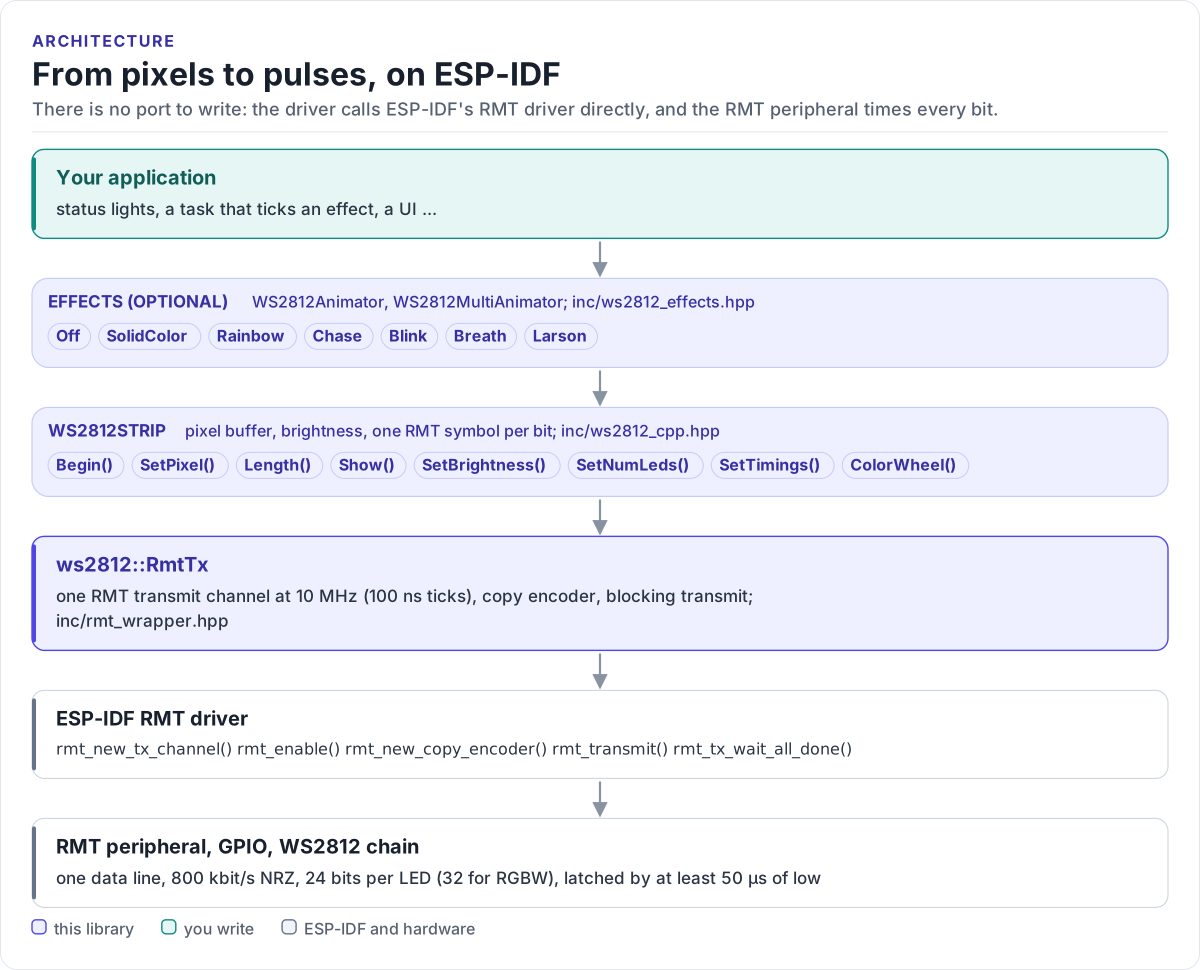
Figure description and sources
From top to bottom. Your application, the only code you write, either runs an effect or sets pixels itself. The effects (WS2812Animator and WS2812MultiAnimator, the Effect values listed from inc/ws2812_effects.hpp) draw into a WS2812Strip. The strip (inc/ws2812_cpp.hpp, public methods listed) keeps the pixel buffer, applies the brightness and turns every bit into one RMT symbol with the configured high and low times. ws2812::RmtTx (inc/rmt_wrapper.hpp) owns one RMT transmit channel at 10 MHz and sends the symbols, blocking until they are out. Below it is ESP-IDF's RMT driver (the calls listed from rmt_wrapper.hpp) and the RMT peripheral, which times the pulses on the GPIO that feeds the first LED.
Drawn from: inc/ws2812_effects.hpp WS2812Animator::Effect; inc/ws2812_cpp.hpp WS2812Strip; inc/rmt_wrapper.hpp ws2812::RmtTx; figure module docs/diagrams/figures/driver-layers.py.
The layers
| Layer | Where | You change it when |
|---|---|---|
Effects: WS2812Animator, WS2812MultiAnimator |
ws2812_effects.hpp, ws2812_multi_animator.hpp |
You want a new effect |
Strip: WS2812Strip |
ws2812_cpp.hpp, ws2812_cpp.cpp |
Never, for a new board |
RMT channel: ws2812::RmtTx |
rmt_wrapper.hpp |
Never |
| ESP-IDF RMT driver and the peripheral | ESP-IDF, esp_driver_rmt |
Never |
Each layer uses only the one below it.
There is no communication interface for you to implement. The other HardFOC drivers talk to a chip over a bus your port provides; a WS2812 has no bus, only a pulse train with 100 ns resolution, and the RMT peripheral is what makes that possible on an ESP32 without blocking the CPU. Porting explains the consequences.
How one frame reaches the strip
sequenceDiagram
    participant A as Application
    participant S as WS2812Strip
    participant T as RmtTx
    participant R as ESP-IDF RMT
    A->>S: SetPixel(i, colour), for each LED
    A->>S: Show()
    S->>S: scale by brightness, one symbol per bit
    S->>T: Transmit(symbols, count)
    T->>R: rmt_transmit(copy encoder)
    T->>R: rmt_tx_wait_all_done()
    R-->>T: ESP_OK when the last symbol is out
    T-->>S: esp_err_t
    S-->>A: esp_err_t
Show() blocks the calling task for the whole frame: about 31 µs per RGB LED with the WS2812B timing
(Signal timing). The RMT sends the symbols on its own; the CPU only refills the channel's symbol
memory from an interrupt.
Design choices
- Symbols built in software, sent with a copy encoder.
Show()writes onermt_symbol_word_tper bit into a buffer the strip owns, then the RMT copies them out. The timing is plain data, soSetTimings()takes effect at the nextShow()and the host tests can check every pulse. - One RMT channel per strip, created in the constructor. The channel takes one memory block of the target.
A failure to create it does not abort:
Begin()returns the error and retries, andShow()returnsESP_ERR_INVALID_STATEuntil the channel is up (Troubleshooting). - Wire order inside the driver. Pixels are
0xRRGGBB;Show()reorders to green, red, blue and appends the reset symbol, so callers never pack for the wire. - Brightness at send time. Pixels are stored unscaled; brightness is applied while encoding, so dimming and restoring never loses colour resolution in the buffer.
- Effects are separate. The strip knows nothing about animation. An animator draws one frame per
Tick()and callsShow(); you decide when to tick. - Heap at construction, not per frame. The strip allocates its pixel and symbol buffers (
std::vector) when it is created or resized;Show()does not allocate.
The C interface
inc/ws2812_control.h is an older C interface for one strip whose length, LED type
and timing are fixed by Kconfig. It does not share code with WS2812Strip: it sends pixel bytes through
led_strip_encoder.c, which appends the reset (API guide).
Source map
| Path | Contents |
|---|---|
inc/ws2812_cpp.hpp, src/ws2812_cpp.cpp |
WS2812Strip, LedType, version functions |
inc/ws2812_effects.hpp, src/ws2812_effects.cpp |
WS2812Animator and its effects |
inc/ws2812_multi_animator.hpp, src/ws2812_multi_animator.cpp |
WS2812MultiAnimator |
inc/rmt_wrapper.hpp |
ws2812::RmtTx (and RmtRx, a receive wrapper the driver does not use) |
inc/ws2812_control.h, src/ws2812_control.c, inc/led_strip_encoder.h, src/led_strip_encoder.c |
The C interface and its RMT encoder |
Kconfig |
Defaults for the strip constructor and the C interface |
tests/ |
Host unit tests, ESP-IDF stubs and the compiled documentation snippets |
examples/esp32/ |
ESP-IDF test application |