Architecture
How the driver is put together: three layers, what each owns, and how one command reaches the chip.
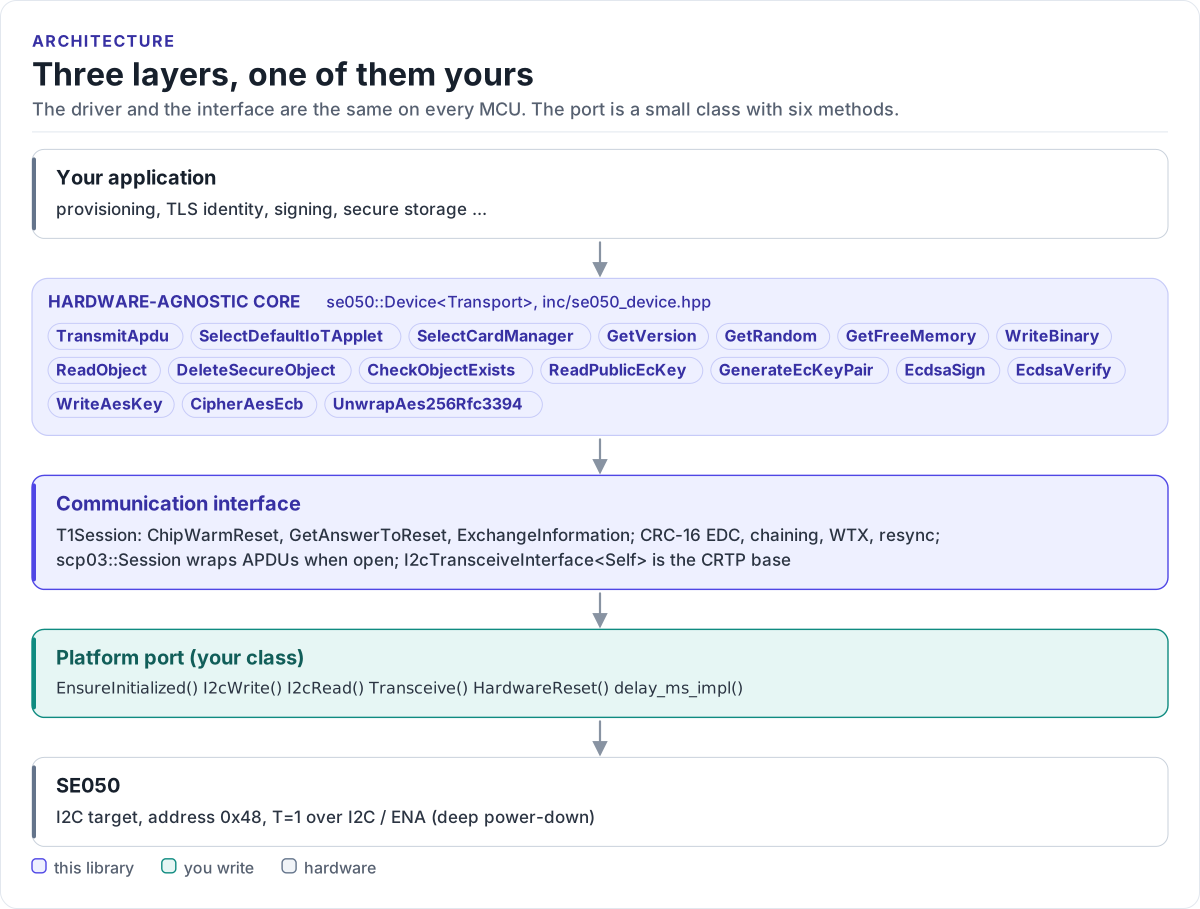
Figure description and sources
From top to bottom. Your application talks to one se050::Device
Drawn from: inc/se050_device.hpp Device commands; inc/se050_t1_session.hpp T1Session; inc/se050_i2c_transport_interface.hpp Derived requirements; figure module docs/diagrams/figures/driver-layers.py.
The three layers
| Layer | Where | Depends on | You change it when |
|---|---|---|---|
Hardware-agnostic core: Device<Transport>, its commands and the APDU, TLV and command builders |
inc/se050_device.hpp, inc/se050_commands.hpp, inc/se050_apdu.hpp |
The interface's methods only | Never, for a new board |
Communication interface: T1Session, scp03::Session, the CRTP base I2cTransceiveInterface |
inc/se050_t1_session.hpp, inc/se050_scp03.hpp, inc/se050_i2c_transport_interface.hpp |
Six methods of your port | Never |
| Platform port: your class | Your project | Your SDK | Once per MCU or board (Porting) |
Everything above the port is the same on ESP32, STM32, a Linux host or the unit-test model. That is how the host tests run the real T=1 and APDU code without a chip.
How one command reaches the chip
sequenceDiagram
    participant A as Application
    participant D as Device
    participant S as scp03::Session
    participant T as T1Session
    participant P as Your port
    A->>D: GetRandom(32, ...)
    D->>D: build APDU 80 04 00 49 04 41 02 00 20 00
    opt SCP03 channel open
        D->>S: WrapCommand (C-MAC, C-ENC)
    end
    D->>T: ExchangeInformation(APDU)
    T->>P: I2cWrite(5A PCB LEN APDU CRC)
    T->>P: I2cRead(3), then I2cRead(LEN + 2)
    P-->>T: A5 PCB LEN R-APDU CRC
    T-->>D: R-APDU, CRC checked
    opt SCP03 channel open
        D->>S: UnwrapResponse (R-MAC, R-ENC)
    end
    D->>D: parse tag 0x41 and SW 90 00
    D-->>A: Error::Ok and 32 bytes
Design choices
- CRTP, not virtual functions. The port is a template parameter:
Device<MyI2c>. The compiler sees your methods directly; there is no vtable, no RTTI and nothing to allocate. Code that must work with several port types takes the device as a template parameter too. - Caller-owned buffers. Every command takes the output buffer and its capacity, and returns
Error::BufferTooSmallrather than truncating. Working buffers are on the stack (Configuration); the SCP03 wrap uses a buffer you bind once. - Errors are values. Every call returns
se050::Error; nothing throws. A status word other than90 00from a typed command becomesError::Protocol;TransmitApdu()and theSelect*()helpers return the raw R-APDU so you can read the status words yourself. - Plaintext unless you provision keys.
TransmitApdu()wraps only whenScp03().IsOpen(); opening the channel needs keys you pass at run time. A channel lost to a bad R-MAC is not replaced by plaintext behind your back: calls fail withError::Authenticationuntil you close or reopen it. See Security model. - One owner. The driver keeps T=1 sequence numbers and the SCP03 counter in the object. It is not thread-safe; give each SE050 one owner task or one mutex around every call.
Source map
| Path | Contents |
|---|---|
inc/se050_device.hpp |
Device<Transport>: the application object and its commands |
inc/se050_t1_session.hpp |
T1Session and the se050::t1 constants: blocks, chaining, WTX, resync |
inc/se050_crc.hpp |
The T=1 EDC (CRC-16) |
inc/se050_apdu.hpp, inc/se050_tlv.hpp |
ISO 7816-4 APDU builders and parsers, BER-TLV helpers |
inc/se050_commands.hpp |
IoT applet command builders and response parsers (se050::cmd) |
inc/se050_applet.hpp, inc/se050_atr.hpp |
SELECT builders and AIDs; the ATR / profile parser |
inc/se050_scp03.hpp, inc/se050_scp03_crypto.hpp |
GlobalPlatform SCP03 session, wrap and unwrap, PUT KEY; AES-128, CMAC, CBC, KDF on the host |
inc/se050_rfc3394.hpp |
RFC 3394 AES key wrap and unwrap over a block-cipher callback |
inc/se050_session.hpp, inc/se050_i2c_transport_interface.hpp |
Raw transport session; the CRTP interface |
inc/se050_types.hpp, inc/se050_driver.hpp |
Error, limits, default address; the umbrella header |
tests/ |
Host unit tests and the compiled documentation snippets |
examples/esp32/ |
ESP-IDF applications and the reference port |