Pin model
How one X-macro row describes a pin, what the rows expand into and who reads the result.
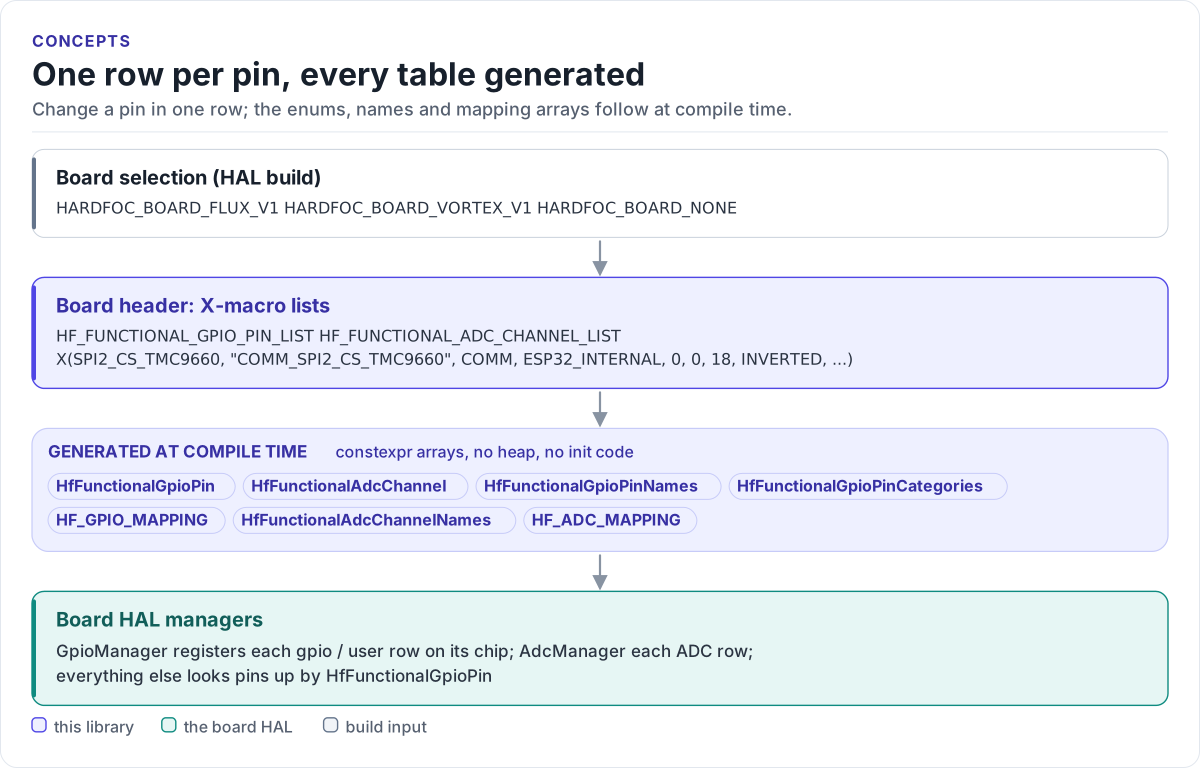
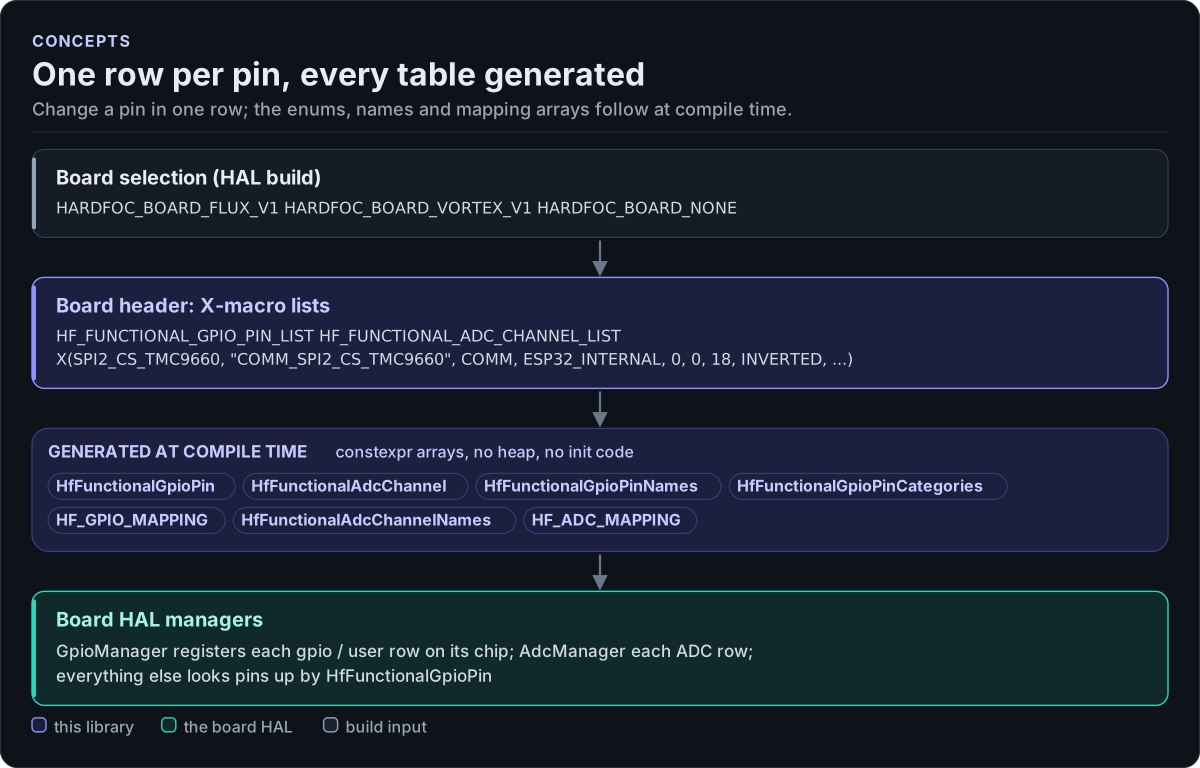
Figure description and sources
From top to bottom. The HAL's build defines one HARDFOC_BOARD_* macro; the selector header (src/hf_functional_pin_config.hpp) includes that board's header. The board header holds two X-macro lists, one row per GPIO function and one per ADC channel. Expanding the lists produces the enums, name and category tables and the mapping arrays (names read from the Vortex V1 header). The board HAL's managers iterate the mapping arrays and look pins up by enum; no other code writes a pin number.
Drawn from: src/hf_functional_pin_config.hpp board selector; src/hf_functional_pin_config_vortex_v1.hpp X-macro lists and generated tables; figure module docs/diagrams/figures/pin-model.py.
One row per function
Each board header defines two lists. HF_FUNCTIONAL_GPIO_PIN_LIST(X) has one X(...) row per digital pin;
HF_FUNCTIONAL_ADC_CHANNEL_LIST(X) one row per analog channel. This row from the Vortex V1 header is the TMC9660
chip select:
X(SPI2_CS_TMC9660, "COMM_SPI2_CS_TMC9660", HfPinCategory::PIN_CATEGORY_COMM, HfGpioChipType::ESP32_INTERNAL,
  0, 0, 18, PIN_LOGIC_INVERTED, PIN_HAS_PULL, PIN_PULL_UP, PIN_PUSH_PULL, 40)
| Position | Field | In the example | Meaning |
|---|---|---|---|
| 1 | ENUM_NAME |
SPI2_CS_TMC9660 |
Becomes HfFunctionalGpioPin::SPI2_CS_TMC9660 |
| 2 | STRING_NAME |
"COMM_SPI2_CS_TMC9660" |
Name for logs and consoles; the prefix repeats the category |
| 3 | CATEGORY |
PIN_CATEGORY_COMM |
Who owns the pin (below) |
| 4 | CHIP_TYPE |
ESP32_INTERNAL |
Chip that carries the pin; each board header defines its own HfGpioChipType |
| 5 | CHIP_UNIT |
0 |
Which instance of that chip (0 = first) |
| 6 | GPIO_BANK |
0 |
Port or bank within the chip (0 = A) |
| 7 | PHYSICAL_PIN |
18 |
Pin number within the bank: GPIO number on an ESP32, port bit 0 to 15 on a PCAL95555 |
| 8 | LOGIC_INVERSION |
PIN_LOGIC_INVERTED |
Active low |
| 9 | HAS_PULL |
PIN_HAS_PULL |
A pull resistor is enabled |
| 10 | PULL_DIRECTION |
PIN_PULL_UP |
Up or down; ignored without a pull |
| 11 | OUTPUT_MODE |
PIN_PUSH_PULL |
Push-pull or open-drain |
| 12 | MAX_CURRENT_MA |
40 |
Maximum current (mA) |
An ADC row has ten fields: enum and string name, chip type, chip unit, ADC unit, physical channel, resolution
(bits), full-scale voltage (mV), divider ratio (1.0f = none) and a description.
Categories
| Category | Prefix | Owned by | should_register_as_gpio() |
|---|---|---|---|
PIN_CATEGORY_CORE |
CORE_ |
The MCU itself: crystal, strapping, USB | false |
PIN_CATEGORY_COMM |
COMM_ |
A bus driver: SPI, UART, I²C, TWAI, LED data | false |
PIN_CATEGORY_GPIO |
GPIO_ |
The HAL's GPIO manager | true |
PIN_CATEGORY_USER |
Application-defined pins | true |
is_reserved_prefix() tells whether a name starts with CORE_, COMM_, SYS_ or INTERNAL_.
What the rows expand into
Every board header expands its lists with the same #define X(...) / #undef X pattern:
| Generated | Type | Index |
|---|---|---|
HfFunctionalGpioPin |
enum class : uint8_t, ends with HF_FUNCTIONAL_GPIO_COUNT |
row order |
HfFunctionalGpioPinNames[] |
std::string_view |
enum value |
HfFunctionalGpioPinCategories[] |
HfPinCategory |
enum value |
HF_GPIO_MAPPING[], HF_GPIO_MAPPING_SIZE |
HfGpioMapping |
enum value |
HfFunctionalAdcChannel |
enum class : uint8_t, ends with HF_FUNCTIONAL_ADC_COUNT |
row order |
HfFunctionalAdcChannelNames[] |
std::string_view |
enum value |
HF_ADC_MAPPING[], HF_ADC_MAPPING_SIZE |
HfAdcMapping |
enum value |
Because the enum and the arrays come from the same rows, HF_GPIO_MAPPING[static_cast<size_t>(pin)] is always the
row of pin. The structures HfGpioMapping and HfAdcMapping and the category enum are shared by every board in
src/hf_functional_pin_config_base.hpp.
Board selection
src/hf_functional_pin_config.hpp includes one board header:
| Define | Board | MCU | Header | GPIO rows | ADC rows |
|---|---|---|---|---|---|
HARDFOC_BOARD_FLUX_V1 |
Flux V1 | ESP32-S3 | src/hf_functional_pin_config_flux_v1.hpp |
27 | 14 |
HARDFOC_BOARD_VORTEX_V1 |
Vortex V1 | ESP32-C6 | src/hf_functional_pin_config_vortex_v1.hpp |
34 | 15 |
HARDFOC_BOARD_NONE |
None (host builds) | none | src/hf_functional_pin_config_none.hpp |
0 | 0 |
HARDFOC_BOARD_NONE (or HF_MCU_FAMILY_NONE) selects an empty map for host builds: the enums have only their
_COUNT entry and every lookup returns nullptr. The repository also has
src/hf_functional_pin_config_pw_controller_v1.hpp, an
STM32H747 carrier profile that the selector does not include yet.
Design choices
- Primitive types only. Board headers use
uint8_t,booland their own enums, so the library depends on no MCU SDK and no driver. The HAL castschip_typeback to its board'sHfGpioChipType. - The header is the board's schematic in code. Comments in the rows record wiring facts (for example, that TMC9660 GPIO17 and GPIO18 are also wired to PCAL95555 inputs P1 and P2).
- No runtime registration code here. The library only describes; the HAL decides how to create drivers.
Next: API guide.