Architecture
How the driver is put together: three layers, what each owns, and how one call reaches the chip.
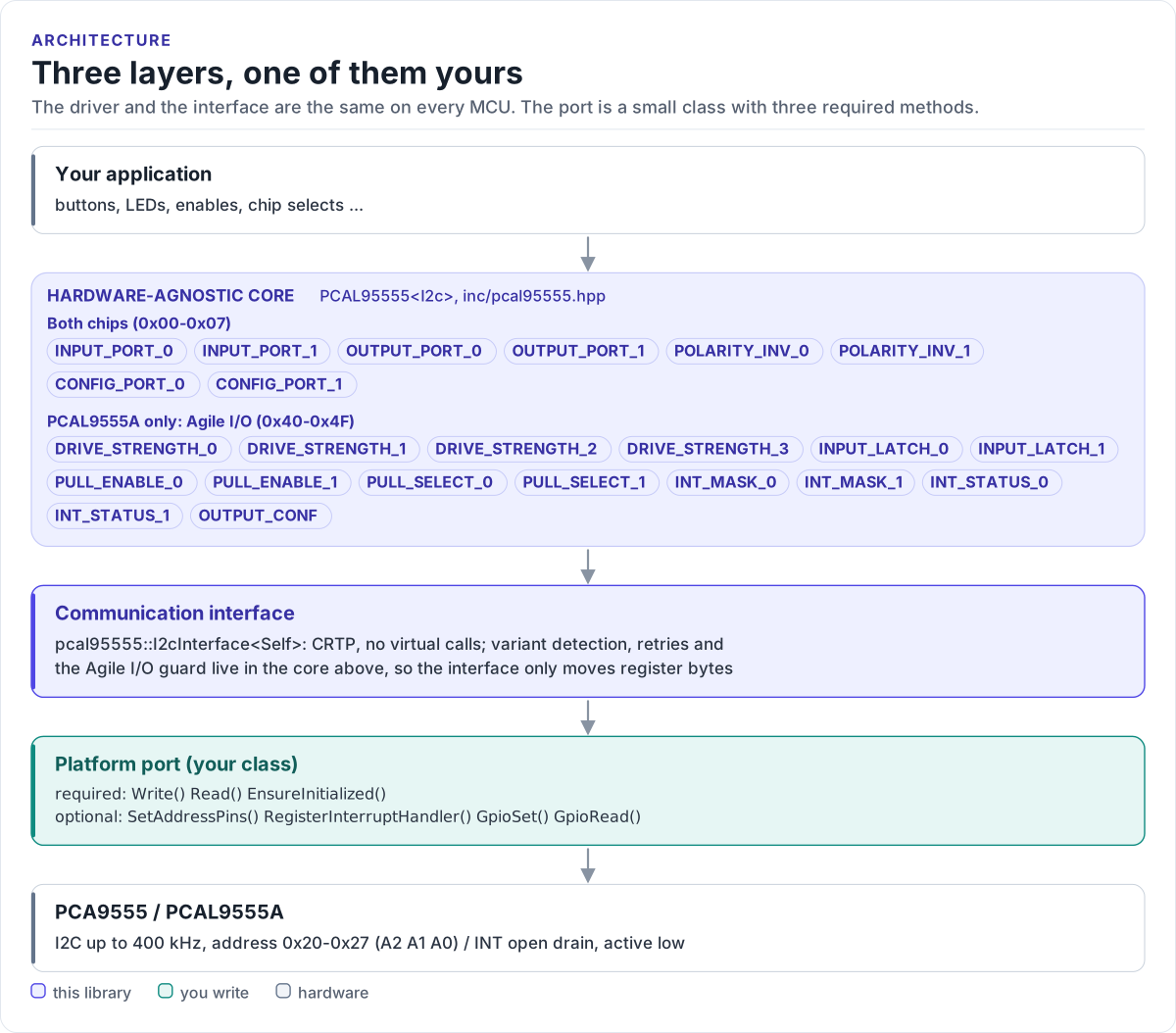
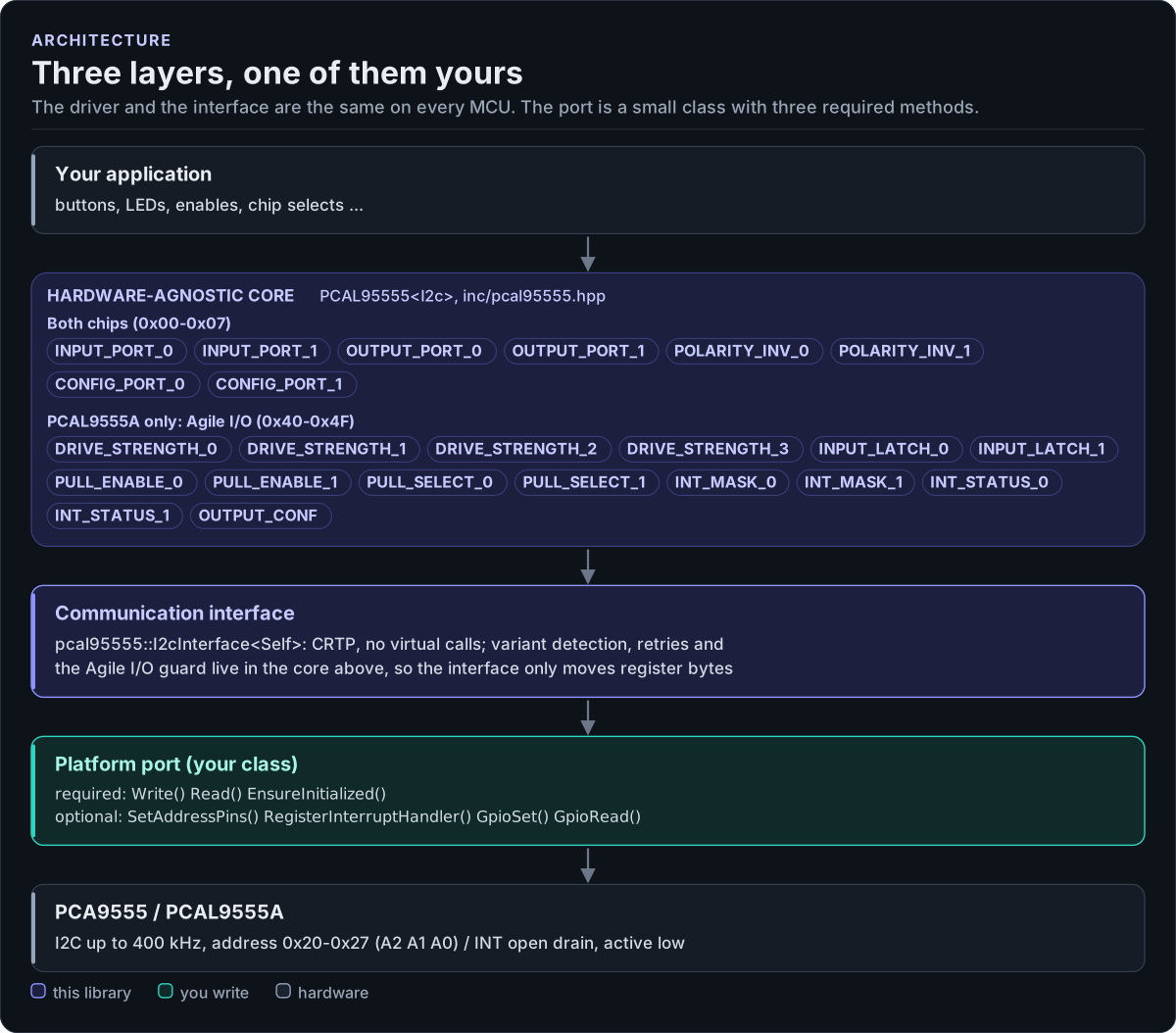
Figure description and sources
From top to bottom. Your application talks to one PCAL95555
Drawn from: inc/pcal95555.hpp Pcal95555Reg; inc/pcal95555_i2c_interface.hpp I2cInterface; figure module docs/diagrams/figures/driver-layers.py.
The three layers
| Layer | Where | You change it when |
|---|---|---|
Core: PCAL95555<I2c> |
pcal95555.hpp, pcal95555.ipp |
Never, for a new board |
Interface: I2cInterface<Self> |
pcal95555_i2c_interface.hpp |
Never |
| Port: your class, over your SDK | Your project | Once per MCU or board (Porting) |
The core depends only on the interface's methods, and the interface only on three methods of your port. Everything above the port is the same on ESP32, STM32, a Linux host or the unit-test model. That is how the host tests run the real driver code without hardware.
How one call reaches the chip
sequenceDiagram
    participant A as Application
    participant D as PCAL95555 core
    participant P as Your port
    participant C as PCAL9555A
    A->>D: WritePin(9, false)
    D->>D: EnsureInitialized() (first call only)
    D->>D: pin 9: port 1, bit 1
    D->>P: Read(0x20, OUTPUT_PORT_1)
    P->>C: W 0x03, Sr, R 1 byte
    C-->>P: 0xFF
    P-->>D: true
    D->>P: Write(0x20, OUTPUT_PORT_1, 0xFD)
    P->>C: W 0x03 0xFD
    C-->>P: ACK
    P-->>D: true
    D-->>A: true (clears I2CWriteFail)
A failed transfer is retried SetRetries() times (once by default) before the call returns false and sets
Error::I2CReadFail or Error::I2CWriteFail.
What happens at initialisation
Construction does no I/O. The first call that needs the chip, or your own EnsureInitialized(), runs:
EnsureInitialized()on your port: bring the bus up.SetAddressPins()on your port, which may drive A2-A0 (the default does nothing).- A read of Input Port 0 at the address: if it fails,
I2CReadFailis set and the call returnsfalse. - Variant detection, unless the constructor fixed the variant: read Input Port 0, read Output Port Configuration (0x4F) without retries, read Input Port 0 again. An ACK at 0x4F means PCAL9555A; a NACK followed by a good read means PCA9555. See PCA9555 and PCAL9555A.
- A snapshot of both input ports, the reference for edge detection.
Why CRTP
The interface is a class template parameter, not a virtual base class. The compiler sees your port's methods
directly and inlines them; the driver has no vtable and needs no RTTI. The cost is that the driver type names the
port: PCAL95555<MyI2c>. Code that has to work with several port types takes the driver as a template parameter
too.
The optional methods (SetAddressPins(), RegisterInterruptHandler(), GpioSet(), GpioRead()) have bodies in
the base class. A port that declares a method with the same name hides the default; the driver always calls through
the port type, so the port's version is the one that runs.
Design choices
- Read-modify-write on single registers. Single-pin calls read the port's register, change one bit and write it back: two transactions. Mask and list calls read both ports once and write each once.
- One register per transaction. No paired or auto-increment transfers, so any I2C controller that can do a register read can run the driver (Hardware).
- Sticky error flags. Calls return
bool; the flags say why, and stay set until cleared or until a later success of the same kind clears its own flag. - Per-object transfer byte. Every register transfer passes the bus a byte that lives in the driver object, not on the caller's stack, for MCUs whose I2C DMA cannot reach task stacks: place the driver object in DMA-capable RAM on such parts. Each object has its own byte, so drivers for different chips are independent (see Porting).
Source map
| Path | Contents |
|---|---|
inc/pcal95555.hpp |
PCAL95555<I2c>, Pcal95555Reg, the pin and error enums, PinReadResult, ChipVariant |
src/pcal95555.ipp |
Template implementation, included by the header |
inc/pcal95555_i2c_interface.hpp |
I2cInterface<Derived>, CtrlPin, GpioSignal |
inc/pcal95555_kconfig.hpp |
Defaults of every CONFIG_PCAL95555_* macro used by InitFromConfig() |
inc/pcal95555_version.h.in |
Version header template, filled in by CMake |
Kconfig |
ESP-IDF menu for the start-up configuration |
tests/ |
Host unit tests and the compiled documentation snippets |
examples/esp32/ |
ESP-IDF applications for an ESP32-S3 |