Transfer function
How the driver turns a voltage into a temperature, which coefficients it uses, and how large the errors are.
The equation
The datasheet characterises the sensor with a first-order transfer function (Equation 4-1):
The driver solves it for the temperature:
v_zero_c is V0°C, the output at 0 °C, and v_per_c is TC, the temperature coefficient,
both in volts. The constants are in namespace hf::mcp9700. They default to the datasheet's typical values and
can be replaced per sensor (Configuration).
| Coefficient | Default | Constant |
|---|---|---|
v_zero_c |
0.5 V | kDefaultVoltsAtZeroC |
v_per_c |
0.01 V/°C | kDefaultVoltsPerCelsius |
Output over temperature
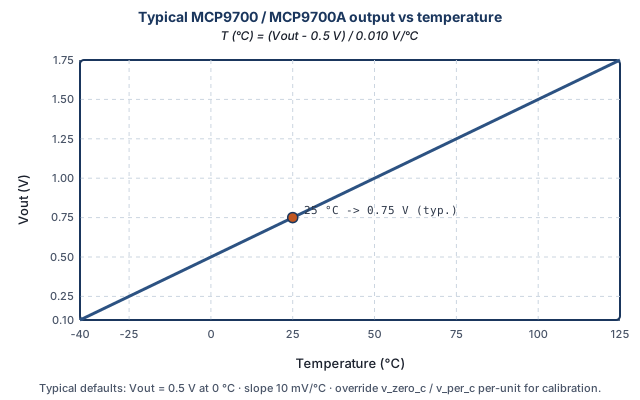
| Temperature (°C) | VOUT, typical (V) |
|---|---|
| −40 | 0.10 |
| 0 | 0.50 |
| +25 | 0.75 |
| +85 | 1.35 |
| +125 | 1.75 |
These values follow from the typical coefficients. They do not depend on the supply voltage: the output is not ratiometric, and the line regulation is 0.1 °C/V typical.
Where the error comes from
| Source | Size | What to do |
|---|---|---|
| Sensor accuracy | ±4 °C (MCP9700), ±2 °C (MCP9700A), 0 °C to +70 °C | Choose the grade; calibrate (Hardware) |
| Nonlinearity | ±0.5 °C typical, 0 °C to +70 °C | Left after a one-point calibration; AN1001 compensates it |
| ADC offset and gain | Depends on the MCU | Calibrated ADC readings in the adapter |
| ADC resolution | 0.08 °C to 1 °C per code | Choose the reference and range (Hardware) |
| Noise | Depends on the board | Decoupling, averaging (API guide) |
A one-point calibration at +25 °C reduces the first row to ±0.5 °C typical between 0 °C and +70 °C (datasheet Section 4.1). Measuring a change relative to +25 °C is accurate to ±1 °C typical over the same range without any calibration.
Limits of the model
- The driver applies the equation only inside the specified range plus a margin (−48 °C to +133 °C, 20 mV to
1.83 V by default). An open or grounded input (0 V, which would be −50 °C) and a shorted-to-supply input fail
with
Error::kOutOfRangeinstead of returning a temperature (API guide). - The coefficients are fixed when you construct the object. To change them, construct a new one.
- There is no curve correction for the nonlinearity; the datasheet's AN1001 describes a lookup-table method.
Next
Configuration shows how to calibrate the coefficients; Hardware shows how to set up the ADC.