Porting
Run the driver on a new MCU by writing one class: the ADC adapter.
The driver never calls your SDK directly. It calls two methods on the class you pass as the AdcType template
parameter (documented on Mcp9700Thermistor in inc/mcp9700_thermistor.hpp).
There is no base class: the calls are resolved at compile time, so there are no virtual functions, no vtable and
nothing to allocate.
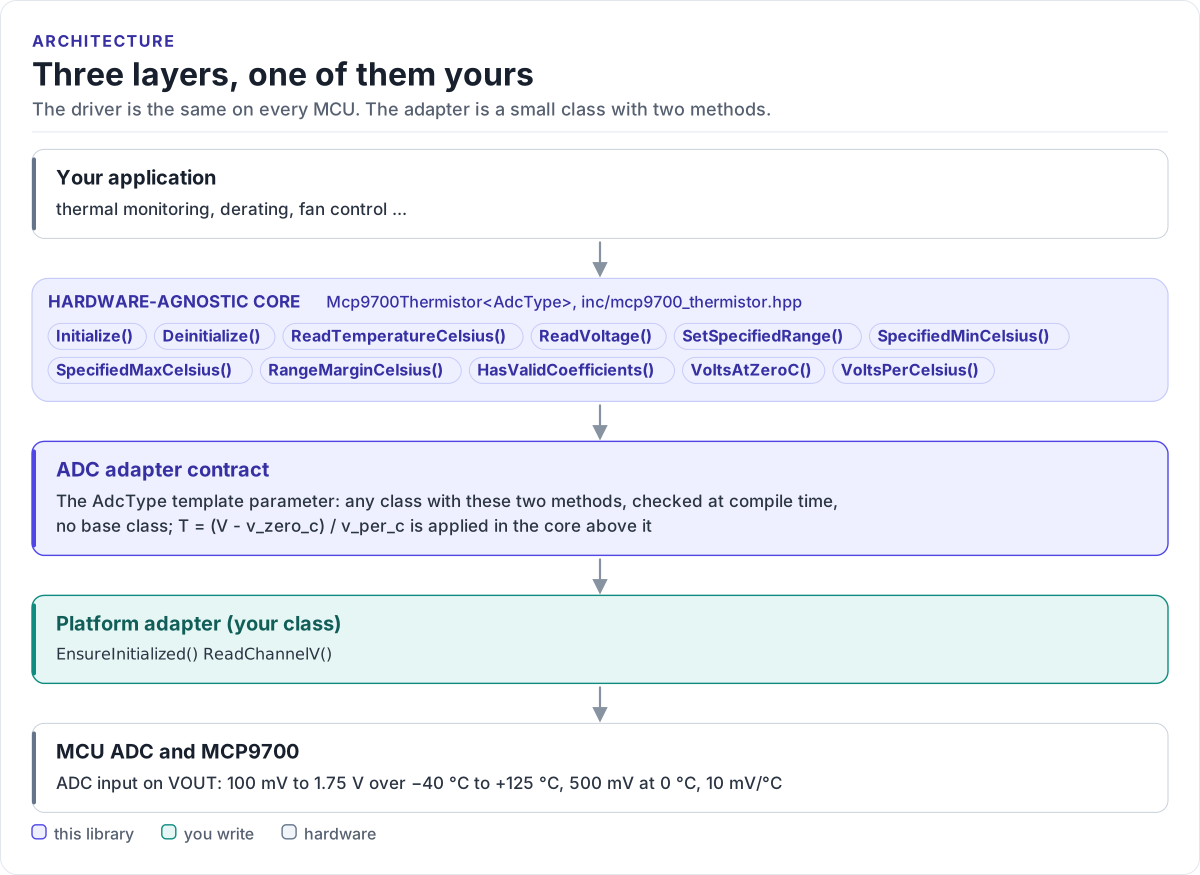
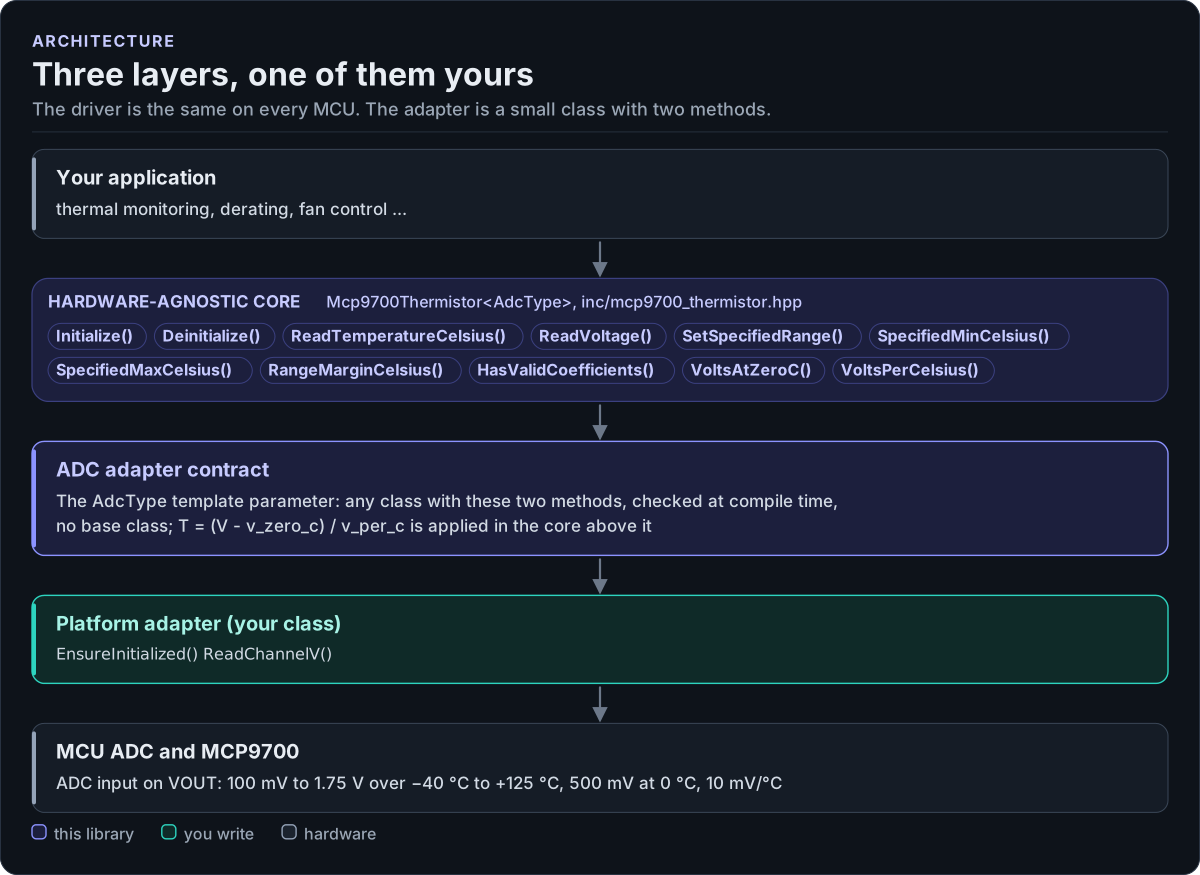
Figure description and sources
From top to bottom. Your application talks to one Mcp9700Thermistor
Drawn from: inc/mcp9700_thermistor.hpp Mcp9700Thermistor public calls; inc/mcp9700_thermistor.hpp AdcType contract; figure module docs/diagrams/figures/driver-layers.py.
What you implement
Both are noexcept; the adapter below shows the exact signatures.
| Method | Contract |
|---|---|
EnsureInitialized() |
Bring the ADC up; return true when it can read. Called by every Initialize() |
ReadChannelV() |
One reading of channel, in volts at the sensor pin, into *voltage_v; return 0 on success, anything else on failure |
ReadChannelV() returns an int where 0 is success, so an adapter can return the value of an error enum whose
success value is 0. The driver only tests it against zero.
The adapter
class MyAdc {
public:
  // Bring the ADC up. The driver calls this from Initialize(); return true when it is ready.
  bool EnsureInitialized() noexcept {
    if (!ready_) {
      ready_ = platform_adc_init();
    }
    return ready_;
  }

  // Volts at the MCP9700 VOUT pin. Return 0 on success, any other value on failure.
  int ReadChannelV(uint8_t channel, float* voltage_v) noexcept {
    int32_t mv = 0;
    if (!ready_ || !platform_adc_read_mv(channel, &mv)) {
      return 1;
    }
    *voltage_v = static_cast<float>(mv) / 1000.0F;
    return 0;
  }

private:
  bool ready_ = false;
};
Rules the adapter must follow:
- Volts, at the pin. Not millivolts, not raw codes. Undo any divider, attenuator or amplifier gain.
- Calibrated. Apply your ADC's calibration (offset, gain, curve) before returning.
- Idempotent initialisation.
EnsureInitialized()may be called once per sensor and again afterDeinitialize(); set the ADC up only the first time. - Fail loudly. Return non-zero when the conversion fails or the channel is unknown; the driver then leaves the
caller's value untouched. Do not write
*voltage_von failure. - One channel, one sensor. The channel number is yours to define: an ADC channel, a multiplexer input or an index into a table.
Reference implementation
The ESP32-C6 example's Esp32Mcp9700Adc in
mcp9700_esp32c6_example.cpp is a complete adapter over
ESP-IDF adc_oneshot: ADC_UNIT_1, ADC_CHANNEL_0 (GPIO0), 12-bit, with curve-fitting calibration when the
chip supports it. Start from it for any ESP-IDF target.
Check your adapter
- Build it: the adapter on this page is compiled by the host CI from
tests/docs/my_adc.hpp, with the driver instantiated over it. - Measure VOUT with a multimeter and compare it with what
ReadChannelV()returns. They should agree within your ADC's error. - At room temperature,
ReadTemperatureCelsius()should report roughly +20 °C to +30 °C (VOUT about 0.7 V to 0.8 V). - Touch the sensor: the reading should rise within a few seconds.
Threads
The driver is not thread-safe. Give each sensor one owner task, or guard every call on a driver object (and its adapter) with one mutex. Sensors that share an ADC share its lock too.
Next
Testing and CI shows how the adapter and driver are tested without hardware.