Skip to content

Figures

Every figure on this site is drawn by a Python module from facts extracted from the code, so it is rebuilt, not redrawn, when the code changes. CI runs hardfoc-docs figures --check and fails when a committed figure no longer matches the code. Each figure below lists the files it is drawn from.

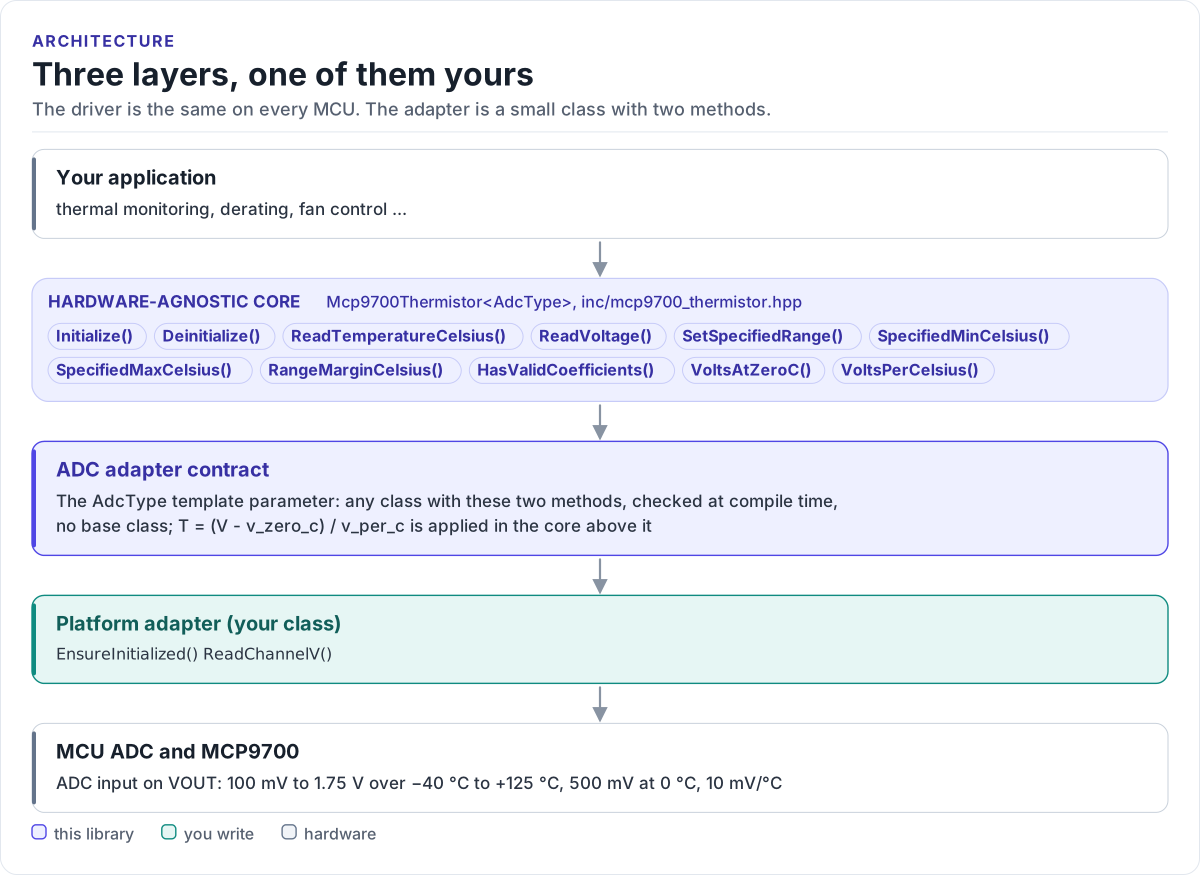
Three layers, one of them yours

Layer diagram: the application calls the hardware-agnostic MCP9700 driver, which relies on the ADC adapter contract, which the platform adapter you write fulfils, which reads the MCU's ADC connected to the MCP9700's analog output.Layer diagram: the application calls the hardware-agnostic MCP9700 driver, which relies on the ADC adapter contract, which the platform adapter you write fulfils, which reads the MCU's ADC connected to the MCP9700's analog output.
Three layers, one of them yours
Figure description and sources

From top to bottom. Your application talks to one Mcp9700Thermistor object per sensor, whose public calls (listed from inc/mcp9700_thermistor.hpp) initialise the ADC and return degrees Celsius. The core turns one ADC voltage into a temperature with (V - v_zero_c) / v_per_c. The ADC adapter contract is the template parameter: any class with the two methods named in the header's documentation, checked at compile time. The platform port is the only code you write: that class, which brings your ADC up and returns the voltage at the sensor's VOUT pin. Below it is the hardware.

Drawn from: inc/mcp9700_thermistor.hpp Mcp9700Thermistor public calls; inc/mcp9700_thermistor.hpp AdcType contract; figure module docs/diagrams/figures/driver-layers.py.

Figure module: docs/diagrams/figures/driver-layers.py

Drawn from: