Porting
Run the driver on a new MCU by writing one class: the register transport, over I2C or SPI.
The driver never calls your SDK directly. It calls four methods on a class you derive from
bmp581::BusInterface<Self> (in inc/bmp581_bus_interface.hpp). The base
class uses CRTP: the calls are resolved at compile time, so there are no virtual functions, no vtable and nothing
to allocate.
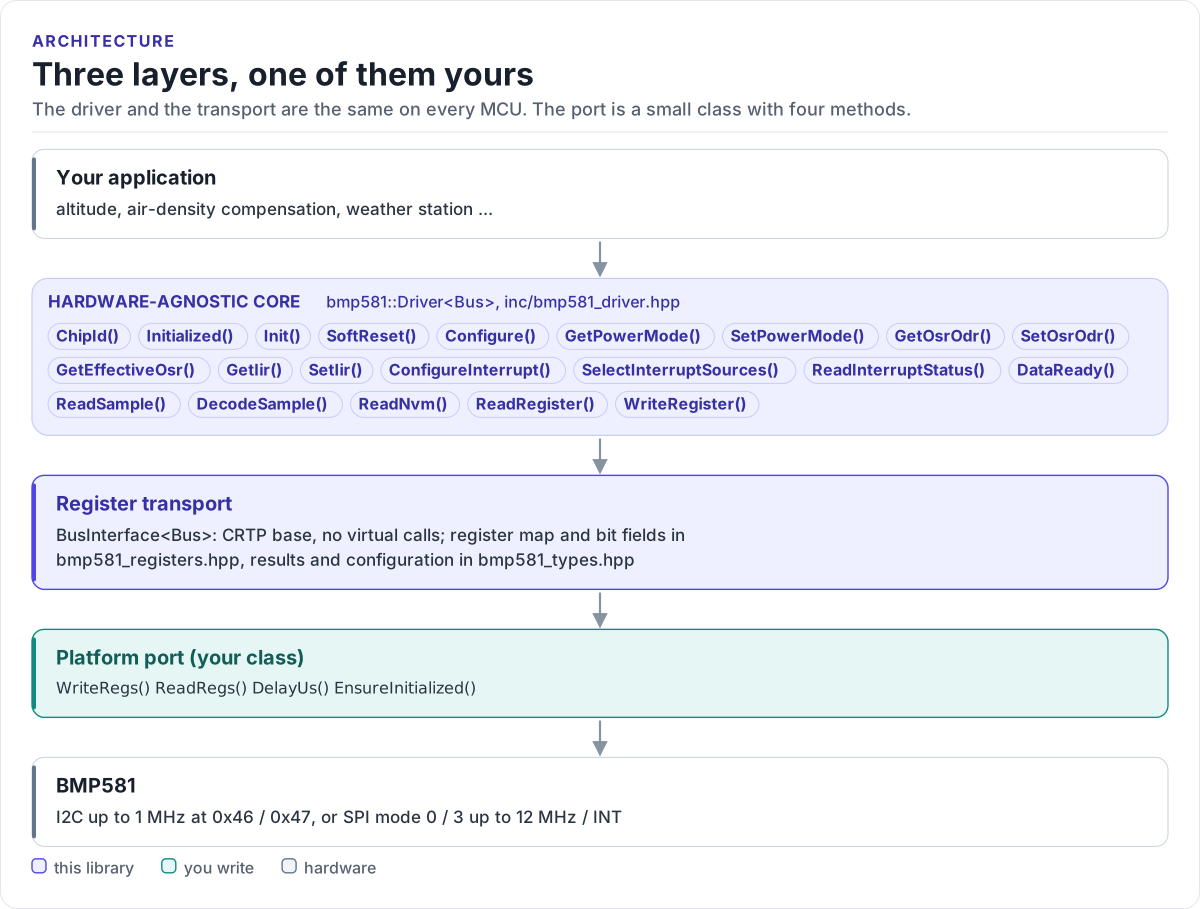
Figure description and sources
From top to bottom. Your application talks to one bmp581::Driver
Drawn from: inc/bmp581_driver.hpp Driver public members; inc/bmp581_bus_interface.hpp BusInterface; figure module docs/diagrams/figures/driver-layers.py.
What you implement
| Method | Contract |
|---|---|
bool WriteRegs(uint8_t reg, const uint8_t* data, std::size_t len) |
Write len bytes to reg, reg + 1, ... Return false on a bus error. The driver writes at most 2 bytes at a time |
bool ReadRegs(uint8_t reg, uint8_t* out, std::size_t len) |
Read len bytes from reg onwards into out. The driver reads at most 6 bytes at a time |
void DelayUs(uint32_t us) |
Block for at least us microseconds. The driver asks for 800 µs to 5 ms |
bool EnsureInitialized() |
Return true when the bus is ready. Init() calls it first and fails with NotInitialized otherwise |
All four must be noexcept-compatible: the driver's calls are noexcept.
Declare the bus as well, so the driver handles the two steps that depend on it:
kInterface |
Soft-reset write not acknowledged | SPI dummy read in Init() and after SoftReset() |
|---|---|---|
Interface::I2c |
Accepted (I2C has no ACK for it, datasheet section 7.36) | Not done |
Interface::Spi |
Reported as Bus (SPI has no ACK to miss) |
Done |
| Not declared | Accepted | Done (harmless over I2C) |
Every other failed transfer is reported as Bus, including the reads that verify a soft reset. A port does not
need to special-case the reset command or track the interface mode itself.
I2C port
class MyI2c : public bmp581::BusInterface<MyI2c> {
public:
// 7-bit address: 0x46 with SDO low, 0x47 with SDO high.
explicit MyI2c(uint8_t address = bmp581::addr::kSecondary) noexcept : address_(address) {}
// Tells the driver no SPI dummy read is needed and the soft-reset command's missing ACK is expected.
static constexpr bmp581::Interface kInterface = bmp581::Interface::I2c;
// One transaction: [reg, data...]. The chip increments the register address after each byte.
bool WriteRegs(uint8_t reg, const uint8_t* data, std::size_t len) noexcept {
uint8_t frame[16];
if (len + 1 > sizeof(frame)) {
return false;
}
frame[0] = reg;
std::memcpy(frame + 1, data, len);
return platform_i2c_write(address_, frame, len + 1); // report every missing ACK
}
// Write the register address, repeated START, read len bytes (auto-increment).
bool ReadRegs(uint8_t reg, uint8_t* out, std::size_t len) noexcept {
return platform_i2c_write_read(address_, ®, 1, out, len);
}
void DelayUs(uint32_t us) noexcept { platform_delay_us(us); }
// Called before every Init(); bring the bus up here if your SDK needs it.
bool EnsureInitialized() noexcept { return true; }
private:
uint8_t address_;
};
Rules the transfer must follow:
- One transaction per call. A write is START, address, register, data, STOP. A read is START, address, register, repeated START (or STOP and START), address, data, STOP.
- Report every missing acknowledge. The chip does not acknowledge the soft-reset command (CMD 0x7E = 0xB6, datasheet section 7.36); the driver expects that one write to fail over I2C and verifies the reset by reading instead. Do not hide it in the port.
- Do not let SDO float. It sets the address bit; floating, the address is undefined.
SPI port
class MySpi : public bmp581::BusInterface<MySpi> {
public:
  // Tells the driver to select SPI with a dummy read after power-up and after a soft reset.
  static constexpr bmp581::Interface kInterface = bmp581::Interface::Spi;

  // SPI writes do not auto-increment: send one (address, data) pair per byte, bit 7 clear.
  bool WriteRegs(uint8_t reg, const uint8_t* data, std::size_t len) noexcept {
    uint8_t tx[16];
    uint8_t rx[16];
    if (2 * len > sizeof(tx)) {
      return false;
    }
    for (std::size_t i = 0; i < len; ++i) {
      tx[2 * i] = static_cast<uint8_t>((reg + i) & 0x7FU);
      tx[2 * i + 1] = data[i];
    }
    return platform_spi_transfer(tx, rx, 2 * len);
  }

  // Reads: address with bit 7 set, then the data bytes (auto-increment); no dummy byte.
  bool ReadRegs(uint8_t reg, uint8_t* out, std::size_t len) noexcept {
    uint8_t tx[16] = {};
    uint8_t rx[16] = {};
    if (len + 1 > sizeof(tx)) {
      return false;
    }
    tx[0] = static_cast<uint8_t>(reg | 0x80U);
    if (!platform_spi_transfer(tx, rx, len + 1)) {
      return false;
    }
    for (std::size_t i = 0; i < len; ++i) {
      out[i] = rx[i + 1];
    }
    return true;
  }

  void DelayUs(uint32_t us) noexcept { platform_delay_us(us); }

  // Called before every Init(); bring the bus up here if your SDK needs it.
  bool EnsureInitialized() noexcept { return true; }
};
Rules the transfer must follow:
- SPI mode 0 or 3, MSB first, up to 12 MHz (7 MHz with VDDIO under 1.62 V).
- Writes do not auto-increment. Send an address byte (bit 7 clear) before every data byte, as the datasheet's
burst-write figure shows. The driver writes two consecutive registers in
SetOsrOdr()andSetIir(). - Reads set bit 7 of the address and return data from the next byte on, with auto-increment.
- Declare
kInterface = Interface::Spi. Power-up and every soft reset return the chip to I2C mode; the driver then does the dummy read that selects SPI (its data is invalid), inInit()and inSoftReset().
| Call from the driver | Bytes on the bus |
|---|---|
WriteRegs(0x36, {a, b}, 2) |
[0x47 W] 0x36 a b |
ReadRegs(0x1D, out, 6) |
[0x47 W] 0x1D [0x47 R] t0 t1 t2 p0 p1 p2 |
| Call from the driver | Bytes on the bus (CSB low for each line) |
|---|---|
WriteRegs(0x36, {a, b}, 2) |
0x36 a 0x37 b |
ReadRegs(0x1D, out, 6) |
0x9D then six bytes clocked in: t0 t1 t2 p0 p1 p2 |
Reference implementation
The ESP32 examples use hf_bmp581_esp_i2c.hpp:
Bmp581EspIdfI2c<port, sda, scl, address, speed>, an I2C port on the legacy ESP-IDF driver/i2c.h API with
FreeRTOS delays. hf_bmp581_esp_spi.hpp is the SPI
counterpart, Bmp581EspIdfSpi<host, mosi, miso, sclk, cs, clock, mode> on the ESP-IDF spi_master driver (mode 0
or 3, at most 12 MHz, checked at compile time). Start from one of them for any ESP-IDF target.
Check your port
- Build it: both ports on this page are compiled by the host CI from
tests/docs/, with the driver instantiated over them. - Call
Init()and printChipId():0x50proves register reads end to end. - Call
SoftReset():ok()proves the CMD write, the reset wait, (on SPI) the dummy read and the reads that verify the reset (CHIP_ID, STATUS, INT_STATUS). - Call
Configure(), thenGetOsrOdr(): reading back what you wrote proves two-byte writes. - Read a few samples: about 101 kPa at sea level, falling by about 12 Pa per metre of height.
Threads
The driver is not thread-safe. Give each sensor one owner task, or guard every call on a driver object (and its port) with one mutex. Several sensors on separate ports, or at both addresses of one I2C bus, can run in parallel as long as the bus driver serialises transactions.