Architecture
How the driver is put together: three layers, what each owns, and how one call reaches the chip.
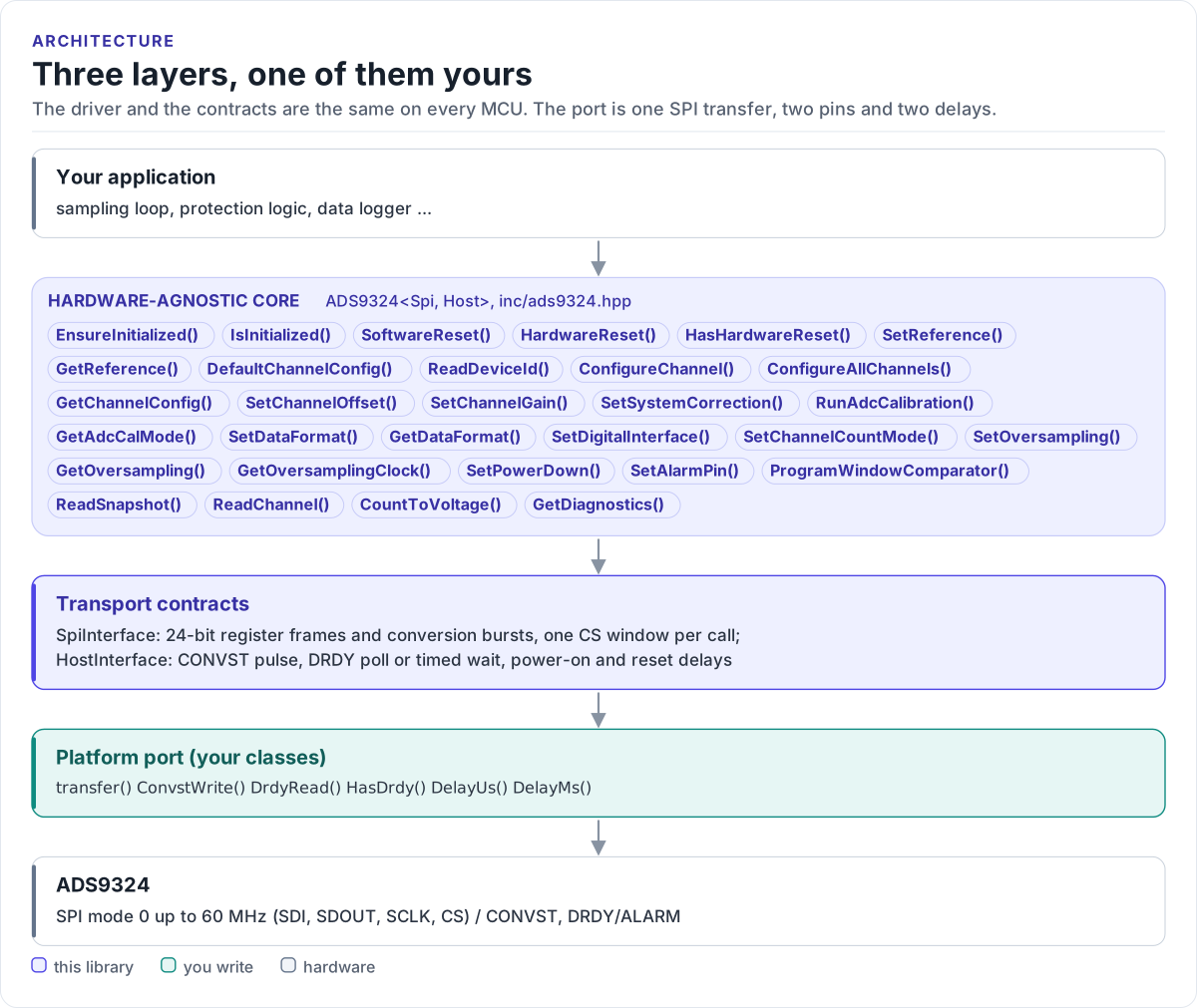
Figure description and sources
From top to bottom. Your application talks to one ADS9324
Drawn from: inc/ads9324.hpp ADS9324 public methods; inc/ads9324_spi_interface.hpp SpiInterface, HostInterface; figure module docs/diagrams/figures/driver-layers.py.
The three layers
| Layer | Where | You change it |
|---|---|---|
Core: ADS9324<Spi, Host>, uses the two contracts only |
ads9324.hpp, ads9324.ipp |
Never, for a new board |
Contracts: SpiInterface, HostInterface, six methods of your port |
ads9324_spi_interface.hpp |
Never |
| Platform port: your classes, over your SDK | Your project | Once per MCU or board (Porting) |
Everything above the port is the same on ESP32, STM32, a Linux host or the unit-test mock. That is how the host tests run the real driver code without hardware.
How one call reaches the chip
sequenceDiagram
    participant A as Application
    participant D as ADS9324 core
    participant S as Your SpiInterface
    participant H as Your HostInterface
    A->>D: ConfigureChannel(9, cfg)
    D->>D: channel 9 = AIN10: bank AIN9-16, local 1, odd nibble
    D->>S: BANK_SEL = 0x0004 (only if the bank changed)
    D->>S: GEN_CFG1 read command, then a dummy frame (read PGA_CONFIG)
    D->>S: PGA_CONFIG with the new high nibble
    D->>S: PGA_BW_SEL read and write
    D-->>A: true
    A->>D: ReadSnapshot()
    D->>H: ConvstWrite(true), DelayUs(1), ConvstWrite(false)
    D->>H: DrdyRead() every 1 µs until high
    D->>S: transfer(32 bytes)
    D-->>A: Snapshot: counts, volts, valid_mask
Why CRTP
The contracts are class template parameters, not virtual base classes. The compiler sees your port's methods
directly and inlines them; the driver has no vtable, allocates nothing and needs no RTTI. The cost is that the
driver type names the port: ADS9324<MySpi, MyHost>. One class can implement both contracts and be passed twice,
as the ESP32 examples do.
What the driver keeps in RAM
The object caches the selected register bank (so a burst of writes to one bank costs one BANK_SEL frame), each
channel's last ChannelConfig (for CountToVoltage()), the data format, lane and word-length settings, the
channel-count mode and two counters. It reads nothing back from the chip except DEVICE_ID and the shared PGA,
bandwidth and comparator registers it read-modify-writes.
Source map
| Path | Contents |
|---|---|
inc/ads9324.hpp |
ADS9324<Spi, Host>: the public API |
src/ads9324.ipp |
Template implementation, included by the header |
inc/ads9324_spi_interface.hpp |
SpiInterface and HostInterface |
inc/ads9324_types.hpp |
Enums, ChannelConfig, Snapshot, ReadResult, Diagnostics, conversion helpers |
inc/ads9324_registers.hpp |
Register addresses, bank values, frame packing (ads9324::reg) |
inc/ads9324_config.hpp |
Compile-time defaults (ADS9324_CFG) |
tests/ |
Host tests and the compiled documentation snippets |
examples/esp32/ |
ESP-IDF applications |