Architecture
How HardFOC firmware is split into repositories, and how the layers are pinned together.
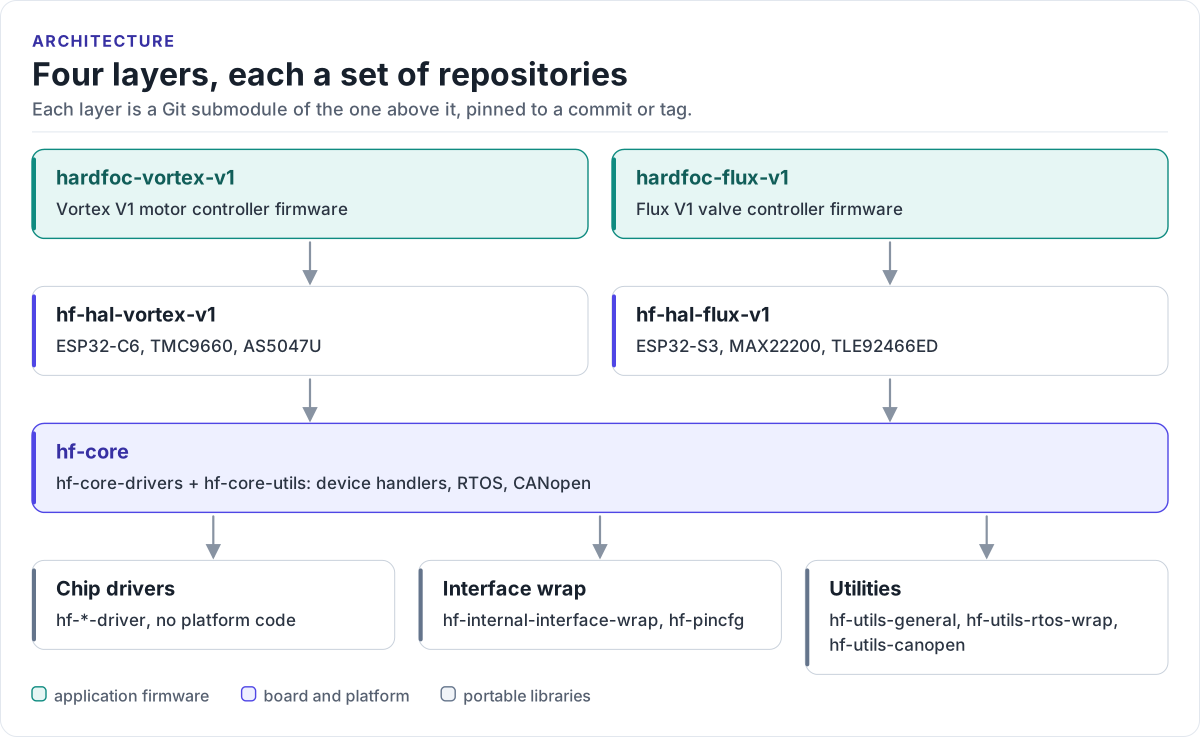
Figure description and sources
From bottom to top, each layer builds on the one below it as a Git submodule pinned to a commit or tag. Chip drivers are hardware-agnostic C++ libraries with no platform code; each one needs only a small bus adapter. hf-core gathers them with the peripheral interface wrap, the pin configuration and the utility libraries (RTOS wrappers, general helpers, CANopen). A board HAL builds one object per board from hf-core, with one manager per board function. A product is the application firmware for one board, on top of its HAL.
Drawn from: mkdocs.yml; figure module docs/diagrams/figures/hardfoc-layers.py.
Layers
| Layer | Repositories | Depends on | Platform code |
|---|---|---|---|
| Products | hardfoc-vortex-v1, hardfoc-flux-v1 |
One board HAL | ESP-IDF application, tasks, CANopen (Vortex) |
| Board HALs | hf-hal-vortex-v1, hf-hal-flux-v1 |
hf-core |
One object per board, one manager per board function |
| Core | hf-core, gathering hf-core-drivers and hf-core-utils |
Drivers, interface wrap, utilities | Device handlers, RTOS wrappers, CANopen helpers |
| Interface wrap | hf-internal-interface-wrap, hf-pincfg |
ESP-IDF | Peripheral base classes (GPIO, ADC, I2C, SPI, UART, CAN, PWM) and their ESP-IDF implementations; per-board pin maps |
| Utilities | hf-utils-general, hf-utils-rtos-wrap, hf-utils-canopen |
None, or FreeRTOS | Header-only helpers, FreeRTOS wrappers, CANopen frame builders |
| Chip drivers | hf-*-driver |
Nothing | None: each driver is a template over a small communication interface |
The repository catalogue lists every repository in each layer, with its documentation.
Submodules, not packages
Each arrow in the figure is a Git submodule pinned to a commit or tag:
flowchart LR
  drv["Chip drivers<br/>hf-*-driver"] --> cd["hf-core-drivers"]
  iw["hf-internal-interface-wrap<br/>hf-pincfg"] --> cd
  ut["hf-utils-general<br/>hf-utils-rtos-wrap<br/>hf-utils-canopen"] --> cu["hf-core-utils"]
  cd --> core["hf-core"]
  cu --> core
  core --> hal["Board HALs"]
  hal --> prod["Products"]
A product therefore builds exactly the commits it pins, all the way down. Moving a layer forward is a pull request that updates one submodule pointer and passes that repository's CI.
Shared tooling
| Repository | Provides |
|---|---|
hf-general-ci-tools |
Reusable workflows (lint, analysis, host builds, the CI gate, releases) and the documentation platform this site is built with |
hf-espidf-ci-tools |
ESP-IDF builds of examples and firmware, releases with artifacts |
hf-espidf-project-tools |
Build and flash scripts for ESP-IDF example projects |
Next: Get started.